ADAM8, also known as cell surface antigen MS2 or CD156a, is a member of the ADAM family that contains a disintegrin and metalloprotease-like domain. ADAM8 can cleave a variety of substrates and has been shown as a sheddase for the low affinity IgE receptor CD23 and the neural recognition molecule CHL1. Expression and regulation studies suggest that ADAM8 is a novel osteoclast stimulating factor and may play a role in asthma. The 824 amino acid precursor of human ADAM8 consists of a signal peptide (residues 1 to 16), a pro peptide (residues 17 to 199), a metaloprotease domain (residues 200 to 400), a disintegrin-like domain (residues 408 to 494), a cysteine-rich region (residues 497 to 613), an EGF-like domain (residues 614 to 640), a transmembrane region (residues 656 to 676) and a cytoplasmic domain (residues 677 to 824). The purified rhADAM8 (residues 158 to 497) contains a part of the pro peptide and the entire metalloprotease and disintegrin-like domains. It can be activated and assayed under the conditions described in the Activity Assay Protocol.
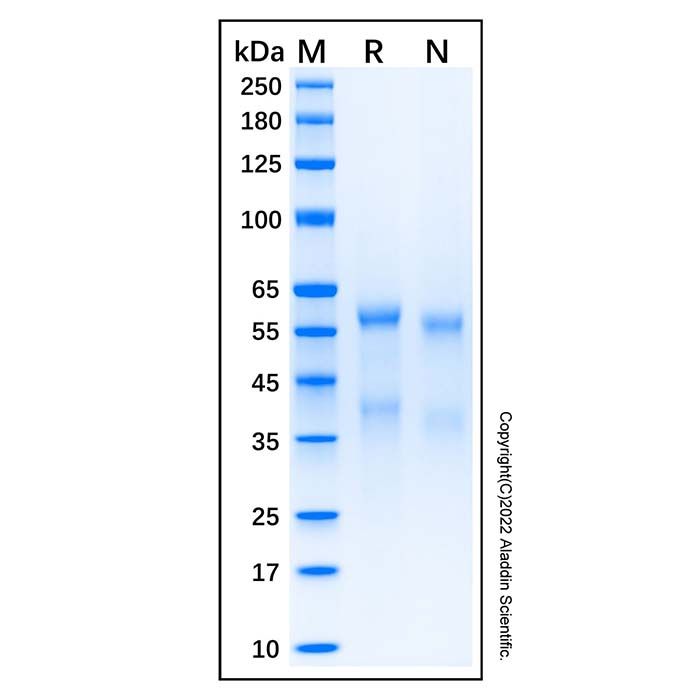
35.0-45.0 & 55.0-65.0 kDa, under reducing conditions; 35.0-45.0 & 55.0-65.0 kDa, under non-reducing conditions.
分子类型
蛋白质
产品线
生物产品
储存与运输
物理形态
冻干(Lyophilized)
储存缓冲液
Lyophilized from 50mM Tris, 150mM NaCl, 5mM CaCl2, pH7.5
浓度
见COA
复溶
We recommend that this vial be briefly centrifuged prior to opening to bring the contents to the bottom. Reconstitute at 0.1 mg/mL in sterile distilled water. Stock solutions should be apportioned into working aliquots and stored at ≤ -20 °C. Further dilutions should be made in appropriate buffered solutions.
储存条件
-20°C储存,避免反复冻融
运输条件
超低温运输
稳定性与储存
-20℃保存 12个月;复溶后建议分装,避免反复冻融。
图片
Recombinant Human ADAM8 Protein (rp169542) - SDS-PAGE 3 μg/lane of Recombinant Human ADAM8 Protein was resolved with SDS-PAGE under reducing (R) and non-reducing (N) conditions and visualized by Coomassie® Blue staining, showing a band at 35.0-45.0 & 55.0-65.0 kDa. Two main fragments bands are visible with apparent MW of 39.9 kDa and 58.3 kDa respectively in reduced SDS-PAGE as a result of its being prone to proteolytic (Uniprot: P78325).

 ZJ25F0724038


 危险品化学品经营许可证(带存储)