CD95 (APO-1/Fas) is an important inducer of the extrinsic apoptosis signaling pathway and therapy induced apoptosis of many tumor cells has been linked to the activity of CD95. is a prototype death receptor characterized by the presence of an 80 amino acid death domain in its cytoplasmic tail. This domain is essential for the recruitment of a number of signaling components upon activation by either agonistic anti-CD95 antibodies or cognate CD95 ligand that initiate apoptosis. The complex of proteins that forms upon triggering of CD95 is called the death-inducting signaling complex (DISC). The DISC consists of an adaptor protein and initiator caspases and is essential for induction of apoptosis. CD95 is also crucial for the negative selection of B cells within the germinal center (GC). Impairment of CD95-mediated apoptosis results in defective affinity maturation and the persistence of autoreactive B-cell clones. Changes in the expression of CD95 and/or its ligand CD95L are frequently found in human cancer. The downregulation or mutation of CD95 has been proposed as a mechanism by which cancer cells avoid destruction by the immune system through reduced apoptosis sensitivity. Thus, CD95 has therefore been viewed as a tumor suppressor. CD95 has been reported to be involved in the activation of NF-kappaB, MAPK3/ERK1, MAPK8/JNK, and the alternate pathways for CTL-mediated cytotoxicity. Accordingly, this protein is implicated in the pathogenesis of various malignancies and diseases of the immune system. The CD95/CD95L system was implicated in the etiology of inflammatory bowel disease (IBD) based, primarily, on the finding that CD95 is highly expressed in the intestinal epithelial cells and that epithelial apoptosis is increased in IBD.
Post-translational: (Microbial infection) Glycosylated at Arg-250 by enteropathogenic E.coli protein NleB1: arginine GlcNAcylation prevents homotypic/heterotypic death domain interactions. Palmitoylated. Palmitoylation by ZDHHC7 prevents the lysosomal degradation of FAS regulating its expression at the plasma membrane. N- and O-glycosylated. O-glycosylated with core 1 or possibly core 8 glycans.
生物活性
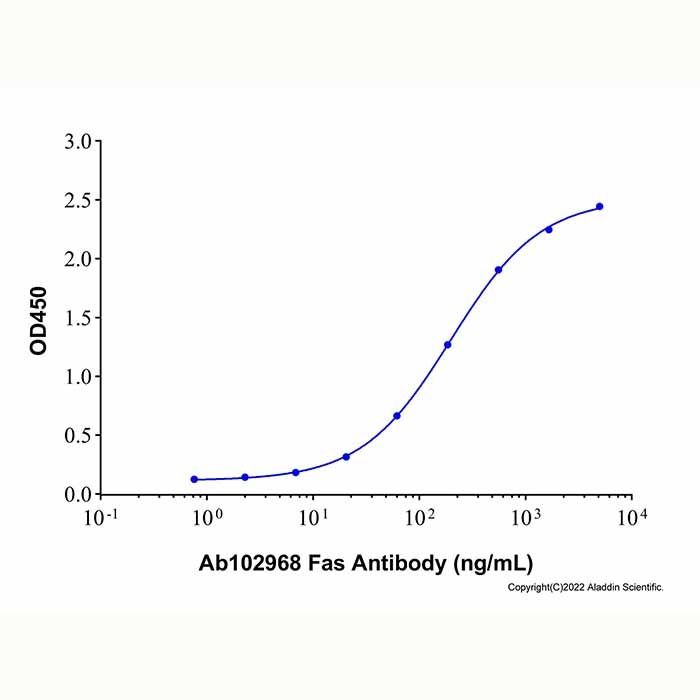
Immobilized Recombinant Human Fas/TNFRSF6/CD95 Protein (rp169551) at 1.0 μg/mL can bind Fas Antibody (Ab102968) with the EC50 of 199.2 ng/mL.
22.7-39.5 kDa, under reducing conditions; 19.9-39.5 kDa, under non-reducing conditions.
分子类型
蛋白质
产品线
生物产品
储存与运输
物理形态
冻干(Lyophilized)
储存缓冲液
Lyophilized from PBS, pH 7.4.
复溶
We recommend that this vial be briefly centrifuged prior to opening to bring the contents to the bottom. Reconstitute at 1.0 mg/mL in sterile distilled water. Stock solutions should be apportioned into working aliquots and stored at ≤ -20 °C. Further dilutions should be made in appropriate buffered solutions.
储存条件
-20°C储存,避免反复冻融
运输条件
超低温运输
稳定性与储存
Store at -20°C for 1 year. Avoid freeze/thaw cycle.
图片
Recombinant Human Fas/TNFRSF6/CD95 Protein (rp169551) - ELISA Immobilized Recombinant Human Fas/TNFRSF6/CD95 Protein (rp169551) at 1.0 μg/mL can bind Fas Antibody (Ab102968) with the EC50 of 199.2 ng/mL.
Recombinant Human Fas/TNFRSF6/CD95 Protein (rp169551) - SDS-PAGE 3 μg/lane of Recombinant Human Fas/TNFRSF6/CD95 Protein was resolved with SDS-PAGE under reducing (R) and non-reducing (N) conditions and visualized by Coomassie® Blue staining, showing a band at 22.7-39.5 kDa under reducing conditions and 19.9-39.5 kDa under non-reducing conditions.

 ZJ25F0116989


 危险品化学品经营许可证(带存储)