
计算溶液所需的质量、体积或浓度。
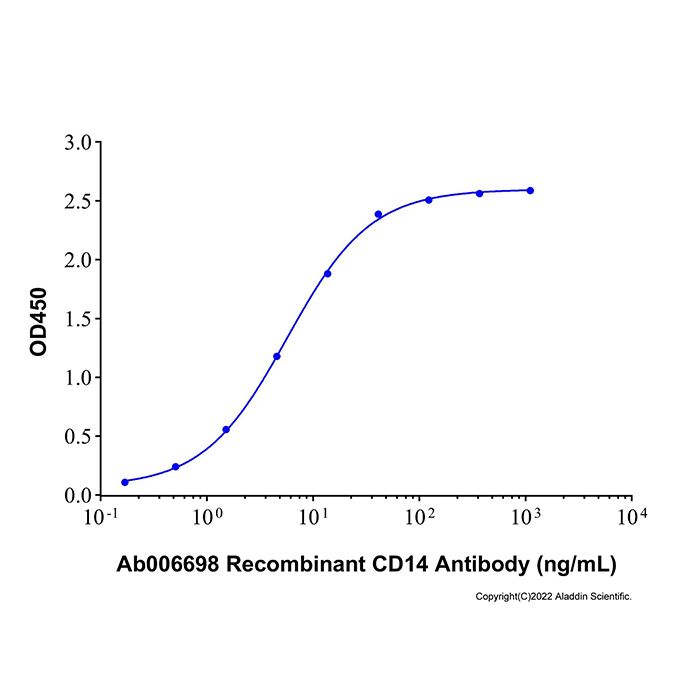
Recombinant Human CD14 Protein (rp169573) - ELISA
Immobilized Recombinant Human CD14 Protein (rp169573) at 1.0 μg/mL can bind Recombinant CD14 Antibody (Ab006698) with the EC
₅
₀
of 5.7 ng/mL.
ActiBioPure™,His标签,PBS Only,无动物源,无载体,生物活性 级 提供 ≥90%(SDS-PAGE) 纯度,适用于对基线干扰要求严格的色谱和分析工作流程。
-20°C储存,避免反复冻融。超低温运输 。请查阅批次 COA 获取详细规格。
SDS、COA、产品数据表及规格说明书均可下载。可通过批号查询获取批次 COA。
在色谱分析、有机合成和交叉偶联反应领域已被 0 篇同行评审文献引用。
The cluster of differentiation (CD) system is commonly used as cell markers in immunophenotyping. Different kinds of cells in the immune system can be identified through the surface CD molecules associating with the immune function of the cell. There are more than 320 CD unique clusters and subclusters have been identified. Some of the CD molecules serve as receptors or ligands important to the cell through initiating a signal cascade which then alter the behavior of the cell. Some CD proteins do not take part in cell signal process but have other functions such as cell adhesion. Cluster of differentiation 14 (CD14) is a member of the CD system. It takes its name from its inclusion in the CD molecule surface marker proteins. CD14 exists in two forms: a form anchored into the membrane or a soluble form. CD14 was found expressed in macrophages, neutrophil granulocyte and dendritic cells. The major function is to serve as a co-receptor (along with TLR4 and MD-2) for the bacterial lipopolysaccharide (LPS) and other pathogen-associated molecular patterns.
Recombinant Human CD14 Protein (rp169573) - ELISA
Immobilized Recombinant Human CD14 Protein (rp169573) at 1.0 μg/mL can bind Recombinant CD14 Antibody (Ab006698) with the EC
₅
₀
of 5.7 ng/mL.
Recombinant Human CD14 Protein (rp169573) - SDS-PAGE
3 μg/lane of Recombinant Human CD14 Protein was resolved with SDS-PAGE under reducing (R) and non-reducing (N) conditions and visualized by Coomassie® Blue staining, showing a band at 39.2-53.0 kDa under reducing conditions and 37.4-51.2 kDa under non-reducing conditions.
通过匹配包装上的批号来查找并下载产品的 COA,每批产品都进行了严格的验证,您可放心使用!
| 批号(Lot Number) | 证书类型 | 货号 |
|---|---|---|
 ZJ24F0809440 |
分析证书 | rp169573 |
| ZJ24F0809441 |
分析证书 | rp169573 |
| ZJ24F0809442 |
分析证书 | rp169573 |
我们的级别选择指南涵盖了目录中所有的变体的纯度、稳定剂状态和应用适用性。
查看 Animal Free 级别指南 → 查看 Carrier Free 级别指南 → 查看 Bioactive 级别指南 → 查看 ActiBioPure™ 级别指南 → 查看 His Tag 级别指南 → 查看 PBS Only 级别指南 →

 危险品化学品经营许可证(带存储)