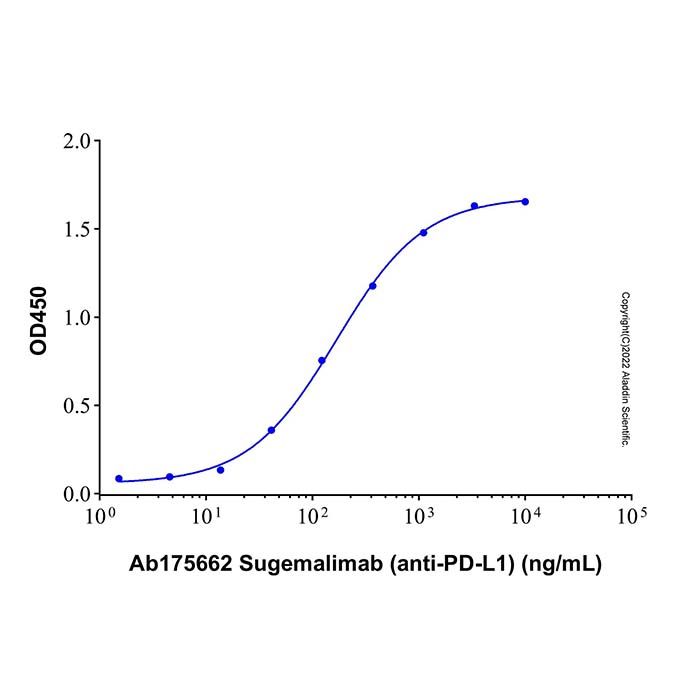
Immobilized Recombinant Human PD-L1 Protein (rp169666) at 2.0 μg/mL can bind Sugemalimab (anti-PD-L1) (Ab175662) with the EC50 of 169.70 ng/mL. Immobilized Recombinant Human PD-L1 Protein (rp169666) at 1.0 μg/mL can bind Avelumab (anti-PD-L1) (A412006) with the EC50 of 77.96 ng/mL. Immobilized Recombinant Human PD-L1 Protein (rp169666) at 1.0 μg/mL can bind Envafolimab (anti-PD-L1) (Ab170617) with the EC50 of 339.40 ng/mL. Immobilized Recombinant Human PD-L1 Protein (rp169666) at 1.0 μg/mL can bind Durvalumab (anti-PD-L1) (D412005) with the EC50 of 35.40 ng/mL.
Purity: ≥95%, by SDS-PAGE visualized with Coomassie® Blue Staining. Description: Programmed death-1 ligand-1 (PD-L1, CD274, B7-H1) has been identified as the ligand for the immunoinhibitory receptor programmed death-1(PD1/PDCD1) and has been demonstrated to play a role in the regulation of immune responses and peripheral tolerance. PD-L1/B7-H1 is a member of the growing B7 family of immune molecules and this protein contains one V-like and one C-like Ig domain within the extracellular domain, and together with PD-L2, are two ligands for PD1 which belongs to the CD28/CTLA4 family expressed on activated lymphoid cells. By binding to PD1 on activated T-cells and B-cells, PD-L1 may inhibit ongoing T-cell responses by inducing apoptosis and arresting cell-cycle progression. Accordingly, it leads to growth of immunogenic tumor growth by increasing apoptosis of antigen specific T cells and may contribute to immune evasion by cancers. PD-L1 thus is regarded as promising therapeutic target for human autoimmune disease and malignant cancers.
Immobilized Recombinant Human PD-L1 Protein (rp169666) at 2.0 μg/mL can bind Sugemalimab (anti-PD-L1) (Ab175662) with the EC50 of 169.70 ng/mL. Immobilized Recombinant Human PD-L1 Protein (rp169666) at 1.0 μg/mL can bind Avelumab (anti-PD-L1) (A412006) with the EC50 of 77.96 ng/mL. Immobilized Recombinant Human PD-L1 Protein (rp169666) at 1.0 μg/mL can bind Envafolimab (anti-PD-L1) (Ab170617) with the EC50 of 339.40 ng/mL. Immobilized Recombinant Human PD-L1 Protein (rp169666) at 1.0 μg/mL can bind Durvalumab (anti-PD-L1) (D412005) with the EC50 of 35.40 ng/mL.
30.7-37.3 kDa, under reducing conditions; 28.6-36.2 kDa, under non-reducing conditions.
分子类型
蛋白质
产品线
生物产品
储存与运输
物理形态
冻干(Lyophilized)
储存缓冲液
Lyophilized from PBS, pH7.4
复溶
We recommend that this vial be briefly centrifuged prior to opening to bring the contents to the bottom. Reconstitute at 1.0 mg/mL in sterile distilled water. Stock solutions should be apportioned into working aliquots and stored at ≤ -20 °C. Further dilutions should be made in appropriate buffered solutions.
储存条件
-20°C储存,避免反复冻融
运输条件
超低温运输
稳定性与储存
在 -20°C 下可保存 1 年。避免冷冻/解冻循环。
图片
Recombinant Human PD-L1 Protein (rp169666) - ELISA Immobilized Recombinant Human PD-L1 Protein (rp169666) at 2.0 μg/mL can bind Sugemalimab (anti-PD-L1) (Ab175662) with the EC₅₀ of 169.70 ng/mL.
Recombinant Human PD-L1 Protein (rp169666) - ELISA Immobilized Recombinant Human PD-L1 Protein (rp169666) at 1.0 μg/mL can bind Avelumab (anti-PD-L1) (A412006) with the EC₅₀ of 77.96 ng/mL.
Recombinant Human PD-L1 Protein (rp169666) - ELISA Immobilized Recombinant Human PD-L1 Protein (rp169666) at 1.0 μg/mL can bind Envafolimab (anti-PD-L1) (Ab170617) with the EC₅₀ of 339.40 ng/mL.
Recombinant Human PD-L1 Protein (rp169666) - ELISA Immobilized Recombinant Human PD-L1 Protein (rp169666) at 1.0 μg/mL can bind Durvalumab (anti-PD-L1) (D412005) with the EC₅₀ of 35.40 ng/mL.
Recombinant Human PD-L1 Protein (rp169666) - SDS-PAGE 3 μg/lane of Recombinant Human PD-L1 Protein was resolved with SDS-PAGE under reducing (R) and non-reducing (N) conditions and visualized by Coomassie® Blue staining, showing a band at 30.7-37.3 kDa under reducing conditions and 28.6-36.2 kDa under non-reducing conditions.

 ZJ24F0606442


 危险品化学品经营许可证(带存储)