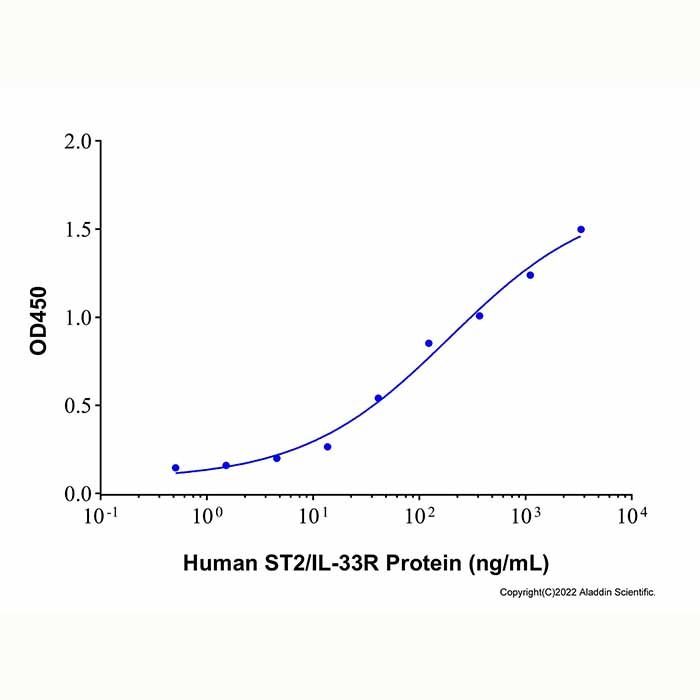
Immobilized Recombinant Human IL-33 Protein (rp169652) at 5.0 μg/mL can bind Recombinant Human ST2/IL-33R Protein (rp169684) with the EC50 of 194.5 ng/mL.
ST2, also known as IL-1 R4 and T1, is an Interleukin-1 receptor family glycoprotein that contributes to Th2 immune responses. Human ST2 consists of a 310 amino acid (aa) extracellular domain (ECD) with three Ig-like domains, a 21 aa transmembrane segment, and a 207 aa cytoplasmic domain with an intracellular TIR domain. Alternate splicing of the 120 kDa human ST2 generates a soluble 60 kDa isoform that lacks the transmembrane and cytoplasmic regions as well as an isoform that additionally lacks the third Ig like domain. Within the ECD, human ST2 shares 68% and 64% aa sequence identity with mouse and rat ST2, respectively. ST2 is expressed on the surface of mast cells, activated Th2 cells, macrophages, and cardiac myocytes. It binds IL-33, a cytokine that is upregulated by inflammation or mechanical strain in smooth muscle cells, airway epithelia, keratinocytes, and cardiac fibroblasts. IL-33 binding induces the association of ST2 with IL-1R AcP, a shared signaling subunit that also associates with IL-1 RI and IL-1 R rp2. In macrophages, ST2 interferes with signaling from IL-1 RI and TLR4 by sequestering the adaptor proteins MyD88 and Mal. In addition to its role in promoting mast cell and Th2 dependent inflammation, ST2 activation enhances antigen induced hypernociception and protects from atherosclerosis and cardiac hypertrophy. The soluble ST2 isoform is released by activated Th2 cells and strained cardiac myocytes and is elevated in the serum in allergic asthma. Soluble ST2 functions as a decoy receptor that blocks IL 33’s ability to signal through transmembrane ST2. Receptor for interleukin-33 (IL-33) which plays crucial roles in innate and adaptive immunity, contributing to tissue homeostasis and responses to environmental stresses together with coreceptor IL1RAP (PubMed:35238669). Its stimulation recruits MYD88, IRAK1, IRAK4, and TRAF6, followed by phosphorylation of MAPK3/ERK1 and/or MAPK1/ERK2, MAPK14, and MAPK8. Possibly involved in helper T-cell function (Probable) (PubMed:16286016). Upon tissue injury, induces UCP2-dependent mitochondrial rewiring that attenuates the generation of reactive oxygen species and preserves the integrity of Krebs cycle required for persistent production of itaconate and subsequent GATA3-dependent differentiation of inflammation-resolving alternatively activated macrophages (By similarity).Isoform B: Inhibits IL-33 signaling.
Post-translational: Ubiquitinated at Lys-321 in a FBXL19-mediated manner; leading to proteasomal degradation. Ubiquitination by TRAF6 via 'Lys-27'-linked polyubiquitination and deubiquitination by USP38 serves as a critical regulatory mechanism for fine-tuning IL1RL1-mediated inflammatory response (PubMed:35238669).
生物活性
Immobilized Recombinant Human IL-33 Protein (rp169652) at 5.0 μg/mL can bind Recombinant Human ST2/IL-33R Protein (rp169684) with the EC50 of 194.5 ng/mL.
49.5-71.9 kDa, under reducing conditions; 48.2-67.9 & 99.3-123.4 & 162.3-195.2 & 230.0-250.0 kDa, under non-reducing conditions.
分子类型
蛋白质
产品线
生物产品
储存与运输
物理形态
冻干(Lyophilized)
储存缓冲液
Lyophilized from PBS, pH 7.4
复溶
We recommend that this vial be briefly centrifuged prior to opening to bring the contents to the bottom. Reconstitute at 1.0 mg/mL in sterile distilled water. Stock solutions should be apportioned into working aliquots and stored at ≤ -20 °C. Further dilutions should be made in appropriate buffered solutions.
储存条件
-20°C储存,避免反复冻融
运输条件
超低温运输
稳定性与储存
Store at -20°C for 1 year. Avoid freeze/thaw cycle.
图片
Recombinant Human ST2/IL-33R Protein (rp169684) - Binding Activity Immobilized Recombinant Human IL-33 Protein (rp169652) at 5.0 μg/mL can bind Recombinant Human ST2/IL-33R Protein (rp169684) with the EC
₅₀
of 194.5 ng/mL.
Recombinant Human ST2/IL-33R Protein (rp169684) - SDS-PAGE 3 μg/lane of Recombinant Human ST2/IL-33R Protein was resolved with SDS-PAGE under reducing (R) and non-reducing (N) conditions and visualized by Coomassie® Blue staining, showing a band at 49.5-71.9 kDa under reducing conditions and 48.2-67.9 & 99.3-123.4 & 162.3-195.2 & 230.0-250.0 kDa under non-reducing conditions.

 ZJ24F1113709


 危险品化学品经营许可证(带存储)