Transcription factor that plays an important role in cellular development and cell survival (PubMed:7862533). Recognizes and binds to the DNA sequence 5'-GCG(T/G)GGGCG-3' (PubMed:17716689, PubMed:25258363, PubMed:7862533). Regulates the expression of numerous target genes, including EPO. Plays an essential role for development of the urogenital system. It has a tumor suppressor as well as an oncogenic role in tumor formation. Function may be isoform-specific: isoforms lacking the KTS motif may act as transcription factors (PubMed:15520190). Isoforms containing the KTS motif may bind mRNA and play a role in mRNA metabolism or splicing (PubMed:16934801). Isoform 1 has lower affinity for DNA, and can bind RNA (PubMed:19123921).
We recommend that this vial be briefly centrifuged prior to opening to bring the contents to the bottom. Reconstitute at 1.0 mg/mL in sterile distilled water. Stock solutions should be apportioned into working aliquots and stored at ≤ -20 °C. Further dilutions should be made in appropriate buffered solutions.
储存条件
-20°C储存,避免反复冻融
运输条件
超低温运输
稳定性与储存
Store at -20℃ for 1 year. Upon reconstitution, it is recommended to aliquot. Avoid freeze/thaw cycle.
图片
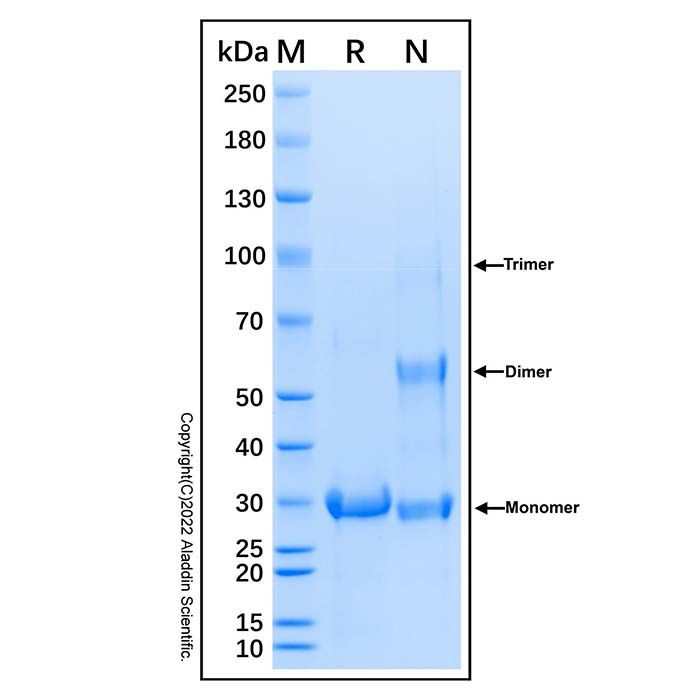
Recombinant Human Wilms Tumor Protein (rp169687) - SDS-PAGE 3 μg/lane of Recombinant Human Wilms Tumor Protein was resolved with SDS-PAGE under reducing (R) and non-reducing (N) conditions and visualized by Coomassie® Blue staining, showing a band at 29.0 kDa under reducing conditions and 29.1 & 55.7 & 91.2 kDa under non-reducing conditions. WT1 can form homologous or heterologous oligomers and interact with other proteins (such as p53, p73, etc.) to regulate gene expression (PMID: 1313285).

 ZJ25F0622624


 危险品化学品经营许可证(带存储)