Measured by its ability to inhibit the TNF-alpha mediated cytotoxicity in the L‑929 mouse fibroblast cells in the presence of the metabolic inhibitor actinomycin D (Catalog # A113142). The ED50 for this effect, in the presence of 0.25 ng/mL of recombinant human TNF-alpha (rp156007), is 0.094 µg/mL.
TNF receptor 1 (TNF RI; also called TNF R-p55/p60 and TNFRSF1A) is a 55 kDa type I transmembrane protein member of the TNF receptor superfamily, designated TNFRSF1A. Human TNF RI is a 455 amino acid (aa) protein that contains a 21 aa signal sequence and 190 aa ECD with a PLAD (pre-ligand assembly domain) that mediates constitutive dimer/trimer formation, followed by four CRD (cysteine-rich domains), a 23 aa transmembrane domain, and a 221 aa cytoplasmic sequence that contains a neutral sphingomyelinase activation domain and a death domain. The ECD of human TNF RI shows 70%, 69%, 80%, 80%, and 73% aa identity with mouse, rat, canine, feline and porcine TNF RI, respectively; and it shows 23% aa identity with the ECD of TNF RII. Both TNF RI and TNF RII (TNFRSF1B) are widely expressed and contain four TNF-alpha trimer-binding CRD in their ECD. However, TNF RI is thought to mediate most of the cellular effects of TNF-alpha. It is essential for proper development of lymph node germinal centers and Peyer's patches, and for combating intracellular pathogens such as Listeria. TNF RI is also a receptor for TNF-beta /TNFSF1B (lymphotoxin-alpha ). TNF RI is stored in the Golgi and translocates to the cell surface following pro‑inflammatory stimuli. TNF-alpha stabilizes TNF RI and induces its sequestering in lipid rafts, where it activates NF kappa B and is cleaved by ADAM-17/TACE. Release of the 28-34 kDa TNF RI ECD also occurs constitutively and in response to products of pathogens such as LPS, CpG DNA or S. aureus protein A. Full-length TNF RI may also be released in exosome-like vesicles. Release helps to resolve inflammatory reactions, since it down-regulates cell surface TNF RI and provides soluble TNF RI to bind TNF-alpha. Exclusion from lipid rafts causes endocytosis of TNF RI complexes and induces apoptosis. Mutations of human TNF R1 can result in inflammatory episodes known as TRAPS (TNFR-associated periodic syndrome).
Post-translational: The soluble form is produced from the membrane form by proteolytic processing.
(Microbial infection) Glycosylated at Arg-376 by enteropathogenic E.coli protein NleB1 and S.typhimurium protein Ssek3: arginine GlcNAcylation prevents homotypic/heterotypic death domain interactions.
生物活性
Measured by its ability to inhibit the TNF-alpha mediated cytotoxicity in the L‑929 mouse fibroblast cells in the presence of the metabolic inhibitor actinomycin D (Catalog # A113142). The ED50 for this effect, in the presence of 0.25 ng/mL of recombinant human TNF-alpha (rp156007), is 0.094 µg/mL.
We recommend that this vial be briefly centrifuged prior to opening to bring the contents to the bottom. Reconstitute at 1.0 mg/mL in sterile distilled water. Stock solutions should be apportioned into working aliquots and stored at ≤ -20 °C. Further dilutions should be made in appropriate buffered solutions.
储存条件
-20°C储存,避免反复冻融
运输条件
超低温运输
稳定性与储存
Store at -20℃ for 12 months. Upon reconstitution, it is recommended to aliquot. Avoid freeze/thaw cycle.
图片
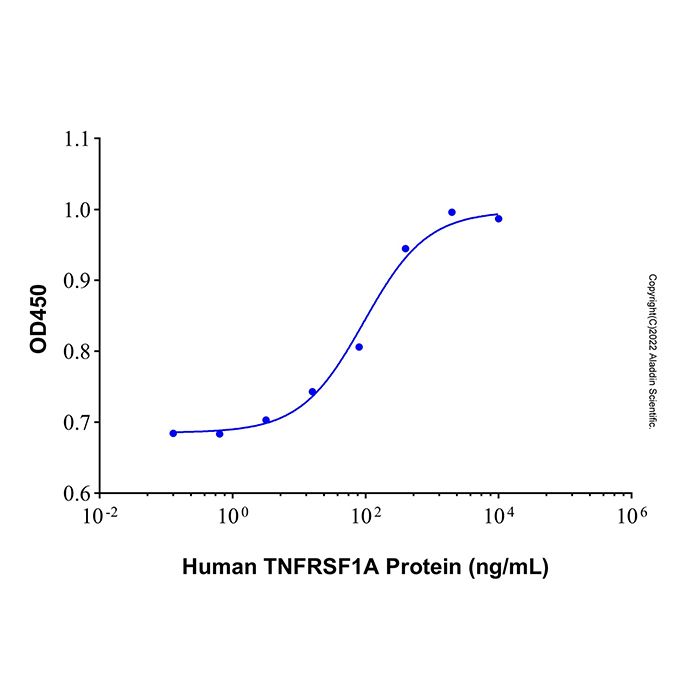
Recombinant Human sTNF RI/TNFRSF1A Protein (rp170122) - Bioactivity Measured by its ability to inhibit the TNF-alpha mediated cytotoxicity in the L‑929 mouse fibroblast cells in the presence of the metabolic inhibitor actinomycin D (A113142). The ED50 for this effect, in the presence of 0.25 ng/mL of Recombinant Human TNF-alpha Protein (rp156007), is 0.094 µg/mL.
Recombinant Human sTNF RI/TNFRSF1A Protein (rp170122) - SDS-PAGE 3 μg/lane of Recombinant Human sTNF RI/TNFRSF1A Protein was resolved with SDS-PAGE under reducing (R) conditions and visualized by Coomassie® Blue staining, showing a band at 27.3-35.2 kDa under reducing conditions.

 ZJ25F1028564


 危险品化学品经营许可证(带存储)