MIP-3 beta, also known as ELC (EBI1-Ligand Chemokine), is one of many novel beta chemokines identified through bioinformatics. MIP-3 beta cDNA encodes a 98 amino acid (aa) residue precursor protein with a predicted 21 aa residue signal peptide that is cleaved to form the 77 aa residue mature secreted protein. MIP-3 beta is distantly related to other beta chemokines (20-30% aa sequence identity) and the gene for MIP-3 beta has been mapped to chromosome 9p13 rather than chromosome 17 where the genes for many human beta chemokines are clustered. MIP-3 beta has been shown to be constitutively expressed in various lymphoid tissues (including thymus, lymph nodes, appendix and spleen). The expression of MIP-3 beta is down-regulated by the anti-inflammatory cytokine IL-10. Recombinant MIP-3 beta has been shown to be chemotactic for cultured human lymphocytes. MIP-3 beta has also been shown to be a unique functional ligand for CCR-7 (previously referred to as the Epstein-Barr virus-induced gene 1 (EBI1) orphan receptor), a chemokine receptor that is expressed in various lymphoid tissues and activated B and T lymphocytes. EBI1 is strongly up-regulated in B cells infected with Epstein-Barr virus and T cells infected with herpesvirus 6 or 7.
We recommend that this vial be briefly centrifuged prior to opening to bring the contents to the bottom. Reconstitute at 0.1 mg/mL in sterile distilled water. Stock solutions should be apportioned into working aliquots and stored at ≤ -20 °C. Further dilutions should be made in appropriate buffered solutions.
储存条件
-20°C储存,避免反复冻融
运输条件
超低温运输
稳定性与储存
-20℃保存 12个月;复溶后建议分装,避免反复冻融。
图片
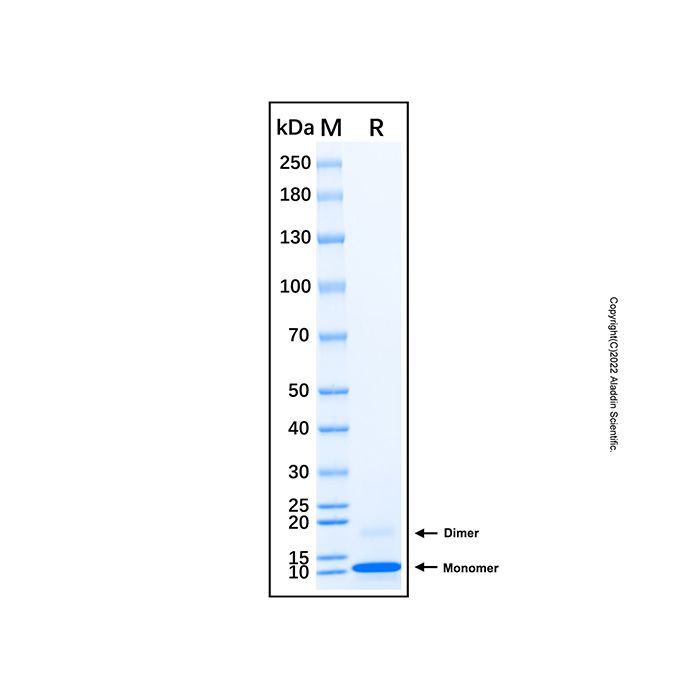
Recombinant Human CCL19/MIP-3 beta Protein (rp170436) - SDS-PAGE
3 μg/lane of Recombinant Human CCL19/MIP-3 beta Protein was resolved with SDS-PAGE under reducing (R) conditions and visualized by Coomassie® Blue staining, showing the bands at 11.3 & 18.4 kDa under reducing conditions.
CCL19/MIP-3 beta Protein belongs to the chemokine family, and these proteins often form dimers or multimers through disulfide bonds (Uniprot ID: Q99731).

 ZJ25F1230548


 危险品化学品经营许可证(带存储)