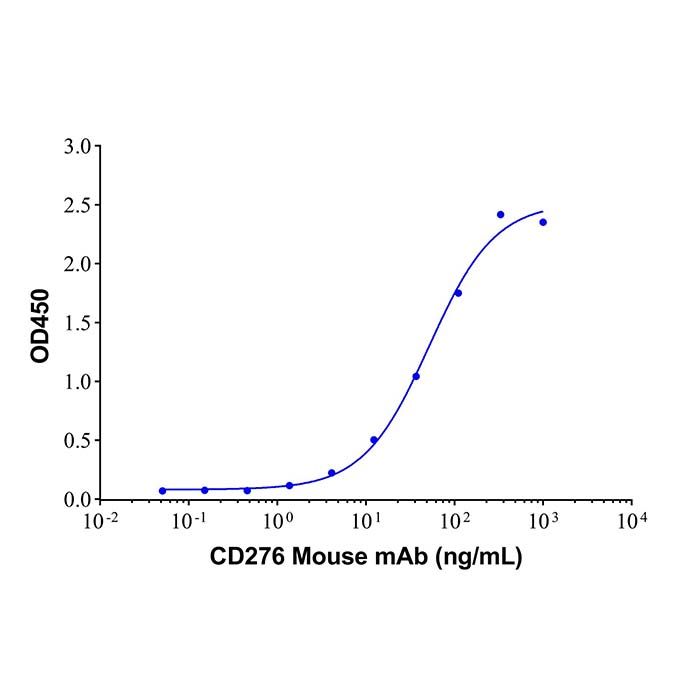
1、Measured by its binding ability in a functional ELISA. Immobilized CD276 mouse mAb at 1.0 μg/mL can bind Recombinant Human B7-H3 (4Ig)/B7-H3b Protein (rp176244) with the EC50 of 51.95 ng/mL. 2、Measured by its binding ability in a functional ELISA. Immobilized human Human B7-H3 (4Ig)/B7-H3b (rp176244) at 1.0 μg/mL can bind CD276 mouse mAb with the EC50 of 1.86 ng/mL.
Purity:>95%, by SDS-PAGE visualized with Coomassie® Blue Staining Description: Human B7 homolog 3 (B7-H3) is a member of the B7 family of immune proteins that provide signals for the regulation of immune responses. Other family members include B7-1, B7-2, B7-H1/PD-L1, B7-H2, and PD-L2. B7 family proteins are type I transmembrane immunoglobulin (Ig) superfamily members that contain extracellular Ig V‑like and Ig C‑like domains with a short cytoplasmic tail. Among the family members there is about 20 - 40% amino acid (aa) sequence identity. B7-H3 was initially reported to be a 316 aa type I transmembrane precursor protein that contained a signal sequence, an extracellular region with one V‑type and one C‑type Ig domain, a transmembrane segment and a short cytoplasmic tail. Subsequent studies have identified a second 110 kDa form whose precursor is 534 aa in length. Termed 4IgB7-H3 or B7-H3b, this molecule has two additional Ig-like domains (one V‑type and one C‑type) and shows a ubiquituous expression pattern. It would appear that the human 4Ig form is the principal, if not the only form of B7-H3. Its precursor contains a 26 aa signal sequence, a 435 aa extracellular region, a 31 aa transmembrane domain, and a 42 aa cytoplasmic tail. The four Ig-like domains alternate between V‑type and C‑type, and apparently are the consequence of a V‑C type tandem duplication. B7-H3b is expressed on dendritic cells as well as activated T, B and NK cells. The mouse gene differs from that of human in that it cannot code for four Ig-like domains; only a V‑type:C‑type pair. Human B7-H3b binding to an undefined receptor has shown to be inhibitory to NK cell illing and cytokine release. It also seems to be required for late stage osteoblast differentiation.
1、Measured by its binding ability in a functional ELISA. Immobilized CD276 mouse mAb at 1.0 μg/mL can bind Recombinant Human B7-H3 (4Ig)/B7-H3b Protein (rp176244) with the EC50 of 51.95 ng/mL. 2、Measured by its binding ability in a functional ELISA. Immobilized human Human B7-H3 (4Ig)/B7-H3b (rp176244) at 1.0 μg/mL can bind CD276 mouse mAb with the EC50 of 1.86 ng/mL.
63.2-82.3 kDa, under reducing conditions; 58.6-73.9 kDa, under non-reducing condition
分子类型
蛋白质
产品线
生物产品
储存与运输
物理形态
冻干(Lyophilized)
储存缓冲液
Lyophilized from PBS, pH7.4
复溶
We recommend that this vial be briefly centrifuged prior to opening to bring the contents to the bottom. Reconstitute at 0.5 mg/mL in sterile distilled water. Stock solutions should be apportioned into working aliquots and stored at ≤ -20 °C. Further dilutions should be made in appropriate buffered solutions.
储存条件
-20°C储存,避免反复冻融
运输条件
超低温运输
稳定性与储存
在 -20°C 下可稳定保存 1 年。避免冷冻/解冻循环。
图片
ELISA: Recombinant Human B7-H3(4Ig)/B7-H3b Protein (rp176244) Measured by its binding ability in a functional ELISA. Immobilized CD276 mouse mAb at 1.0 μg/mL can bind Recombinant Human B7-H3 (4Ig)/B7-H3b Protein (rp176244) with the EC₅₀ of 51.95 ng/mL.
Recombinant Human B7-H3(4Ig)/B7-H3b Protein (rp176244) - ELISA Measured by its binding ability in a functional ELISA. Immobilized human Human B7-H3 (4Ig)/B7-H3b (rp176244) at 1.0 μg/mL can bind CD276 mouse mAb with the EC₅₀ of 1.86 ng/mL.
Recombinant Human B7-H3(4Ig)/B7-H3b Protein (rp176244) - SDS-PAGE 3 μg/lane of Recombinant Human B7-H3(4Ig)/B7-H3b Protein was resolved with SDS-PAGE under reducing (R) and non-reducing (N) conditions and visualized by Coomassie® Blue staining, showing a band at 63.2 - 82.3 kDa under reducing conditions and 58.6 - 73.9 kDa under non-reducing conditions.

 ZJ24F0202912


 危险品化学品经营许可证(带存储)