Fibronectin (FN) is a large, modular glycoprotein that generates a polymeric fibrillar network in the extracellular matrix (ECM), and forms soluble, disulfide-linked dimeric protomers in plasma and other body fluids. Fibronectin is a ligand for many molecules, including fibrin, heparin, chondroitin sulfate, collagen/gelatin, and integrins. It is involved in multiple cellular processes such as cell adhesion/migration, blood clotting, morphogenesis, tissue repair, and cell signaling. Fibronectin functions are mediated by the insoluble polymeric fibrillar network. Conversion of soluble Fibronectin to Fibronectin fibrils in the ECM is initiated by binding to cell surface integrins, resulting in exposure of cryptic epitopes necessary for polymerization. Fibronectin is made up of three types of homologous structural motifs termed FN type I, type II, and type III repeats. Alternative splicing generates multiple isoforms of Fibronectin which may have insertions of extra type III domains (EDA and EDB) or alteration of the type III connecting segment (IIICS). Differential splicing within the IIICS domain determines the presence of CS1 and CS2 sequences, and its sensitivity to proteases. The tilt angle between type III domains #9 and #10 (which contains an RGD motif) determines integrin binding affinity, suggesting how structural differences between fibrillar and soluble Fibronectin may influence their function. From the N-terminus to the furin cleavage site at amino acid 1908, human Fibronectin shares 92% amino acid sequence identity with mouse and rat Fibronectin.
Post-translational: Sulfated.It is not known whether both or only one of Thr-2155 and Thr-2156 are/is glycosylated.Forms covalent cross-links mediated by a transglutaminase, such as F13A or TGM2, between a glutamine and the epsilon-amino group of a lysine residue, forming homopolymers and heteropolymers (e.g. fibrinogen-fibronectin, collagen-fibronectin heteropolymers).Phosphorylated by FAM20C in the extracellular medium.Proteolytic processing produces the C-terminal NC1 peptide, anastellin.Some lysine residues are oxidized to allysine by LOXL3, promoting fibronectin activation and matrix formation.Serotonylated on Gln residues by TGM2 in response to hypoxia.
生物活性
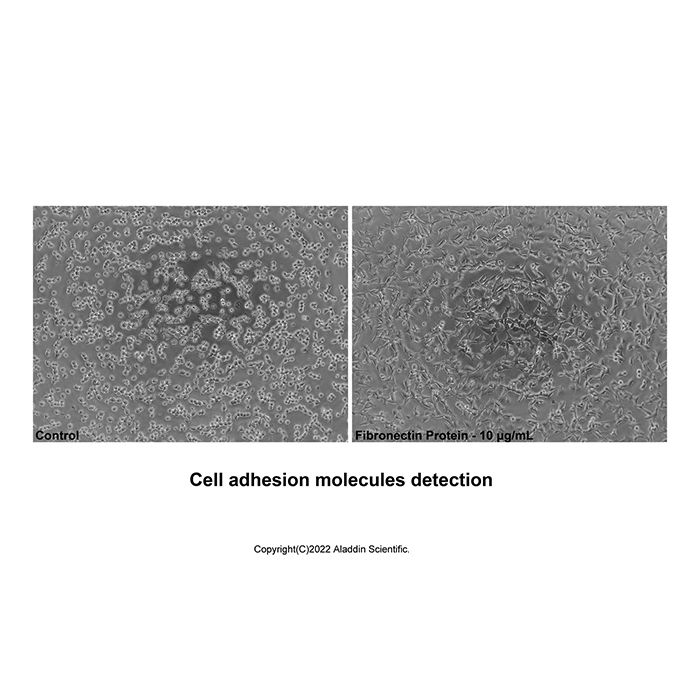
Measured by the ability of the immobilized protein to support the adhesion of NIH-3T3 mouse embryonic fibroblast cells.
We recommend that this vial be briefly centrifuged prior to opening to bring the contents to the bottom. Reconstitute at 1.0 mg/mL in sterile distilled water. Stock solutions should be apportioned into working aliquots and stored at ≤ -20 °C. Further dilutions should be made in appropriate buffered solutions.
储存条件
-20°C储存,避免反复冻融
运输条件
超低温运输
稳定性与储存
Store at -20℃ for 12 months. Upon reconstitution, it is recommended to aliquot. Avoid freeze/thaw cycle.
图片
Recombinant Human Fibronectin Protein (rp176702) - Bioactivity Measured by the ability of the immobilized protein to support the adhesion of NIH-3T3 mouse embryonic fibroblast cells.
Recombinant Human Fibronectin Protein (rp176702) - SDS-PAGE 3 μg/lane of Recombinant Human Fibronectin Protein was resolved with SDS-PAGE under reducing (R) and visualized by Coomassie® Blue staining, showing a band at 27.7-32.3 kDa.

 ZJ25F0928133


 危险品化学品经营许可证(带存储)