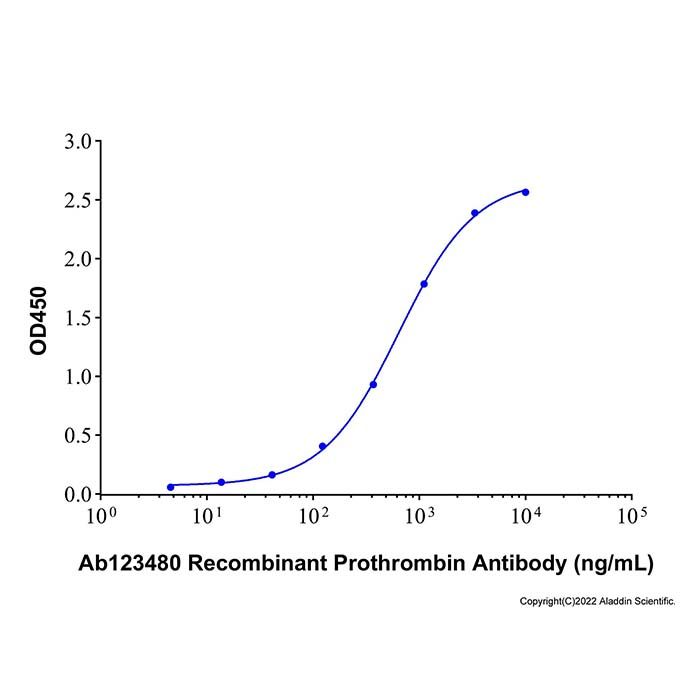
Immobilized Recombinant Human Coagulation Factor II/Prothrombin Protein (rp176718) at 2.0 μg/mL can bind Recombinant Prothrombin Antibody (Ab123480) with the EC50 of 643.0 ng/mL.
Coagulation Factor II, commonly known as thrombin, is an essential component of the coagulation cascade in which it converts fibrinogen to fibrin, activates factors V, VII, VIII, XIII and forms complexes with protein C and thrombomodulin. It also activates platelets and regulates the behavior of additional cells through protease‑activated receptors (PARs) . It may have either protective or deleterious functions, depending on the level and location. Its activity is regulated by endogenous inhibitors such as anti-thrombin III (serpin C1) or heparin cofactor II (serpin D1). A plasma serine protease, thrombin is synthesized in the liver as a 622 amino acid precursor with a 24 amino acid signal peptide. Cleavage by itself or by similar enzymes converts the proenzyme to three forms designated as alpha ‑, beta ‑ and gamma ‑thrombin. Composed of a disulfide bond-linked dimer of the light chain (A) (residues 328-363) and the heavy chain (B) (residues 364‑622), alpha -thrombin displays the diverse functions as described above. In comparison, the further processed B chains of beta - and gamma -thrombin have no known physiological function, but retain most of the activity towards small synthetic substrates. The recombinant human thrombin may be used to process proteins containing the thrombin cleavage site. The conditions for processing different proteins, such as the ratio of protein/thrombin, buffer components, temperature and time of incubation, may vary and should be empirically determined.
Post-translational: The gamma-carboxyglutamyl residues, which bind calcium ions, result from the carboxylation of glutamyl residues by a microsomal enzyme, the vitamin K-dependent carboxylase. The modified residues are necessary for the calcium-dependent interaction with a negatively charged phospholipid surface, which is essential for the conversion of prothrombin to thrombin. N-glycosylated. N-glycan heterogeneity at Asn-121: Hex3HexNAc3 (minor), Hex4HexNAc3 (minor) and Hex5HexNAc4 (major). At Asn-143: Hex4HexNAc3 (minor) and Hex5HexNAc4 (major). In the penultimate step of the coagulation cascade, prothrombin is converted to thrombin by the prothrombinase complex composed of factor Xa (F10), cofactor Va (F5), and phospholipids. This activation requires factor Xa-catalyzed sequential cleavage at 2 sites, Arg-314 and Arg-363, along 2 possible pathways. In the first pathway, the first cleavage occurs at Arg-314, leading to the formation of the inactive intermediate prethrombin-2. This pathway preferentially occurs on platelets and in the absence of cofactor Va. In the second pathway, the first cleavage occurs at Arg-363, which separates protease domain into 2 chains that remain connected through a disulfide bond and generates the active intermediate meizothrombin. The presence of cofactor Va directs activation along the meizothrombin pathway and greatly accelerates the rate of cleavage at Arg-363, but has a smaller effect on the cleavage of meizothrombin at Arg-314. Meizothrombin accumulates as an intermediate when prothrombinase is assembled on the membrane of red blood cells.
生物活性
Immobilized Recombinant Human Coagulation Factor II/Prothrombin Protein (rp176718) at 2.0 μg/mL can bind Recombinant Prothrombin Antibody (Ab123480) with the EC50 of 643.0 ng/mL.
76.4 kDa, under reducing conditions; 71.9 kDa, under non-reducing conditions.
分子类型
蛋白质
产品线
生物产品
储存与运输
物理形态
液体
储存缓冲液
20mM MES, 500mM Choline Chloride, pH 6.0.
浓度
见COA
储存条件
-20°C储存,避免反复冻融
运输条件
超低温运输
稳定性与储存
-20℃(12个月);收货后建议分装,避免反复冻融。
图片
Recombinant Human Coagulation Factor II/Prothrombin Protein (rp176718) - ELISA
Immobilized Recombinant Human Coagulation Factor II/Prothrombin Protein (rp176718) at 2.0 μg/mL can bind Recombinant Prothrombin Antibody (Ab123480) with the EC₅₀ of 643.0 ng/mL.
Recombinant Human Coagulation Factor II/Prothrombin Protein (rp176718) - SDS-PAGE
2 μg/lane of Recombinant Human Coagulation Factor II/Prothrombin Protein was resolved with SDS-PAGE under reducing (R) and non-reducing (N) conditions and visualized by Coomassie® Blue staining, showing a band at 76.4 kDa under reducing conditions and 71.9 kDa under non-reducing conditions.

 ZJ25F1230174


 危险品化学品经营许可证(带存储)