Monoacylglycerol lipase, also known as MAG lipase and MGLL, is a member of the serine hydrolase superfamily with the typical serine hydrolase catalytic triad. It converts monoacylglycerides to free fatty acids and glycerol. An important physiological process performed by MGLL is the breakdown of the endocannabinoid 2‑arachidonoylglycerol (2-AG) by hydrolysis to provide the arachidonic acid precursor for pro‑inflammatory eicosanoid synthesis. MGLL knock‑out mice exhibited enhanced learning and improved performance in novel object recognition due to the increased level of 2‑AG. In Alzheimer’s disease, inactivation of MGLL suppressed accumulation of β‑amyloid and reduced the expression of β-site amyloid precursor protein cleaving enzyme 1 (BACE1).
生物活性
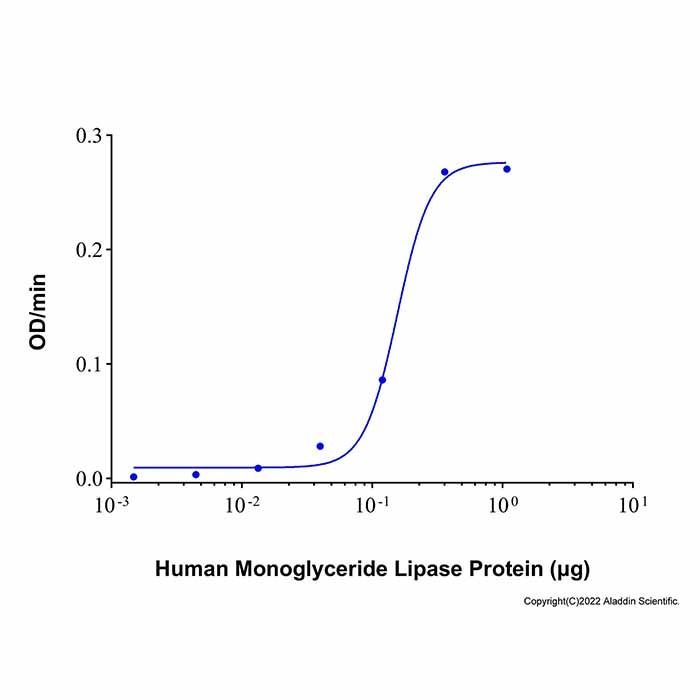
Measured by its ability to hydrolyze 4-Nitrophenyl butyrate (N138584). The specific activity is >15,000 pmol/min/μg.
Store at -20°C for 1 year. Avoid freeze/thaw cycle.
图片
Recombinant Human Monoglyceride Lipase Protein (rp179784) - Enzyme Activity Measured by its ability to hydrolyze 4-Nitrophenyl butyrate (N138584). The specific activity is >15,000 pmol/min/μg.
Recombinant Human Monoglyceride Lipase Protein (rp179784) - SDS-PAGE 3 μg/lane of Recombinant Human Monoglyceride Lipase Protein was resolved with SDS-PAGE under reducing (R) and visualized by Coomassie® Blue staining, showing band at 34.6 & 68.6 kDa under reducing conditions.
Monoglyceride Lipase can form a homodimer (PMID: 19957260, PMID: 19962385).

 ZJ25F0319513


 危险品化学品经营许可证(带存储)