Myeloid progenitor inhibitory factor (MPIF-1), also known as CK beta 8 and MIP-3, is a member of the CC chemokine subfamily that is designated CCL23. Alternative splicing of the MPIF-1 gene results in two mRNAs that encode a short (CK beta 8) and a long (CK beta 8-1) isoform of the chemokine. CK beta 8 cDNA encodes a 120 amino acid (aa) residue precursor protein with a putative 21 aa residue signal peptide that is cleaved to generate a 99 aa residue mature CK beta 8 (aa 22 - 120). Additional N-terminal processing of the 99 aa residue variant can generate a 75 aa residue CK beta 8 (aa 46 - 120) that is significantly more active than the 99 aa residue variant. Similarly, CK beta 8-1 encodes a 137 aa residue precursor protein that can give rise to a 116 and a 92 aa residue chemokine. Among CC chemokine members, MPIF-1 is most closely related to MIP-5/CCL15 (67% sequence identity) and MIP-1 alpha /CCL3 (51%). MPIF-1 mRNA is most abundant in the adult lung and liver, but is also present in bone marrow, placenta, and various myelomonocytic cell lines. MPIF-1 has been shown to suppress the low proliferative potential colony-forming cells that give rise to granulocyte and monocyte lineages. MPIF-1 binds to CCR1 with high affinity and has been shown to be a potent chemoattractant and activator of monocytes, dendritic cells, and osteoclast precursors. Shows chemotactic activity for monocytes, resting T-lymphocytes, and neutrophils, but not for activated lymphocytes. Inhibits proliferation of myeloid progenitor cells in colony formation assays. This protein can bind heparin. Binds CCR1. CCL23(19-99), CCL23(22-99), CCL23(27-99), CCL23(30-99) are more potent chemoattractants than CCL23.
Post-translational: The N-terminal is proteolytically cleaved by proteases associated with inflammatory responses. The processed forms, CCL23(19-99), CCL23(22-99), CCL23(27-99) and CCL23(30-99) exhibit increase in CCR1-mediated signaling and chemotaxis assays in vitro.
生物活性
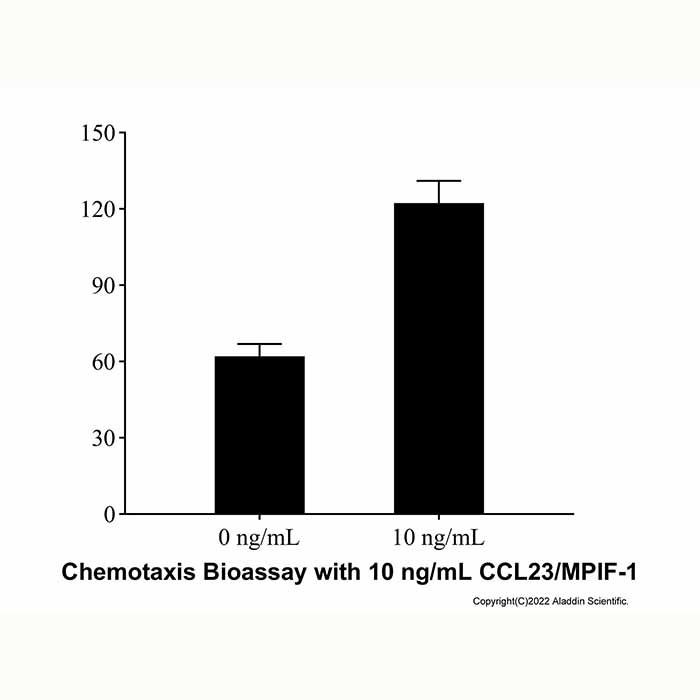
Determined by its ability to chemoattract human T cells population using a concentration range of 10.0-100.0 ng/mL.
12.1 kDa, under reducing conditions; 12.3 & 17.1 kDa, under non-reducing conditions.
分子类型
蛋白质
产品线
生物产品
储存与运输
物理形态
冻干(Lyophilized)
储存缓冲液
Lyophilized from PBS, pH 7.4.
复溶
We recommend that this vial be briefly centrifuged prior to opening to bring the contents to the bottom. Reconstitute at 0.1 mg/mL in sterile distilled water. Stock solutions should be apportioned into working aliquots and stored at ≤ -20 °C. Further dilutions should be made in appropriate buffered solutions.
储存条件
-20°C储存,避免反复冻融
运输条件
超低温运输
稳定性与储存
Store at -20°C for 1 year. Avoid freeze/thaw cycle.
图片
Recombinant Human CCL23/MPIF-1 Protein (rp179826) - Protein Bioactivity Determined by its ability to chemoattract human T cells population using a concentration range of 10.0-100.0 ng/mL.
Recombinant Human CCL23/MPIF-1 Protein (rp179826) - SDS-PAGE 3 μg/lane of Recombinant Human CCL23/MPIF-1 Protein was resolved with SDS-PAGE under reducing (R) and non-reducing (N) conditions and visualized by Coomassie® Blue staining, showing a band at 12.1 kDa under reducing conditions and 12.3 & 17.1 kDa under non-reducing conditions.

 ZJ24F1114391


 危险品化学品经营许可证(带存储)