Protein Function::
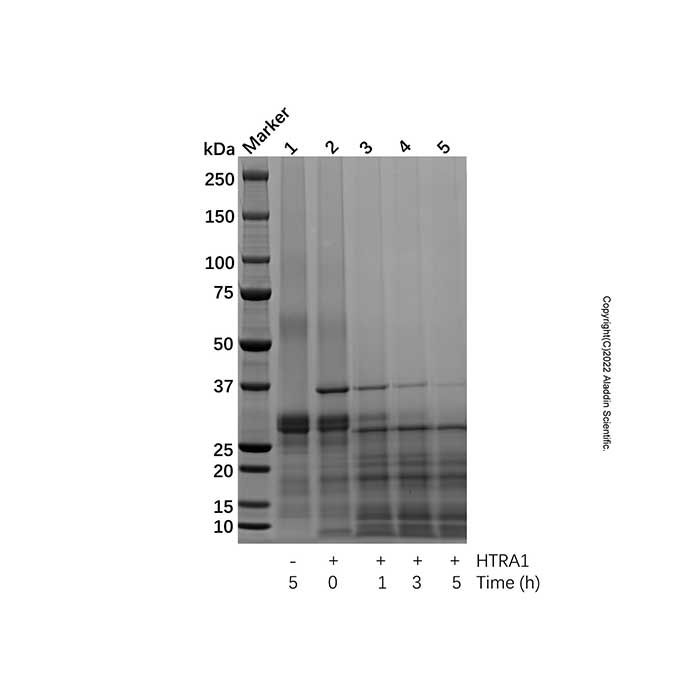
HTRA1 is a member of the mammalian HTRA (high temperature requirement A) serine protease family. The E. coli HTRA homolog functions as a chaperone-protease and is essential for bacterial survival at temperatures above 42 °C. Among the four mammalian HTRA proteins, HTRA1, -3 and -4 are secreted while HTRA2 is localized in mitochondria. HTRA1 contains an N-terminal insulin-like growth factor binding protein (IGFBP) domain, a Kazal-type trypsin inhibitor motif, and C-terminal trypsin-like protease and PDZ domains. It is involved in several pathologies including Alzheimer’s disease, rheumatoid arthritis, osteoarthritis and age‑related macular degeneration, although the mechanisms by which HTRA1 exerts its effects are not clear. HTRA1 also has properties of a tumor suppressor protein, which makes it a target for cancer therapy. In addition HTRA1 is known to regulate the TGF-beta signaling pathway and bone mineralization. Recombinant human HTRA1 lacks the N-terminal IGFBP and Kazal-like domains, but retains the serine protease and PDZ domains.

 ZJ24F0809492


 危险品化学品经营许可证(带存储)