Midkine (MK or MDK) also known as neurite growth-promoting factor 2 (NEGF2) is a basic heparin-binding growth factor of low molecular weight, and forms a family with pleiotrophin. Midkine is a retinoic acid-responsive, heparin-binding growth factor expressed in various cell types during embryogenesis. It promotes angiogenesis, cell growth, and cell migration. Midkine is also expressed in several carcinomas, suggesting that it may play a role in tumorigenesis, perhaps through its effects on angiogenesis. Midkine binds anaplastic lymphoma kinase (ALK) which induces ALK activation and subsequent phosphorylation of the insulin receptor substrate (IRS1), followed by the activation of mitogen-activated protein kinase (MAPK) and PI3-kinase and the induction of cell proliferation. Midkine is involved in neointima formation after arterial injury, possibly by mediating leukocyte recruitment. Also involved in early fetal adrenal gland development. Midkine exhibited increased expression in the breast carcinomas but showed much lower expression in the normal breast tissue. Thus, it can be used as a breast carcinomas marker.
生物活性
Determined by its ability to chemoattract human neutrophils using a concentration range of 1.0-10.0 ng/mL.
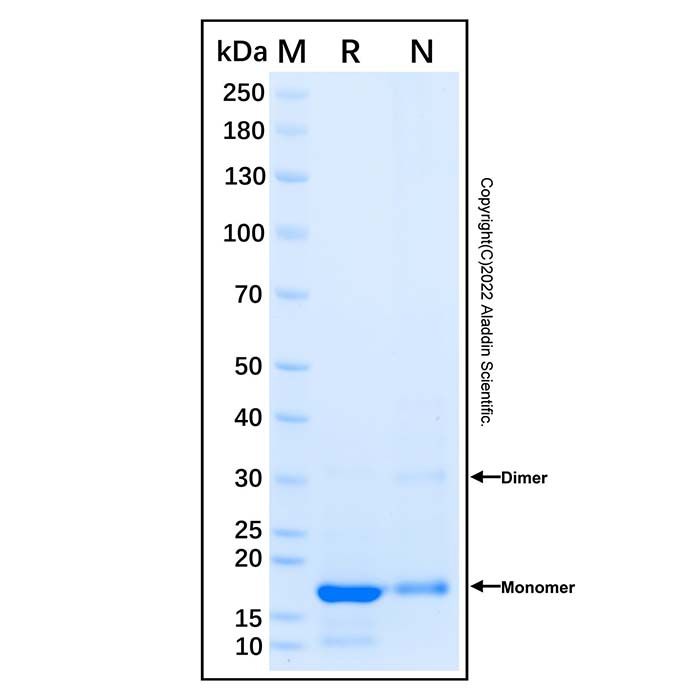
16.8 kDa, under reducing conditions; 17.4 & 30.5 kDa, under non-reducing conditions.
分子类型
蛋白质
产品线
生物产品
储存与运输
物理形态
冻干(Lyophilized)
储存缓冲液
Lyophilized from PBS, 500mM NaCl, pH 7.4.
浓度
见COA
复溶
We recommend that this vial be briefly centrifuged prior to opening to bring the contents to the bottom. Reconstitute at 0.1 mg/mL in sterile distilled water. Stock solutions should be apportioned into working aliquots and stored at ≤ -20 °C. Further dilutions should be made in appropriate buffered solutions.
储存条件
-20°C储存,避免反复冻融
运输条件
超低温运输
稳定性与储存
-20℃保存 12个月;复溶后建议分装,避免反复冻融。
图片
Recombinant Human Midkine Protein (rp179849) - SDS-PAGE 3 μg/lane of Recombinant Human Midkine Protein was resolved with SDS-PAGE under reducing (R) and non-reducing (N) conditions and visualized by Coomassie® Blue staining, showing a band at 16.8 kDa under reducing conditions and 17.4 & 30.5 kDa under non-reducing conditions. Midkine Protein exists as a homodimer and interacts with ALK (PubMed:12122009).

 ZJ25F0927222


 危险品化学品经营许可证(带存储)