无动物源,无载体,His标签,≥90%(SDS-PAGE),expressed in CHO; 见COA
生化机理
alpha -L-Iduronidase is a member of the glycoside hydrolase family encoded by the IDUA gene. It is an important enzyme required for the lysosomal degradation of glycosaminoglycans (GAGS) and hydrolyzes the non-reducing terminal a-L-iduronic acid residues in GAGS including dermatan sulfate and heparan sulfate. Human IDUA is a 653 aa protein composed of a signal peptide removed in the lysosome for mature form and three domains: a triosephosphate isomerase barrel fold containing the catalytic site, a B-sandwich domain, and an Ig(Ig)-like domain. The protein has six reported N-glycosylation sites and the glycosylation status of the enzyme correlates with its catalytic activity. More than a hundred disease-associated variants in the IDUA gene have been identified. Mutations in IDUA that result in enzymatic deficiency lead to the autosomal recessive disease mucopolysaccharidosis type I (MPS I). MPS I can be classified into three clinical subtypes; Hurler syndrome, Hurler-Scheie syndrome, and Scheie syndrome with decreasing severity, respectively. MPS I causes progressive cellular, tissue and organ damage, and several clinical studies using enzyme replacement therapy show positive results. More recently, the IDUA gene has been linked to osteoporosis. H33Q, present in the recombinant product, represents a benign and common polymorphism.
Post-translational: N-glycosylation at Asn-372 contributes to substrate binding and is required for full enzymatic activity.
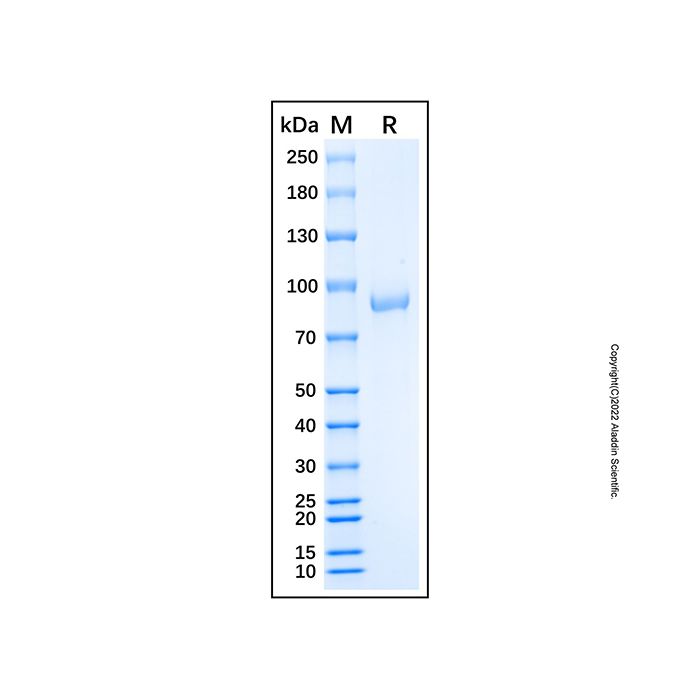
Recombinant Human alpha-L-Iduronidase/IDUA Protein (rp181246) - SDS-PAGE
2 μg/lane of Recombinant Human alpha-L-Iduronidase/IDUA Protein was resolved with SDS-PAGE under reducing (R) and visualized by Coomassie® Blue staining, showing a band at 82.8-97.7 kDa under reducing conditions.

 ZJ26F0333654


 危险品化学品经营许可证(带存储)