TGF-beta 3 (transforming growth factor-beta 3) is a member of a TGF-beta superfamily subgroup that is defined by their structural and functional similarities. TGF-beta 3 and its closely related proteins, TGF-beta 1 and beta 2, act as cellular switches to regulate immune function, cell proliferation, and epithelial-mesenchymal transition. The non-redundant biological effects of TGF- beta 3 include involvement in palatogenesis, chondrogenesis, and pulmonary development. Human TGF-beta 3 cDNA encodes a 412 amino acid (aa) precursor that contains a 20 aa signal peptide and a 392 aa proprotein. The proprotein is processed by a furin-like convertase to generate a 220 aa latency-associated peptide (LAP) and a 112 aa mature TGF-beta 3. Mature human TGF- beta 3 shows 100%, 99%, and 98% aa identity with mouse/dog/horse, rat, and pig TGF- beta 3, respectively. TGF-beta 3 is secreted as a latent complex. This latent form of TGF-beta 3 is activated by integrins, thrombospondin-1, plasmin, and matrix metalloproteases. It can also be activated by extreme pH and reactive oxygen species. TGF-beta 3 binds with high affinity to TGF-beta RII, a type II serine/threonine kinase receptor. This receptor then phosphorylates and activates type I serine/threonine kinase receptors, TGF- beta RI or ALK-1, to modulate transcription through Smad phosphorylation. The divergent biological effects exerted by individual TGF-beta isoforms is dependent upon the recruitment of co-receptors (TGF- beta RIII and endoglin) and the subsequent initiation of Smad-dependent or -independent signaling pathways.
Post-translational: Transforming growth factor beta-3 proprotein: The precursor proprotein is cleaved in the Golgi apparatus to form Transforming growth factor beta-3 (TGF-beta-3) and Latency-associated peptide (LAP) chains, which remain non-covalently linked, rendering TGF-beta-3 inactive. Methylated at Gln-293 by N6AMT1.
生物活性
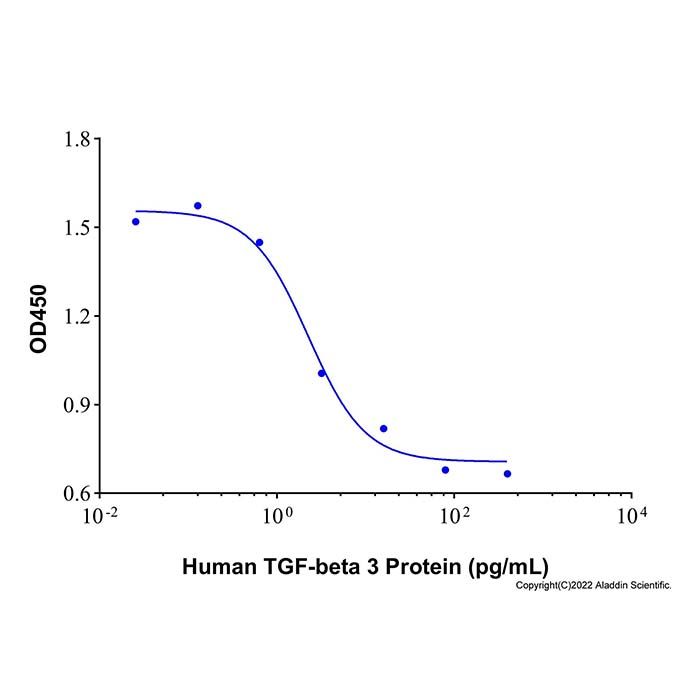
Measured by its ability to inhibit the IL-4-dependent proliferation of TF-1 cells. The ED50 for this effect is 2.3 pg/mL.
12.0-15.0 & 39.3 & 51.8 kDa, under reducing conditions; 49.3 & 95.0-109.0 kDa, under non-reducing conditions.
分子类型
蛋白质
产品线
生物产品
储存与运输
物理形态
冻干(Lyophilized)
储存缓冲液
Lyophilized from PBS, pH 7.4
浓度
expressed in HEK293; 见COA
复溶
We recommend that this vial be briefly centrifuged prior to opening to bring the contents to the bottom. Reconstitute at 0.1 mg/mL in sterile distilled water. Stock solutions should be apportioned into working aliquots and stored at ≤ -20 °C. Further dilutions should be made in appropriate buffered solutions.
储存条件
-20°C储存,避免反复冻融
运输条件
超低温运输
稳定性与储存
-20℃保存 12个月;复溶后建议分装,避免反复冻融。
图片
Recombinant Human TGF-beta 3 Protein (rp181280) - Protein Bioactivity
Measured by its ability to inhibit the IL-4-dependent proliferation of TF-1 cells. The ED₅₀ for this effect is 2.3 pg/mL.
Recombinant Human TGF-beta 3 Protein (rp181280) - SDS-PAGE
3 μg/lane of Recombinant Human TGF-beta 3 Protein was resolved with SDS-PAGE under reducing (R) and non-reducing (N) conditions and visualized by Coomassie® Blue staining, showing the bands at 12.0-15.0 & 39.3 & 51.8 kDa under reducing conditions and 49.3 & 95.0-109.0 kDa under non-reducing conditions.
Transforming growth factor β-3 (TGF-beta 3) is a homodimer connected by disulfide bonds (PubMed: 8819159).



 危险品化学品经营许可证(带存储)