产品名称
Recombinant Human Tenascin C Protein
别名
重组人Tenascin C蛋白 | 重组人腱糖蛋白C
英文别名
Cytotactin | Glioma-associated-extracellular matrix antigen | GMEM | hexabrachion (tenascin C, cytotactin) | hexabrachion (tenascin) | Hexabrachion | HXB | HXBcytotactin | JI | Myotendinous antigen | neuronectin | Tenascin C | Tenascin J1 | tenascin | tenascin-C isoform 14/AD1/16 | Tenascin-C | TNC | TN-C | TNGP
规格或纯度
无动物源,无载体,生物活性,ActiBioPure™,高性能,His标签,PBS Only,≥90%(SDS-PAGE)
生化机理
Tenascin C, also known as hexabrachion, cytotactin, neuronectin, GMEM, JI, myotendinous antigen, glioma-associated-extracellular matrix antigen, and GP 150-225, is a member of the Tenascin family of extracellular matrix proteins. It is secreted as a disulfide-linked homohexamer whose subunits can vary in size from approximately 200 kDa to over 300 kDa due to differences in glycosylation. Rotary-shadowed electron micrographs of the purified molecule show six strands joined to one another at one end in a globular domain with each arm terminating in a knob-like structure. The human Tenascin C monomer is synthesized as a precursor with a 22 amino acid (aa) signal sequence and a 2179 aa mature chain (SwissProt # P24821). The mature chain consists of a coiled-coil region (aa 118-145), followed by 15 EGF-like domains, 15 fibronectin type-III domains, and a fibrinogen C-terminal domain. In addition, there are 23 potential sites of N-linked glycosylation. Alternative splicing within the fibronectin type-III repeats produces six isoforms for human Tenascin C. Mature human Tenascin C (isoform 1) shares 84% aa sequence identity with mature mouse Tenascin C. In the developing embryo, Tenascin C is expressed during neural, skeletal, and vascular morphogenesis. In the adult, it virtually disappears with continued basal expression detectable only in tendon-associated tissues. However, greatup-regulation in expression occurs in tissues undergoing remodeling processes seen during wound repair and neovascularization or in pathological states such as inflammation or tumorigenesis. Biologically, Tenascin C functions as an adhesion-modulatory extracellular matrix protein. Specifically, it antagonizes the adhesive effects of fibronectin, and impacts the ability of fibroblasts to deposit and contract the matrix by affecting the morphology and signaling pathways of adherent cells. Tenascin C acts by blocking syndecan-4 binding at the edges of the wound and by suppressing fibronectin-mediated activation of RhoA and focal adhesion kinase (FAK). Tenascin C thus promotes epidermal cell migration and proliferation during wound repair. Extracellular matrix protein implicated in guidance of migrating neurons as well as axons during development, synaptic plasticity as well as neuronal regeneration. Promotes neurite outgrowth from cortical neurons grown on a monolayer of astrocytes. Ligand for integrins alpha-8/beta-1, alpha-9/beta-1, alpha-V/beta-3 and alpha-V/beta-6. In tumors, stimulates angiogenesis by elongation, migration and sprouting of endothelial cells (PubMed:19884327).
生物活性
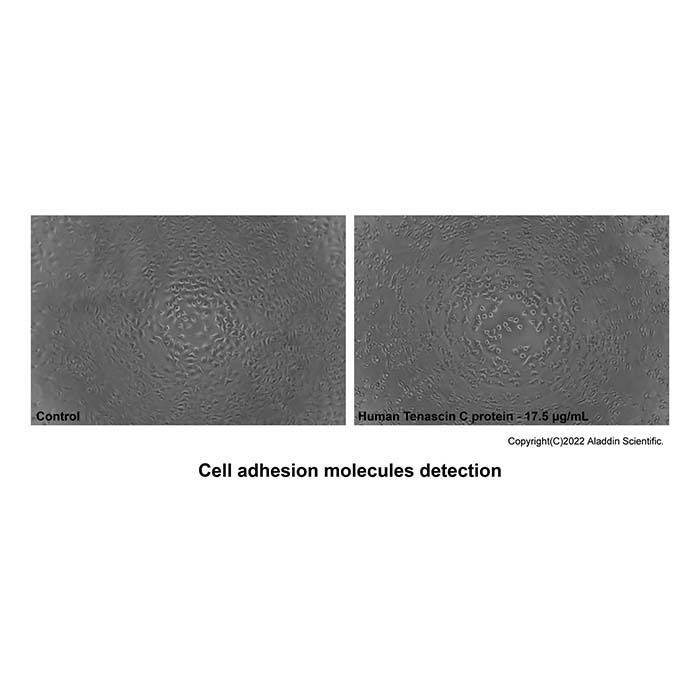
1. Measured by the ability of the immobilized protein to block Fibronectin-mediated adhesion of NIH‑3T3 mouse embryonic fibroblast cells. rhTenascin-C immobilized at 17.5 μg/mL, in the presence of 0.1 μg/mL human Fibronectin, will block approximately 63% NIH3/T3 cell adhesion (5 x 10⁴ cells/well, 100 μL/well). 2. Measured by the ability of the immobilized protein to block Fibronectin-mediated adhesion of NIH‑3T3 mouse embryonic fibroblast cells. The IC50 for this effect is 1.20 μg/mL in the presence of 0.1 μg/mL human Fibronectin.
序列
MGAMTQLLAGVFLAFLALATEGGVLKKVIRHKRQSGVNATLPEENQPVVFNHVYNIKLPVGSQCSVDLESASGEKDLAPPSEPSESFQEHTVDGENQIVFTHRINIPRRACGCAAAPDVKELLSRLEELENLVSSLREQCTAGAGCCLQPATGRLDTRPFCSGRGNFSTEGCGCVCEPGWKGPNCSEPECPGNCHLRGRCIDGQCICDDGFTGEDCSQLACPSDCNDQGKCVNGVCICFEGYAGADCSREICPVPCSEEHGTCVDGLCVCHDGFAGDDCNKPLCLNNCYNRGRCVENECVCDEGFTGEDCSELICPNDCFDRGRCINGTCYCEEGFTGEDCGKPTCPHACHTQGRCEEGQCVCDEGFAGVDCSEKRCPADCHNRGRCVDGRCECDDGFTGADCGELKCPNGCSGHGRCVNGQCVCDEGYTGEDCSQLRCPNDCHSRGRCVEGKCVCEQGFKGYDCSDMSCPNDCHQHGRCVNGMCVCDDGYTGEDCRDRQCPRDCSNRGLCVDGQCVCEDGFTGPDCAELSCPNDCHGQGRCVNGQCVCHEGFMGKDCKEQRCPSDCHGQGRCVDGQCICHEGFTGLDCGQHSCPSDCNNLGQCVSGRCICNEGYSGEDCSEVSPHHHHHH
SDS-PAGE
80.4 kDa, under reducing conditions.

 ZJ25F0926798


 危险品化学品经营许可证(带存储)