无动物源, 无载体, His标签, ≥95%(SDS-PAGE), expressed in HEK293; 见COA
生化机理
Osteoprotegerin (OPG), also called OCIF (osteoclastogenesis inhibitory factor) is a secreted 55-60 kDa protein that regulates bone density. As a member of the tumor necrosis factor receptor (TNFR) superfamily of proteins, it is designated TNFRSF11B. Human OPG cDNA encodes 401 amino acids (aa) including a 21 aa signal peptide and a 380 aa mature soluble protein with four TNFR domains, two death domains and a heparin-binding region. The cysteine-rich TNFR domains are essential for ligand interaction, while a cysteine at the C-terminus mediates homodimerization. Mature human OPG shares 86%, 87%, 92%, 92% and 88% amino acid sequence identity with mouse, rat, equine, canine and bovine OPG, respectively. OPG is widely expressed and constitutively released as a homodimer by mesenchymal stem cells, fibroblasts and endothelial cells. Regulation of its expression by estrogen, parathyroid hormone and cytokines is complex and changes with age. OPG has been called a decoy receptor for the TNF superfamily ligands, TRANCE (tumor necrosis factor-related activation-induced cytokine), also called RANK L (receptor activator of NF kappa B ligand), and TRAIL (TNF-related apoptosis-inducing ligand), which also bind TNF family receptors RANK and TRAIL receptors 1-4, respectively. TRAIL decreases the release of OPG from cells that express it, while OPG inhibits TRAIL-induced apoptosis. Expression of RANK L on the cell surface, and thus its ability to stimulate osteoclastogenesis, is regulated by OPG by intracellular and extracellular mechanisms. Within osteoblasts, interaction of the basic domain of OPG with RANK L in the Golgi inhibits RANK L secretion. Extracellularly, OPG binding to RANK L results in clathrin-mediated internalization and degradation of both proteins. Binding of OPG by syndecan-1 heparin sulfates on multiple myeloma cells also results in OPG internalization and degradation, contributing to bone loss. OPG deficiency can cause juvenile Paget’s disease in humans, and insufficient OPG to balance with RANK L and RANK can produce osteoporosis and vascular calcification in both mice and humans.
Post-translational: N-glycosylated. Contains sialic acid residues. The N-terminus is blocked.
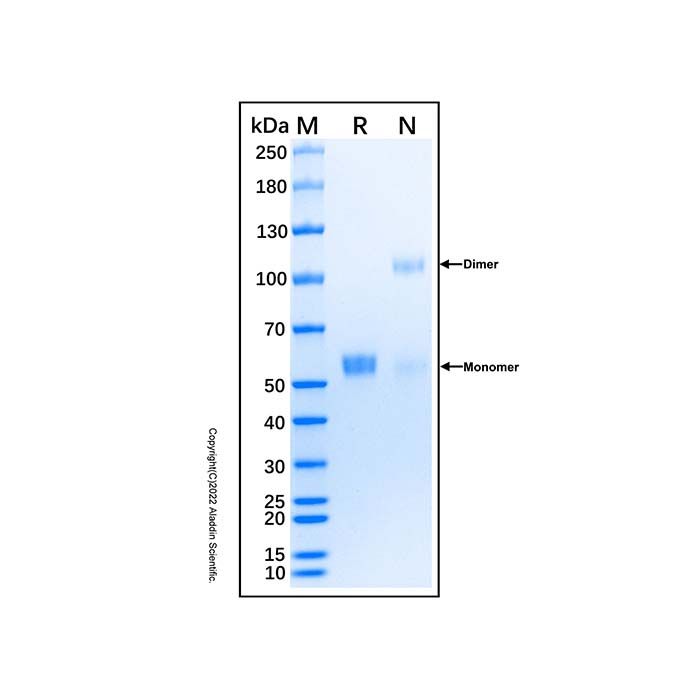
51.9-63.3 kDa, under reducing conditions; 53.1-60.5 & 102.3-113.9 kDa, under non-reducing conditions.
分子类型
蛋白质
产品线
生物产品
储存与运输
物理形态
冻干(Lyophilized)
储存缓冲液
Lyophilized from PBS, pH 7.4
浓度
expressed in HEK293; 见COA
复溶
We recommend that this vial be briefly centrifuged prior to opening to bring the contents to the bottom. Reconstitute at 0.1 mg/mL in sterile distilled water. Stock solutions should be apportioned into working aliquots and stored at ≤ -20 °C. Further dilutions should be made in appropriate buffered solutions.
储存条件
-20°C储存,避免反复冻融
运输条件
超低温运输
稳定性与储存
-20℃保存 12个月;复溶后建议分装,避免反复冻融。
图片
Recombinant Human Osteoprotegerin/TNFRSF11B Protein (rp181566) - SDS-PAGE
3 μg/lane of Recombinant Human Osteoprotegerin/TNFRSF11B Protein was resolved with SDS-PAGE under reducing (R) and non-reducing (N) conditions and visualized by Coomassie® Blue staining, showing the bands at 51.9-63.3 kDa under reducing conditions and 53.1-60.5 & 102.3-113.9 kDa under non-reducing conditions.
The Osteoprotegerin/TNFRSF11B Protein forms homodimers through disulfide bonds, accompanied by molecular weight shift due to glycosylation (Uniport: O00300).

 ZJ26F0738102


 危险品化学品经营许可证(带存储)