CD318 antigen | CD318 | CDCP1 | CUB domain containing protein 1 | CUB domain-containing protein 1 | Membrane glycoprotein gp140 | SIMA135 | SIMA135TRASK | Subtractive immunization M plus HEp3-associated 135 kDa protein | Transmembrane and associated with
规格或纯度
无动物源,无载体,His标签,PBS Only,≥90%(SDS-PAGE),见COA
生化机理
CDCP1 (CUB-domain containing protein 1), also known as Trask or CD318, is a type I transmembrane receptor whose specific role remains unclear. Human CDCP1 is synthesized with a large extracellular domain (ECD) containing three CUB domains, a transmembrane domain and a cytoplasmic domain with 5 tyrosine phosphorylation sites. Full-length CDCP1 (Isoform 1) is ~135 kDa and can be cleaved into a ~70 kDa membrane-bound and a ~65 kDa circulating form. A secreted only form of human CDCP1, called Isoform 2, can also be expressed consisting of amino acids (aa) 30-343 of the ECD. The mature ECD of human Isoform 1 shares 84% aa sequence identity to mouse and rat CDCP1 Isoform 1. CDCP1 was originally identified from proteins involved in metastasis and has been found on tumor, stem cells, keratinocytes and colonic epithelial cells. Tyrosine phosphorylation of the intracellular domain of CDCP1 results in downstream signaling through Src-family kinases (SFKs), Akt, and PKCδ. CDCP1 appears to be important for cell-cell and cell-substratum adhesion and the phosphorylation state of CDCP1 regulates this effect. CDCP1 is associated with a poor prognosis in epithelial tumors, such as lung, pancreatic, colorectal, renal, and ovarian carcinomas and is a novel marker of the most aggressive human triple-negative breast cancers. Several different extracellular forms of CDCP1 have been shown to exhibit disease-specific expression in prostate cancer.
Post-translational: Phosphorylated on tyrosine by kinases of the SRC family such as SRC and YES as well as by the protein kinase C gamma/PRKCG. Dephosphorylated by phosphotyrosine phosphatases. Also phosphorylated by suramin, a heparin analog. Tyrosine phosphorylated in response to dissociation of integrin alpha-6 beta-4 from laminin-5. N-glycosylated. A soluble form may also be produced by proteolytic cleavage at the cell surface (shedding). Another peptide of 80 kDa (p80) is present in cultured keratinocytes probably due to tryptic cleavage at an unidentified site on its N-terminal side. Converted to p80 by plasmin, a trypsin-like protease.
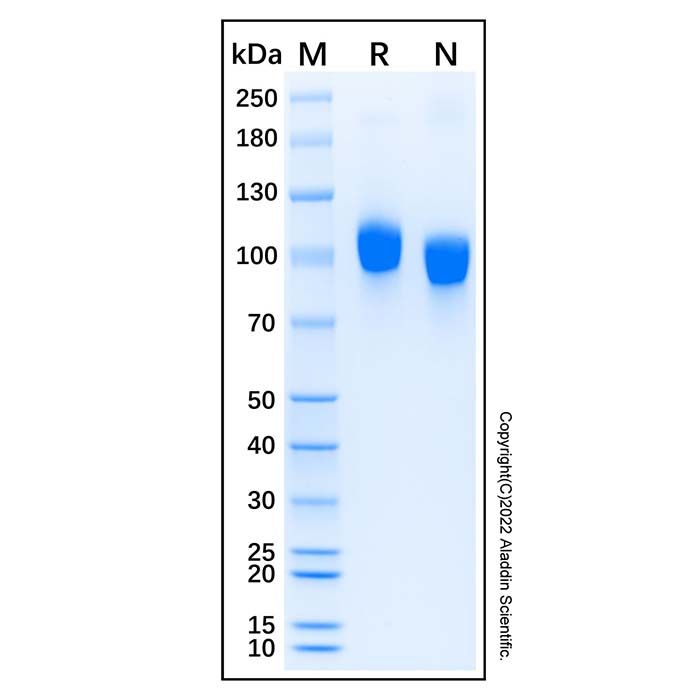
92.3-115.3 kDa, under reducing conditions; 86.7-107.0 kDa, under non-reducing conditions.
分子类型
蛋白质
产品线
生物产品
储存与运输
物理形态
冻干(Lyophilized)
储存缓冲液
Lyophilized from PBS, pH 7.4
浓度
见COA
复溶
We recommend that this vial be briefly centrifuged prior to opening to bring the contents to the bottom. Reconstitute at 1.0 mg/mL in sterile distilled water. Stock solutions should be apportioned into working aliquots and stored at ≤ -20 °C. Further dilutions should be made in appropriate buffered solutions.
储存条件
-20°C储存,避免反复冻融
运输条件
超低温运输
稳定性与储存
Store at -20℃ for 12 months. Upon reconstitution, it is recommended to aliquot. Avoid freeze/thaw cycle.
图片
Recombinant Human CDCP1 Protein (rp181598) - SDS-PAGE 3 μg/lane of Recombinant Human CDCP1 Protein was resolved with SDS-PAGE under reducing (R) and non-reducing (N) conditions and visualized by Coomassie® Blue staining, showing a band at 92.3-115.3 kDa under reducing conditions and 86.7-107.0 kDa under non-reducing conditions.

 ZJ25F0622960


 危险品化学品经营许可证(带存储)