无载体,生物活性,ActiBioPure™,His标签,≥95%(SDS-PAGE),expressed in E. coli; 见COA
生化机理
Pyruvate kinases are glycolytic enzymes that catalyze the transfer of a phosphoryl group from phosphoenolpyruvate to ADP, generating ATP, the final step in the glycolysis pathway. There are two pyruvate kinase muscle isozymes, PKM1 and PKM2, caused by alternative splicing at the carboxy termini. PKM2 is specifically expressed in proliferating cells, such as embryonic stem cells, embryonic carcinoma cells, and various cancer cells. Switching from PKM1 to PKM2 in tumor cells causes the shift in cellular metabolism to aerobic glycolysis, which is important for tumor cell proliferation and survival. In addition, PKM2 exists in two oligomeric forms: a highly active tetrameric form and nearly inactive dimeric form. The ratio between the two forms determines whether glucose are channeled to biosynthetic processes or used for glycolytic ATP production. The oligomerization of PKM2 is allosterically stimulated by D-fructose 1,6‑biphosphate (FBP) and is inhibited by oxalate and 3,3',5-triiodo-L-thyronine (T3).
Post-translational: ISGylated. Under hypoxia, hydroxylated by EGLN3. Acetylation at Lys-305 is stimulated by high glucose concentration, it decreases enzyme activity and promotes its lysosomal-dependent degradation via chaperone-mediated autophagy.
Isoform M2: Acetylated at Lys-433 by EP300, leading to impair phosphoenolpyruvate substrate-binding and promote its homodimerization and subsequent translocation to the nucleus (PubMed:24120661).
Deacetylation at Lys-433 by SIRT6 promotes its nuclear export into the cytoplasm, leading to suppress its nuclear localization and oncogenic function (PubMed:26787900). S-nitrosylation at Cys-423 and Cys-424 inhibits homotetramerization and pyruvate kinase activity (PubMed:30487609).
S-nitrosylation is indirectly inhibited by AKR1A1 which degrades S-nitroso-CoA, a cofactor required to S-nitrosylate proteins (PubMed:30487609). FGFR1-dependent tyrosine phosphorylation is reduced by interaction with TRIM35.
生物活性
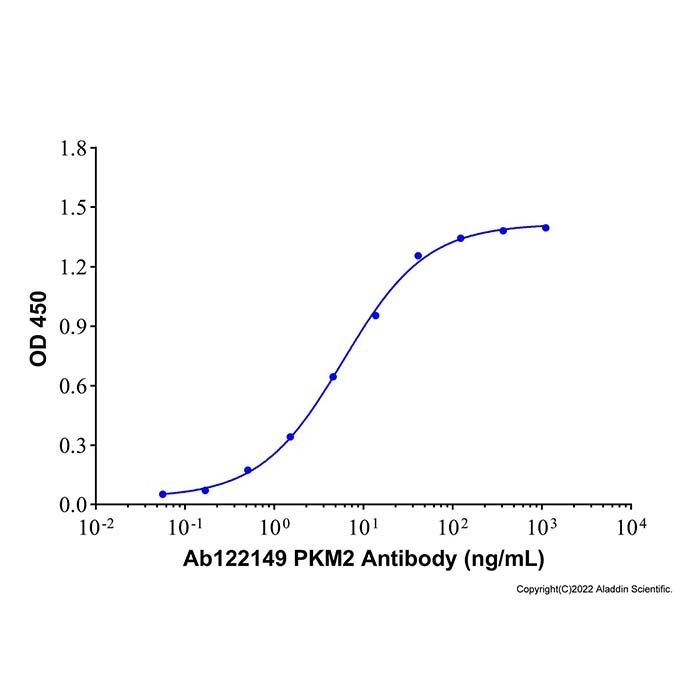
Immobilized Recombinant Human PKM2 Protein (rp183633) at 1.0 μg/mL can bind PKM2 Antibody (Ab122149) with the EC50 of 5.9 ng/mL.
We recommend that this vial be briefly centrifuged prior to opening to bring the contents to the bottom. Reconstitute at 1.0 mg/mL in sterile distilled water. Stock solutions should be apportioned into working aliquots and stored at ≤ -20 °C. Further dilutions should be made in appropriate buffered solutions.

 ZJ26F0737167


 危险品化学品经营许可证(带存储)