15-hydroxyprostaglandin dehydrogenase [NAD+], also known as Prostaglandin dehydrogenase 1, HPGD, and PGDH1, is a member of the short-chain dehydrogenases/reductases (SDR) family. Prostaglandins (PGs) play a key role in the onset of labor in many species and regulate uterine contractility and cervical dilatation. Therefore, the regulation of prostaglandin output by PG synthesizing and metabolizing enzymes in the human myometrium may determine uterine activity patterns in human labor both at preterm and at term. Prostaglandin dehydrogenase (PGDH) metabolizes prostaglandins (PGs) to render them inactive. HPGD is down-regulated by cortisol, dexamethasone, and betamethasone and down-regulated in colon cancer. It is up-regulated by TGFB1. HPGD contributes to the regulation of events that are under the control of prostaglandin levels. HPGD catalyzes the NAD-dependent dehydrogenation of lipoxin A4 to form 15-oxo-lipoxin A4. and inhibits in vivo proliferation of colon cancer cells. Defects in HPGD are the cause of primary hypertrophic osteoarthropathy autosomal recessive (PHOAR), cranio-osteoarthropathy (COA), and isolated congenital nail clubbing.
生物活性
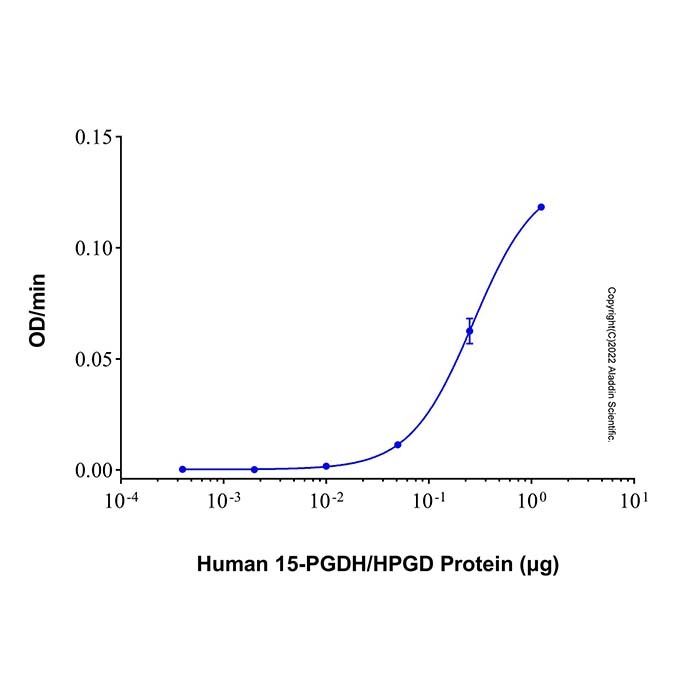
Measure by the production of NADH during the oxidation of PGF2 alpha (D136300). The specific activity is >1,500 pmol/min/μg.
Store at -20°C for 1 year. Avoid freeze/thaw cycle.
图片
Recombinant Human 15-PGDH/HPGD Protein - Protein Bioactivity Measure by the production of NADH during the oxidation of PGF2 alpha (D136300). The specific activity is >1,500 pmol/min/μg.
Recombinant Human 15-PGDH/HPGD Protein (rp183685) - SDS-PAGE 5 μg/lane of Recombinant Human 15-PGDH/HPGD Protein was resolved with SDS-PAGE under reducing (R) and non-reducing (N) conditions and visualized by Coomassie® Blue staining, showing a band at 26.0 kDa.

 ZJ24F1215319


 危险品化学品经营许可证(带存储)