ALS | ALS1 | Amyotrophic lateral sclerosis 1 adult | Cu/Zn SOD | Cu/Zn superoxide dismutase | Epididymis secretory protein Li 44 | HEL S 44 | Homodimer | hSod1 | Indophenoloxidase A | IPOA | Mn superoxide dismutase | SOD | SOD soluble | SOD1 | SOD2 | SODC
规格或纯度
无载体,His标签,PBS Only,≥95%(SDS-PAGE),见COA
生化机理
SOD1 belongs to the Cu-Zn superoxide dismutase family. It binds copper and zinc ions and is one of two isozymes responsible for destroying free superoxide radicals in the body. The encoded isozyme is a soluble cytoplasmic protein, acting as a homodimer to convert naturally-occuring but harmful superoxide radicals to molecular oxygen and hydrogen peroxide. The other isozyme is a mitochondrial protein. Mutations in this gene have been implicated as causes of familial amyotrophic lateral sclerosis. Rare transcript variants have been reported for this gene. SOD1 destroys radicals which are normally produced within the cells and which are toxic to biological systems. Defects in SOD1 are the cause of amyotrophic lateral sclerosis type 1 (ALS1). ALS1 is a familial form of amyotrophic lateral sclerosis, a neurodegenerative disorder affecting upper and lower motor neurons and resulting in fatal paralysis. Sensory abnormalities are absent. Death usually occurs within 2 to 5 years. The etiology of amyotrophic lateral sclerosis is likely to be multifactorial, involving both genetic and environmental factors. The disease is inherited in 5-10% of cases leading to familial forms.
Post-translational: Unlike wild-type protein, the pathogenic variants ALS1 Arg-38, Arg-47, Arg-86 and Ala-94 are polyubiquitinated by RNF19A leading to their proteasomal degradation. The pathogenic variants ALS1 Arg-86 and Ala-94 are ubiquitinated by MARCH5 leading to their proteasomal degradation. The ditryptophan cross-link at Trp-33 is responsible for the non-disulfide-linked homodimerization. Such modification might only occur in extreme conditions and additional experimental evidence is required. Palmitoylation helps nuclear targeting and decreases catalytic activity. Succinylation, adjacent to copper catalytic site, probably inhibits activity. Desuccinylation by SIRT5 enhances activity.
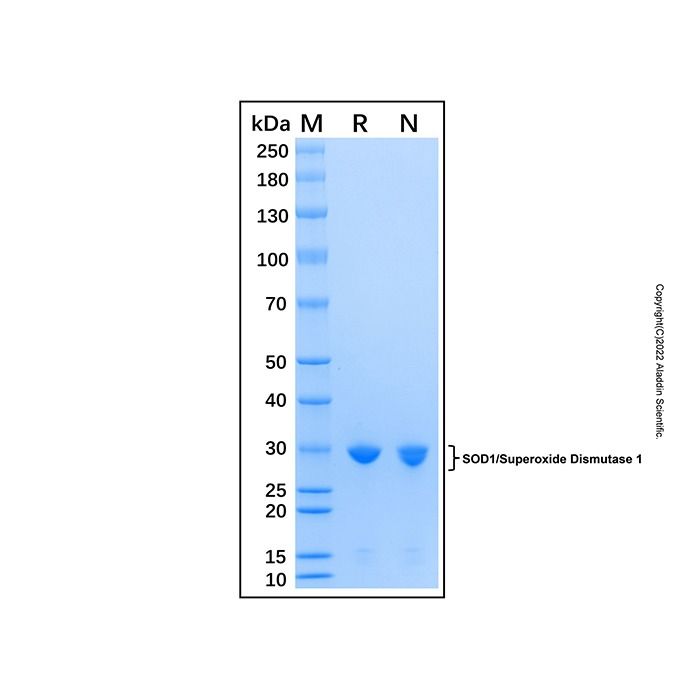
29.3 kDa, under reducing conditions; 29.9 kDa, under non-reducing conditions.
分子类型
蛋白质
产品线
生物产品
储存与运输
物理形态
冻干(Lyophilized)
储存缓冲液
Lyophilized from PBS, pH 7.4.
浓度
见COA
复溶
We recommend that this vial be briefly centrifuged prior to opening to bring the contents to the bottom. Reconstitute at 1.0 mg/mL in sterile distilled water. Stock solutions should be apportioned into working aliquots and stored at ≤ -20 °C. Further dilutions should be made in appropriate buffered solutions.
储存条件
-20°C储存,避免反复冻融
运输条件
超低温运输
稳定性与储存
储存-20℃(12个月),复溶后建议分装,避免反复冻融。
图片
Recombinant Human Superoxide Dismutase 1 Protein (rp183705) - SDS-PAGE 3 μg/lane of Recombinant Human Superoxide Dismutase 1 Protein was resolved with SDS-PAGE under reducing (R) and non-reducing (N) conditions and visualized by Coomassie® Blue staining, showing a band at 29.3 kDa under reducing conditions and 29.9 kDa under non-reducing conditions.

 ZJ25F0521564


 危险品化学品经营许可证(带存储)