ARNT interacting protein | ARNT-interacting protein | Basic helix loop helix PAS protein MOP1 | Basic-helix-loop-helix-PAS protein MOP1 | bHLHe78 | Class E basic helix-loop-helix protein 78 | HIF 1A | HIF 1alpha | HIF-1-alpha | HIF-1alpha | HIF-alpha | HI
规格或纯度
生物活性, ActiBioPure™, 无载体, ≥90%(SDS-PAGE)
生化机理
HIF-1 alpha, also known as HIF1A, contains 1 basic helix-loop-helix (bHLH) domain, 1 PAC (PAS-associated C-terminal) domain, and 2 PAS (PER-ARNT-SIM) domains. It is one of the two subunits of Hypoxia-inducible factor-1 (HIF1). HIF1 is a transcription factor found in mammalian cells cultured under reduced oxygen tension that plays an essential role in cellular and systemic homeostatic responses to hypoxia. HIF1 is a heterodimer composed of an alpha subunit and a beta subunit. The beta subunit has been identified as the aryl hydrocarbon receptor nuclear translocator (ARNT). HIF-1 alpha is expressed in most tissues with the highest levels in the kidney and heart. It is overexpressed in the majority of common human cancers and their metastases, due to the presence of intratumoral hypoxia and as a result of mutations in genes encoding oncoproteins and tumor suppressors. HIF-1 alpha functions as a master transcriptional regulator of the adaptive response to hypoxia. Under hypoxic conditions, it activates the transcription of over 40 genes, including erythropoietin, glucose transporters, glycolytic enzymes, vascular endothelial growth factor, HILPDA, and other genes whose protein products increase oxygen delivery or facilitate metabolic adaptation to hypoxia. HIF1A plays an essential role in embryonic vascularization, tumor angiogenesis, and the pathophysiology of ischemic disease. HIF-1 alpha binds to core DNA sequence 5'-[AG]CGTG-3' within the hypoxia response element (HRE) of target gene promoters. Activation requires the recruitment of transcriptional coactivators such as CREBPB and EP300.
Post-translational: S-nitrosylation of Cys-800 may be responsible for increased recruitment of p300 coactivator necessary for transcriptional activity of HIF-1 complex. Requires phosphorylation for DNA-binding. Phosphorylation at Ser-247 by CSNK1D/CK1 represses kinase activity and impairs ARNT binding. Phosphorylation by GSK3-beta and PLK3 promote degradation by the proteasome (By similarity). Sumoylated; with SUMO1 under hypoxia. Sumoylation is enhanced through interaction with RWDD3. Both sumoylation and desumoylation seem to be involved in the regulation of its stability during hypoxia. Sumoylation can promote either its stabilization or its VHL-dependent degradation by promoting hydroxyproline-independent HIF1A-VHL complex binding, thus leading to HIF1A ubiquitination and proteasomal degradation. Desumoylation by SENP1 increases its stability amd transcriptional activity (By similarity).
There is a disaccord between various publications on the effect of sumoylation and desumoylation on its stability and transcriptional activity (Probable). Acetylation of Lys-532 by ARD1 increases interaction with VHL and stimulates subsequent proteasomal degradation. Deacetylation of Lys-709 by SIRT2 increases its interaction with and hydroxylation by EGLN1 thereby inactivating HIF1A activity by inducing its proteasomal degradation. Polyubiquitinated; in normoxia, following hydroxylation and interaction with VHL. Lys-532 appears to be the principal site of ubiquitination. Clioquinol, the Cu/Zn-chelator, inhibits ubiquitination through preventing hydroxylation at Asn-803. Ubiquitinated by E3 ligase VHL. Deubiquitinated by UCHL1. In normoxia, is hydroxylated on Pro-402 and Pro-564 in the oxygen-dependent domain (ODD) by EGLN1/PHD2 and EGLN2/PHD1. EGLN3/PHD3 has also been shown to hydroxylate Pro-564. The hydroxylated prolines promote interaction with VHL, initiating rapid ubiquitination and subsequent proteasomal degradation. Deubiquitinated by USP20. Under hypoxia, proline hydroxylation is impaired and ubiquitination is attenuated, resulting in stabilization. In normoxia, is hydroxylated on Asn-803 by HIF1AN, thus abrogating interaction with CREBBP and EP300 and preventing transcriptional activation. Repressed by iron ion, via Fe2+ prolyl hydroxylase (PHD) enzymes-mediated hydroxylation and subsequent proteasomal degradation. The iron and 2-oxoglutarate dependent 3-hydroxylation of asparagine is (S) stereospecific within HIF CTAD domains. (Microbial infection) Glycosylated at Arg-18 by enteropathogenic E.coli protein NleB1: arginine GlcNAcylation enhances transcription factor activity and impairs glucose metabolism.
生物活性
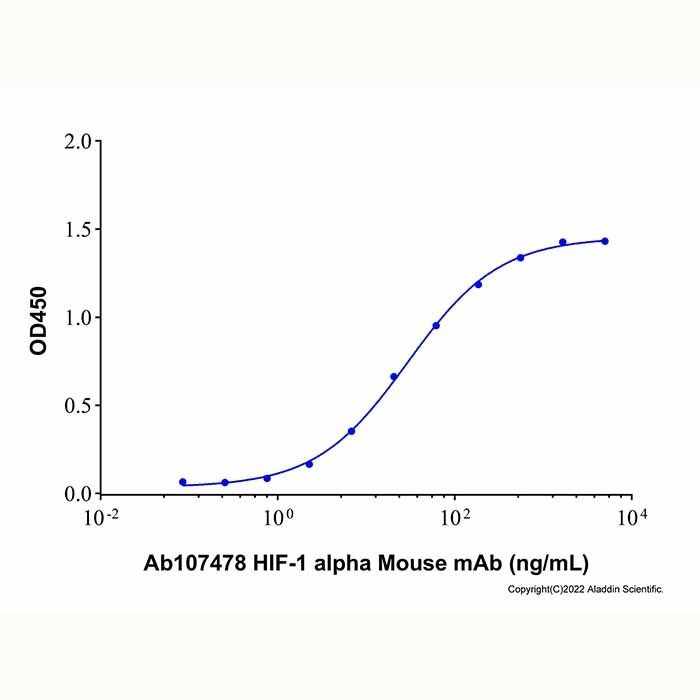
Immobilized Recombinant Human HIF-1 alpha Protein(rp183735) at 1.0 μg/mL can bind HIF-1 alpha Mouse mAb (Ab107478) with the EC50 of 29.5 ng/mL.
50.3 kDa, under reducing conditions; 50.3 kDa, under non-reducing conditions.
分子类型
蛋白质
产品线
生物产品
储存与运输
物理形态
冻干(Lyophilized)
储存缓冲液
Lyophilized from 20mM Tris, 1mM DTT, pH 7.5.
复溶
We recommend that this vial be briefly centrifuged prior to opening to bring the contents to the bottom. Reconstitute at 1.0 mg/mL in sterile distilled water. Stock solutions should be apportioned into working aliquots and stored at ≤ -20 °C. Further dilutions should be made in appropriate buffered solutions.
储存条件
-20°C储存,避免反复冻融
运输条件
超低温运输
稳定性与储存
Store at -20°C for 1 year. Avoid freeze/thaw cycle.
图片
Recombinant Human HIF-1 alpha Protein (rp183735) - ELISA Immobilized Recombinant Human HIF-1 alpha Protein (rp183735) at 1.0 μg/mL can bind HIF-1 alpha Mouse mAb (Ab107478) with the EC50 of 29.5 ng/mL.
Recombinant Human HIF-1 alpha Protein (rp183735) - SDS-PAGE 3 μg/lane of Recombinant Human HIF-1 alpha Protein was resolved with SDS-PAGE under reducing (R) and non-reducing (N) conditions and visualized by Coomassie® Blue staining, showing a band at 50.3 kDa under reducing conditions and non-reducing conditions.

 ZJ25F0217491


 危险品化学品经营许可证(带存储)