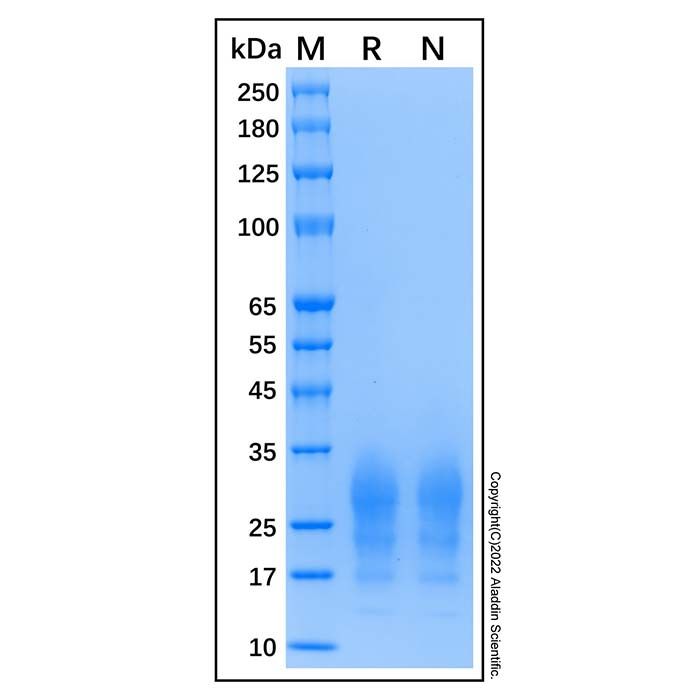
Purity: ≥95%, by SDS-PAGE visualized with Coomassie® Blue Staining Description: CD90, also known as Thy1, is an approximately 25-35 kDa glycoprotein that mediates cellular adhesion and exerts wide-ranging effects in different tissues. CD90 is expressed on hematopoietic progenitor cells, neurons, and activated vascular endothelial cells. Its species-specific expression in lymphoid cells allows its use as a thymocyte and pan T cell marker in mice but not in humans. CD90 can form dimers and higher-order multimers. It binds to heparin, the proteoglycan Syndecan-4, and Integrins alpha M beta 2, alpha V beta 3, and alpha V beta 5. Through these interactions, CD90 inhibits neurite outgrowth, promotes astrocyte adhesion, mediates the adhesion and extravasation of leukocytes and melanoma cells, supports Thrombospondin-1-induced disassembly of fibroblast focal adhesions, and inhibits the activation of latent TGF-beta 1, myofibroblast differentiation, and lung fibrosis. Human Thy-1 shares 63% and 66% amino acid similarity with mouse and rat homologs.
16.8-33.2 kDa, under reducing condition; 16.8-33.2 kDa, under non-reducing condition
分子类型
蛋白质
产品线
生物产品
储存与运输
物理形态
冻干(Lyophilized)
储存缓冲液
Lyophilized from PBS, pH 7.4
复溶
We recommend that this vial be briefly centrifuged prior to opening to bring the contents to the bottom. Reconstitute at 1.0 mg/mL in sterile distilled water. Stock solutions should be apportioned into working aliquots and stored at ≤ -20 °C. Further dilutions should be made in appropriate buffered solutions.
储存条件
-20°C储存,避免反复冻融
运输条件
超低温运输
稳定性与储存
在 -20°C 下可稳定保存 1 年。避免冷冻/解冻循环。
图片
Recombinant Human CD90/Thy1 Protein (rp183754) - SDS-PAGE 3 μg/lane of Recombinant Human CD90/Thy1 Protein was resolved with SDS-PAGE under reducing (R) and non-reducing (N) conditions and visualized by Coomassie® Blue staining, showing a band at 16.8-33.2 kDa.
Recombinant Human CD90/Thy1 Protein (rp183754) - ELISA Immobilized Recombinant Human CD90/Thy1 Protein (rp183754) at 2.0 μg/mL can bind CD90/Thy1 Mouse mAb (Ab095497) with the EC50 of 287.4 ng/mL.

 ZJ24F0505973


 危险品化学品经营许可证(带存储)