无载体,生物活性,ActiBioPure™,≥90%(SDS-PAGE),expressed in E. coli; 见COA
生化机理
This gene encodes a protein that belongs to the Kruppel family of transcription factors. The encoded Zinc Finger Protein is required for normal development of the barrier function of skin. The encoded protein is thought to control the G1-to-S transition of the cell cycle following DNA damage by mediating the tumor suppressor gene p53. Mice lacking this gene have a normal appearance but lose weight rapidly, and die shortly after birth due to fluid evaporation resulting from compromised epidermal barrier function. Alternative splicing results in multiple transcript variants encoding different isoforms.
Post-translational: Ubiquitinated. 'Lys-48'-linked ubiquitinated and targeted for proteasomal degradation by the SCF(BTRC) E3 ubiquitin-protein ligase complex, thereby negatively regulating cell pluripotency maintenance and embryogenesis. Ubiquitinated in a FBXO32-dependent manner, leading to proteasomal degradation.
Polyglutamylated by TTLL1 and TTLL4 at Glu-411, which inhibits KLF4 binding with E3 ligase component BTRC, thereby impeding ubiquitination. Deglutamylated by CCP1 and CCP6; deglutamylation promotes KLF4 ubiquitination. KLF4 glutamylation state plays a critical role in the regulation of its function in cell reprogramming, pluripotency maintenance and embryogenesis.
生物活性
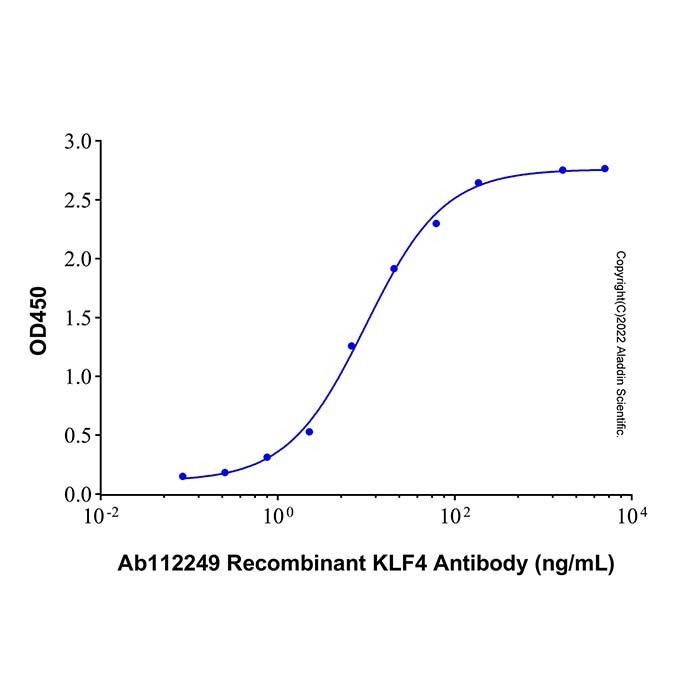
Immobilized Recombinant Human KLF4 Protein (rp183758) at 1.0 μg/mL can bind Recombinant KLF4 Antibody (Ab112249) with the EC50 of 9.92 ng/mL.
Immobilized Recombinant Human KLF4 Protein (rp183758) at 1.0 μg/mL can bind Recombinant KLF4 Antibody (Ab112249) with the EC₅₀ of 9.92 ng/mL.
Recombinant Human KLF4 Protein (rp183758) - SDS-PAGE
3 μg/lane of Recombinant Human KLF4 Protein was resolved with SDS-PAGE under reducing (R) and non-reducing (N) conditions and visualized by Coomassie® Blue staining, showing a band at 45.0 kDa.

 ZJ26F0434611


 危险品化学品经营许可证(带存储)