Cf10 | Coagulation Factor X | EC 3.4.21 | EC 3.4.21.6 | F10 | factor Xa | FX | FXa | Prothrombinase | Stuart Factor | Stuart-Prower factor
规格或纯度
无动物源,无载体,His标签,≥95%(SDS-PAGE),见COA
生化机理
Coagulation factor X, also known as FX, F10, Eponym Stuart-Prower factor, and thrombokinase, is an enzyme of the coagulation cascade. It is one of the vitamin K-dependent serine proteases, and plays a crucial role in the coagulation cascade and blood clotting, as the first enzyme in the common pathway of thrombus formation. Factor X deficiency is one of the rarest of the inherited coagulation disorders. FX deficiency among the most severe of the rare coagulation defects, typically including hemarthroses, hematomas, and umbilical cord, gastrointestinal, and central nervous system bleeding. Factor X is synthesized in the liver as a mature heterodimer formed from a single-chain precursor, and vitamin K is essential for its synthesis. Factor X is activated into factor Xa (FXa) by both factor IX (with its cofactor, factor VIII in a complex known as intrinsic Xase) and factor VII (with its cofactor, tissue factor in a complex known as extrinsic Xase) through cleaving the activation propeptide. As the first member of the final common pathway or thrombin pathway, FXa converts prothrombin to thrombin in the presence of factor Va, Ca2+, and phospholipid during blood clotting and cleaves prothrombin in two places (an arg-thr and then an arg-ile bond). This process is optimized when factor Xa is complexed with activated cofactor V in the prothrombinase complex. Inborn deficiency of factor X is very uncommon, and may present with epistaxis (nose bleeds), hemarthrosis (bleeding into joints) and gastrointestinal blood loss. Apart from congenital deficiency, low factor X levels may occur occasionally in a number of disease states. Furthermore, factor X deficiency may be seen in amyloidosis, where factor X is adsorbed to the amyloid fibrils in the vasculature.
Post-translational: The vitamin K-dependent, enzymatic carboxylation of some glutamate residues allows the modified protein to bind calcium. The vitamin K-dependent, enzymatic carboxylation of some glutamate residues allows the modified protein to bind calcium. Proteolytically cleaved and activated by cathepsin CTSG. The activation peptide is cleaved by factor IXa (in the intrinsic pathway), or by factor VIIa (in the extrinsic pathway) (By similarity). The activation peptide is cleaved by factor IXa (in the intrinsic pathway), or by factor VIIa (in the extrinsic pathway) (By similarity).
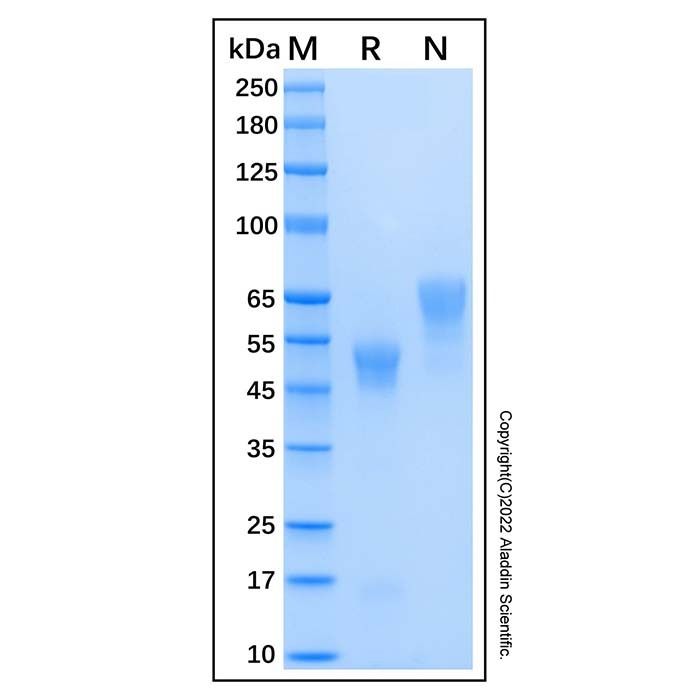
50.3 kDa, under reducing conditions; 69.4 kDa, under non-reducing conditions.
分子类型
蛋白质
产品线
生物产品
储存与运输
物理形态
冻干(Lyophilized)
储存缓冲液
Lyophilized from 20 mM MES, 150 mM NaCl, 0.2 mM CaCl2, pH 5.5.
浓度
见COA
复溶
We recommend that this vial be briefly centrifuged prior to opening to bring the contents to the bottom. Reconstitute at 1.0 mg/mL in sterile distilled water. Stock solutions should be apportioned into working aliquots and stored at ≤ -20 °C. Further dilutions should be made in appropriate buffered solutions.
储存条件
-20°C储存,避免反复冻融
运输条件
超低温运输
稳定性与储存
Store at -20°C for 1 year. Avoid freeze/thaw cycle.
图片
Recombinant Human Coagulation Factor Xa Protein (rp184033) - SDS-PAGE 3 μg/lane of Recombinant HumanCoagulation Factor Xa Protein was resolved with SDS-PAGE under reducing (R) and non-reducing (N) conditions and visualized by Coomassie® Blue staining, showing a band at 50.3 kDa under reducing conditions and 69.4 kDa under non-reducing conditions.

 ZJ25F0319620


 危险品化学品经营许可证(带存储)