A member of the sulfatase family, GNS is required for the lysosomal degradation of the glycosaminoglycans (GAG) heparan sulfate and keratan sulfate. It hydrolyzes the 6-sulfate group of the N-acetyl-D-glucosamine 6-sulfate units of the GAG. GNS deficiency results in mucopolysaccharidosis type IIID (MPS IIID or Sanfilippo D Syndrome), an inborn error leading to lysosomal accumulation of heparan sulfate. MPS IIID has profound mental deterioration, hyperactivity, and relatively mild somatic manifestations. The deduced amino acid sequence of human GNS consists of a signal peptide (residues 1-36) and a mature chain (residues 37-552) that may be further processed into N-terminal and C-terminal fragments. rhGNS corresponds to the single chain and has sulfatase activity described in Activity Assay Protocol.
Post-translational: The form A (78 kDa) is processed by internal peptidase cleavage to a 32 kDa N-terminal species (form B) and a 48 kDa C-terminal species. The conversion to 3-oxoalanine (also known as C-formylglycine, FGly), of a serine or cysteine residue in prokaryotes and of a cysteine residue in eukaryotes, is critical for catalytic activity.
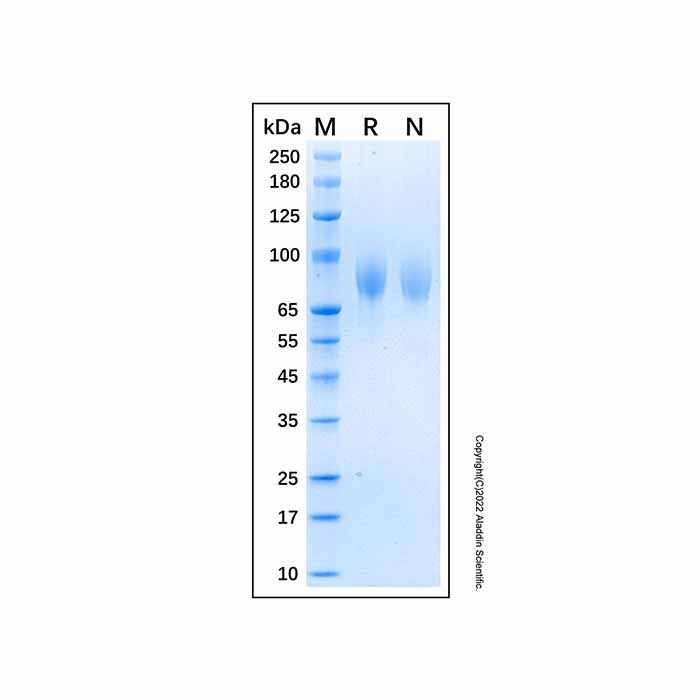
80.6 kDa, under reducing conditions; 80.6 kDa, under non-reducing conditions.
分子类型
蛋白质
产品线
生物产品
储存与运输
物理形态
液体
储存缓冲液
20mM Tris, 150mM NaCl, 10% Glycerol, pH 8.0.
浓度
见COA
储存条件
-20°C储存,避免反复冻融
运输条件
超低温运输
稳定性与储存
Store at -20°C for 1 year. Avoid freeze/thaw cycle.
图片
Recombinant Human GNS Protein (rp184039) - SDS-PAGE 3 μg/lane of Recombinant Human GNS Protein was resolved with SDS-PAGE under reducing (R) and non-reducing (N) conditions and visualized by Coomassie® Blue staining, showing a band at 80.6 kDa.

 ZJ24F1215634


 危险品化学品经营许可证(带存储)