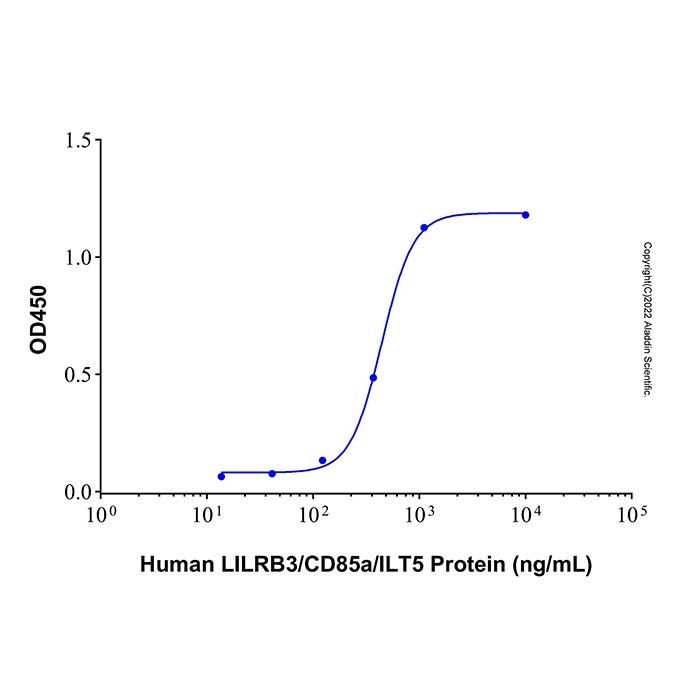
Immobilized Recombinant Human Angiopoietin-like 7/ANGPTL7 Protein (rp142833) at 5.0 μg/mL can bind Recombinant Human LILRB3/CD85a/ILT5 Protein (rp184064) with the EC50 of 444.7 ng/mL.
Leukocyte immunoglobulin-like receptor subfamily B (LILRB3), also known as ILT5, LIR3, and CD85a, is an immunoglobulin superfamily member involved in immune regulation. Subfamily B members have cytoplasmic immunoreceptor tyrosine-based inhibitory motifs (ITIMs) that inhibit signaling events via phosphatase SHP-1. Subfamily A members are activating receptors that lack ITIMs and signal through association with FcR gamma. Mature LILRB3 is a highly polymorphic 85-95 kDa glycoprotein that consists of a 420 amino acid (aa) extracellular domain (ECD) with four Ig-like domains, a 21 aa transmembrane segment, and a 167 aa cytoplasmic domain with three ITIMs. Alternative splicing generates an isoform with a 17 aa insertion in the juxtamembrane ECD. In mouse and rat, the LILRB3 gene encodes the PIR-B protein, which has six Ig-like domains. Rodent PIR-B and human LILRB3 share 55% aa sequence identity within common regions of their ECDs. LILRB3 is expressed on the surface of peripheral monocytes, neutrophils, eosinophils, basophils, and mast cell progenitors. Triggering of LILRB3 inhibits the activation of macrophages, mast cells, neutrophils, basophils, and B cells. On osteoclast precursors, LILRB3 ligation inhibits RANK L/TRANCE or M-CSF induced differentiation. LILRB3 can also bind to ligands exposed on necrotic tumor cells. Both PIR-B and LILRB3 are receptors for S. aureus, and activation of these receptors by bacteria influences the innate immune response triggered by TLRs. R&D Systems in-house testing indicates that LILRB3 binds to Angiopoietin-like 7, consistent with the demonstrated functional interactions between other members of these protein families. In the mouse CNS, PIR-B functions as a receptor for the myelin proteins Nogo, MAG, and OMgp and mediates their inhibitory action on neurite outgrowth and axon regeneration. Upon binding to MAG, PIR-B associates with TrkB and NGF R/p75 in cerebellar granule neurons.
Post-translational: Phosphorylated on tyrosine residues by LYN. Phosphorylation at Tyr-595 and Tyr-625 is important for interaction with PTPN6/SHP-1 and PTPN11/SHP-2.
生物活性
Immobilized Recombinant Human Angiopoietin-like 7/ANGPTL7 Protein (rp142833) at 5.0 μg/mL can bind Recombinant Human LILRB3/CD85a/ILT5 Protein (rp184064) with the EC50 of 444.7 ng/mL.
54.2-71.3kDa, under reducing conditions; 54.2-71.3 kDa, under non-reducing conditions.
分子类型
蛋白质
产品线
生物产品
储存与运输
物理形态
冻干(Lyophilized)
储存缓冲液
Lyophilized from PBS, pH 7.4
复溶
We recommend that this vial be briefly centrifuged prior to opening to bring the contents to the bottom. Reconstitute at 1.0 mg/mL in sterile distilled water. Stock solutions should be apportioned into working aliquots and stored at ≤ -20 °C. Further dilutions should be made in appropriate buffered solutions.
储存条件
-20°C储存,避免反复冻融
运输条件
超低温运输
稳定性与储存
Store at -20°C for 1 year. Avoid freeze/thaw cycle.
图片
Recombinant Human LILRB3/CD85a/ILT5 Protein (rp184064) - Binding Activity Immobilized Recombinant Human Angiopoietin-like 7/ANGPTL7 Protein (rp142833) at 5.0 μg/mL can bind Recombinant Human LILRB3/CD85a/ILT5 Protein (rp184064) with the EC50 of 444.7 ng/mL.
Recombinant Human LILRB3/CD85a/ILT5 Protein (rp184064) - SDS-PAGE 3 μg/lane of Recombinant Human LILRB3/CD85a/ILT5 Protein was resolved with SDS-PAGE under reducing (R) and non-reducing (N) conditions and visualized by Coomassie® Blue staining, showing a band at 54.2-71.3 kDa under reducing conditions and non-reducing conditions.

 ZJ24F1215382


 危险品化学品经营许可证(带存储)