p70S6K is responsible for the phosphorylation of 40S ribosomal protein S6 and is ubiquitously expressed in human adult tissues. p70S6K is activated by serum stimulation and this activation is inhibited by wortmannin and rapamycin. p70S6K activity undergoes changes in the cell cycle and increases 20-fold in G1 cells released from G0. p70S6K activation requires sequential phosphorylations at proline-directed residues in the putative autoinhibitory pseudosubstrate domain, as well as at T389, a site phosphorylated by phosphoinositide-dependent kinase 1 (PDK-1).
Post-translational: Phosphorylation at Thr-412 is regulated by mTORC1. The phosphorylation at this site is maintained by an agonist-dependent autophosphorylation mechanism (PubMed:18925875, PubMed:19085255, PubMed:22017876, PubMed:23429703, PubMed:29236692).Activated by phosphorylation at Thr-252 by PDPK1 (PubMed:19864428, PubMed:9445476). Dephosphorylation by PPP1CC at Thr-412 in mitochondrion (PubMed:17936702).
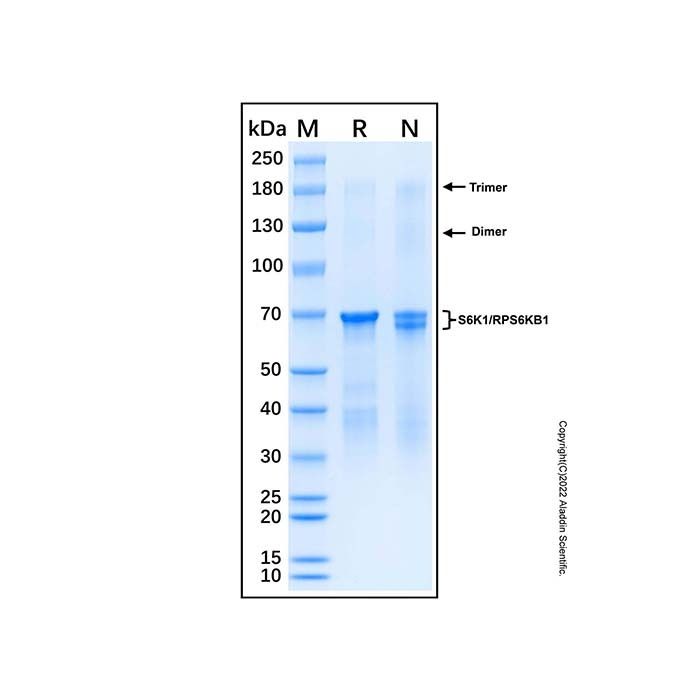
Recombinant Human p70 S6 Kinase Protein (rp184102) - SDS-PAGE 2 μg/lane of Recombinant Human p70 S6 Kinase Protein was resolved with SDS-PAGE under reducing (R) and non-reducing (N) conditions and visualized by Coomassie® Blue staining, showing a band at 69.0 & 128.0 & 183.4 kDa under reducing conditions and 65.8 & 70.3 & 120.2 & 183.4 kDa under non-reducing conditions. p70 S6 Kinase activity is highly dependent on phosphorylation. Different phosphorylation states can result in slight differences in molecular weight or changes in migration rate (such as band smearing or slight shifts) (PMID: 23731517).

 ZJ25F0622564


 危险品化学品经营许可证(带存储)