3-phosphoinositide-dependent protein kinase 1 | 3-phosphoinositide-dependent protein kinase 2 pseudogene | PDK1 | PDK-1 | PDPK1 | PDPK2 | PDPK2P | PkB kinase like gene 1 | PKB kinase
规格或纯度
无载体,His标签,≥95%(SDS-PAGE),见COA
生化机理
PDK-1 (3-phosphoinositide-dependent protein kinase) is activated by the presence of PtdIns P3 or PtdIns P2. PDK‑1 then activates protein kinase B (PKB) that, in turn, inactivates glycogen synthase kinase-3 (GSK-3). The phosphorylation of other proteins by PKB and GSK-3 is likely to mediate many of the intracellular actions of insulin. Thus, PDK‑1 plays a key role in mediating many of the actions of the second messenger(s) PtdIns P3 and/or PtdIns P2. Human PDK‑1 is a 556 amino acid residue monomeric enzyme comprised of a catalytic domain that is most similar to the PKA, PKB, and PKC subfamily of protein kinases.
Post-translational: Phosphorylated on tyrosine and serine/threonine. Phosphorylation on Ser-241 in the activation loop is required for full activity. PDK1 itself can autophosphorylate Ser-241, leading to its own activation.
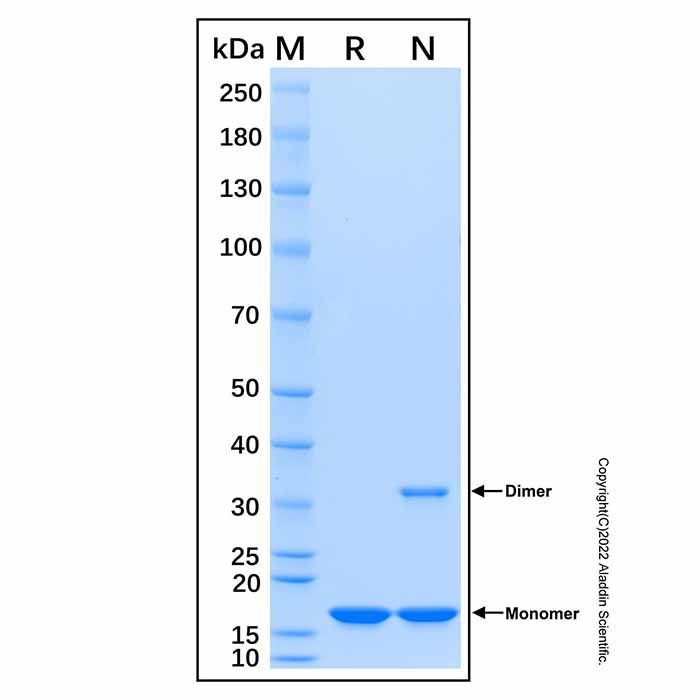
16.4 kDa, under reducing conditions; 16.6 & 31.8 kDa, under non-reducing conditions.
分子类型
蛋白质
产品线
生物产品
储存与运输
物理形态
冻干(Lyophilized)
储存缓冲液
Lyophilized from 20mM Tris, 500mM NaCl, pH 8.0.
浓度
见COA
复溶
We recommend that this vial be briefly centrifuged prior to opening to bring the contents to the bottom. Reconstitute at 1.0 mg/mL in sterile distilled water. Stock solutions should be apportioned into working aliquots and stored at ≤ -20 °C. Further dilutions should be made in appropriate buffered solutions.
储存条件
-20°C储存,避免反复冻融
运输条件
超低温运输
稳定性与储存
-20℃保存 6 个月;复溶后建议分装,避免反复冻融。
图片
Recombinant Human PDK1 Protein (rp184107) - SDS-PAGE 3 μg/lane of Recombinant Human PDK1 Protein was resolved with SDS-PAGE under reducing (R) and non-reducing (N) conditions and visualized by Coomassie® Blue staining, showing a band at 16.4 kDa under reducing conditions and 16.6 & 31.8 kDa under non-reducing conditions. The observation of PDK1 Protein as both dimers and monomers under non-reducing (NR) conditions suggests that a portion of the protein forms dimers. This dimerization may be mediated by (or stabilized by) disulfide bonds (Uniprot: O15530).



 危险品化学品经营许可证(带存储)