cell cycle regulated protein kinase | EC 2.7.11 | EC 2.7.11.21 | PLK | PLK1 | PLK-1 | polo (Drosophia)-like kinase | polo like kinase | polo-like kinase 1polo-like kinase (Drosophila) | Serine/threonine-protein kinase 13 | serine/threonine-protein kinase
规格或纯度
无载体,His标签,≥90%(SDS-PAGE),见COA
生化机理
PLK1 is a member of the Polo-Like Kinase family that localizes to centrosomes or spindle pole bodies and undergoes dramatic subcellular relocation during the cell cycle. Deregulated activities of PLKs often result in abnormalities in centrosome duplication, maturation, and/or microtubule dynamics. PLKs also regulate the function of the Golgi complex. Deregulated expression of human PLK1 is strongly correlated with the development of many types of malignancies, and ectopic expression of PLK1 dominant negative protein leads to rapid cell death.
Post-translational: Catalytic activity is enhanced by phosphorylation of Thr-210. Phosphorylation at Thr-210 is first detected on centrosomes in the G2 phase of the cell cycle, peaks in prometaphase and gradually disappears from centrosomes during anaphase. Dephosphorylation at Thr-210 at centrosomes is probably mediated by protein phosphatase 1C (PP1C), via interaction with PPP1R12A/MYPT1. Autophosphorylation and phosphorylation of Ser-137 may not be significant for the activation of PLK1 during mitosis, but may enhance catalytic activity during recovery after DNA damage checkpoint. Phosphorylated in vitro by STK10.Ubiquitinated by the anaphase promoting complex/cyclosome (APC/C) in anaphase and following DNA damage, leading to its degradation by the proteasome. Ubiquitination is mediated via its interaction with FZR1/CDH1. Ubiquitination and subsequent degradation prevents entry into mitosis and is essential to maintain an efficient G2 DNA damage checkpoint. Monoubiquitination at Lys-492 by the BCR(KLHL22) ubiquitin ligase complex does not lead to degradation: it promotes PLK1 dissociation from phosphoreceptor proteins and subsequent removal from kinetochores, allowing silencing of the spindle assembly checkpoint (SAC) and chromosome segregation.
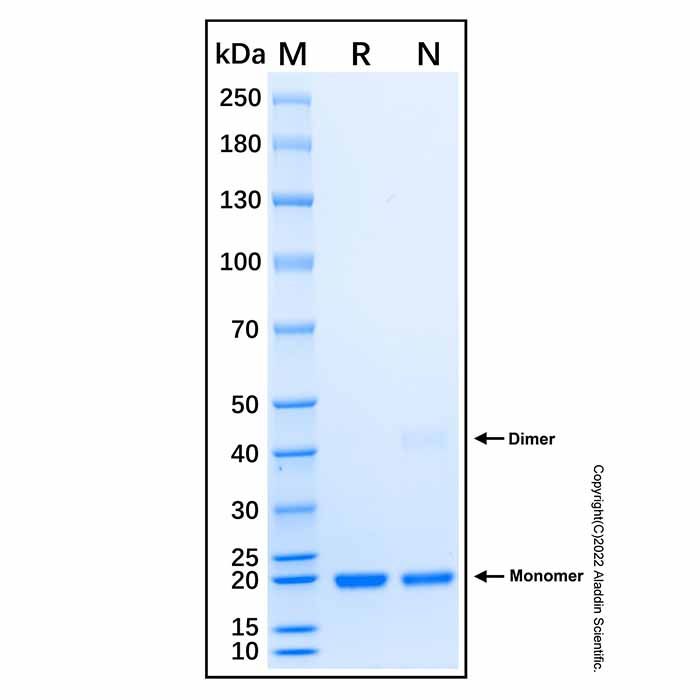
Recombinant Human PLK1 Protein (rp184108) - SDS-PAGE 3 μg/lane of Recombinant Human PLK1 Protein was resolved with SDS-PAGE under reducing (R) and non-reducing (N) conditions and visualized by Coomassie® Blue staining, showing a band at 19.9 kDa under reducing conditions and 19.9 & 42.8 kDa under non-reducing conditions. PLK1 and its subdomains undergo dimerization in vitro (PMID: 37488194).

 ZJ25F0826154


 危险品化学品经营许可证(带存储)