APG 5 | APG 5L | APG5 | APG5 autophagy 5 like | APG5 like | APG5-like | APG5L | Apoptosis specific protein | Apoptosis-specific protein | ASP | ATG 5 | Atg5 | ATG5 autophagy related 5 homolog | ATG5_HUMAN | Autophagy protein 5 | Autophagy related 5 | hAPG
规格或纯度
无载体,His标签,≥95%(SDS-PAGE),见COA
生化机理
Involved in autophagic vesicle formation. Conjugation with ATG12, through a ubiquitin-like conjugating system involving ATG7 as an E1-like activating enzyme and ATG10 as an E2-like conjugating enzyme, is essential for its function. The ATG12-ATG5 conjugate acts as an E3-like enzyme which is required for lipidation of ATG8 family proteins and their association to the vesicle membranes. Involved in mitochondrial quality control after oxidative damage, and in subsequent cellular longevity. The ATG12-ATG5 conjugate also negatively regulates the innate antiviral immune response by blocking the type I IFN production pathway through direct association with RARRES3 and MAVS. Also plays a role in translation or delivery of incoming viral RNA to the translation apparatus. Plays a critical role in multiple aspects of lymphocyte development and is essential for both B and T lymphocyte survival and proliferation. Required for optimal processing and presentation of antigens for MHC II. Involved in the maintenance of axon morphology and membrane structures, as well as in normal adipocyte differentiation. Promotes primary ciliogenesis through removal of OFD1 from centriolar satellites and degradation of IFT20 via the autophagic pathway. May play an important role in the apoptotic process, possibly within the modified cytoskeleton. Its expression is a relatively late event in the apoptotic process, occurring downstream of caspase activity. Plays a crucial role in IFN-gamma-induced autophagic cell death by interacting with FADD.
Post-translational: Conjugated to ATG12; which is essential for autophagy, but is not required for association with isolation membrane. Acetylated by EP300.
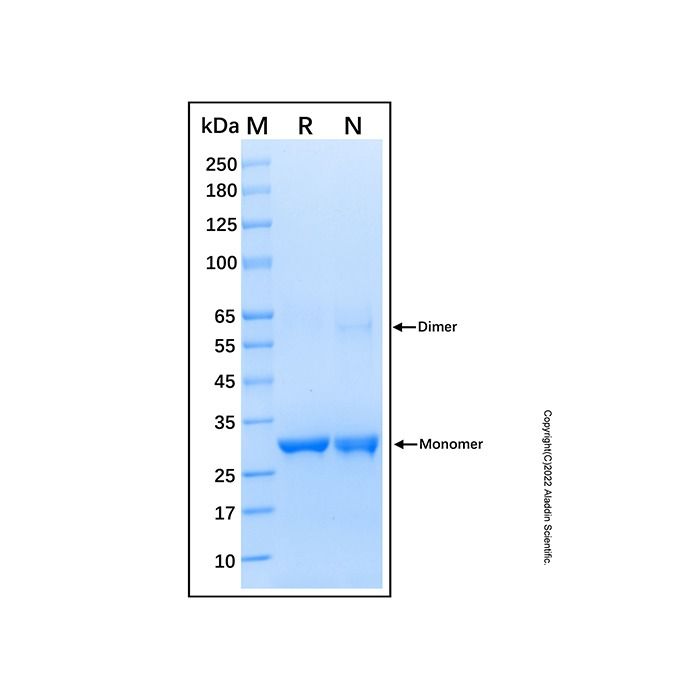
29.8 kDa, under reducing conditions; 29.9 & 61.3 kDa, under non-reducing conditions.
分子类型
蛋白质
产品线
生物产品
储存与运输
物理形态
冻干(Lyophilized)
储存缓冲液
Lyophilized from 20mM Tris, 500mM NaCl, 8M Urea, 35 mM imidazole, pH 8.0.
浓度
见COA
复溶
We recommend that this vial be briefly centrifuged prior to opening to bring the contents to the bottom. Reconstitute at 1.0 mg/mL in sterile distilled water. Stock solutions should be apportioned into working aliquots and stored at ≤ -20 °C. Further dilutions should be made in appropriate buffered solutions.
储存条件
-20°C储存,避免反复冻融
运输条件
超低温运输
稳定性与储存
Store at -20°C for 1 year. Avoid freeze/thaw cycle.
图片
Recombinant Human APG5L/ATG5 Protein (rp184113) - SDS-PAGE 3 μg/lane of Recombinant Human APG5L/ATG5 Protein was resolved with SDS-PAGE under reducing (R) and non-reducing (N) conditions and visualized by Coomassie® Blue staining, showing a band at 29.8 kDa under reducing conditions and 29.9 & 61.3 kDa under non-reducing conditions. ATG7 functions as a homodimer, and it has two ATP-binding sites and two catalytic cysteines, ATG5 may have similar functions to ATG7 (PMID: 19236009).

 ZJ25F0521159


 危险品化学品经营许可证(带存储)