
计算溶液所需的质量、体积或浓度。
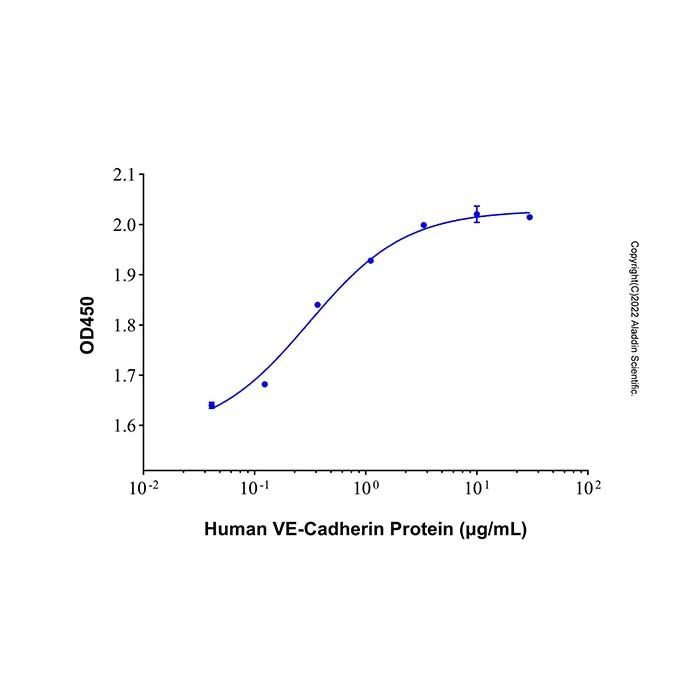
Recombinant Human VE-Cadherin Protein (rp184119) - Protein Bioactivity
Measured by the ability of the immobilized protein to support the adhesion of HUVEC cells. The ED50 for this effect is 308.4 ng/mL.
ActiBioPure™,His标签,PBS Only,无动物源,无载体,生物活性,高性能 级 提供 ≥90%(SDS-PAGE) 纯度,适用于对基线干扰要求严格的色谱和分析工作流程。
-20°C储存,避免反复冻融。超低温运输 。请查阅批次 COA 获取详细规格。
SDS、COA、产品数据表及规格说明书均可下载。可通过批号查询获取批次 COA。
在色谱分析、有机合成和交叉偶联反应领域已被 0 篇同行评审文献引用。
Cadherins (Calcium dependent adhesion molecules) are a class of transmembrane proteins. Cadherin-5, also known as VE-cadherin, CDH5 and CD144, an endothelial specific cell-cell adhesion molecule, plays a pivotal role in the formation, maturation and remodeling of the vascular wall. VE-Cadherin is widely considered to be specific for vascular endothelia in which it is either the sole or the predominant cadherin, often co-existing with N-cadherin. This specificity of VE-cadherin for vascular endothelial cells is important not only in blood and lymph vessel biology and medicine, but also for cell-type-based diagnoses, notably those of metastatic tumors. As a classical cadherin, VE-Cadherin links endothelial cells together by homophilic interactions mediated by its extracellular part and associates intracellularly with the actin cytoskeleton via catenins. Mechanisms that regulate VE-cadherin-mediated adhesion are important for the control of vascular permeability and leukocyte extravasation. In addition to its adhesive functions, VE-Cadherin regulates various cellular processes such as cell proliferation and apoptosis and modulates vascular endothelial growth factor receptor functions. Consequently, VE-cadherin is essential during embryonic angiogenesis.
Recombinant Human VE-Cadherin Protein (rp184119) - Protein Bioactivity
Measured by the ability of the immobilized protein to support the adhesion of HUVEC cells. The ED50 for this effect is 308.4 ng/mL.
Recombinant Human VE-Cadherin Protein (rp184119) - Protein Bioactivity
Measured by the ability of the immobilized protein to support the adhesion of HUVEC human umbilical vein endothelial cells, When 3 x 10⁴ cells per well are added to Recombinant Human VE-Cadherin Protein (rp184119) coated plates (370 ng/mL, 100 μL/well) can significantly improve cells adhesion.
Recombinant Human VE-Cadherin Protein (rp184119) - SDS-PAGE
3 μg/lane of Recombinant Human VE-Cadherin Protein was resolved with SDS-PAGE under reducing (R) and non-reducing (N) conditions and visualized by Coomassie® Blue staining, showing a band at 82.0-98.0 kDa.
通过匹配包装上的批号来查找并下载产品的 COA,每批产品都进行了严格的验证,您可放心使用!
| 批号(Lot Number) | 证书类型 | 货号 |
|---|---|---|
 ZJ25F1028365 |
分析证书 | rp184119 |
| ZJ25F1028366 |
分析证书 | rp184119 |
| ZJ25F1028367 |
分析证书 | rp184119 |
我们的级别选择指南涵盖了目录中所有的变体的纯度、稳定剂状态和应用适用性。
查看 Animal Free 级别指南 → 查看 Carrier Free 级别指南 → 查看 Bioactive 级别指南 → 查看 ActiBioPure™ 级别指南 → 查看 High Performance 级别指南 → 查看 His Tag 级别指南 → 查看 PBS Only 级别指南 →

 危险品化学品经营许可证(带存储)