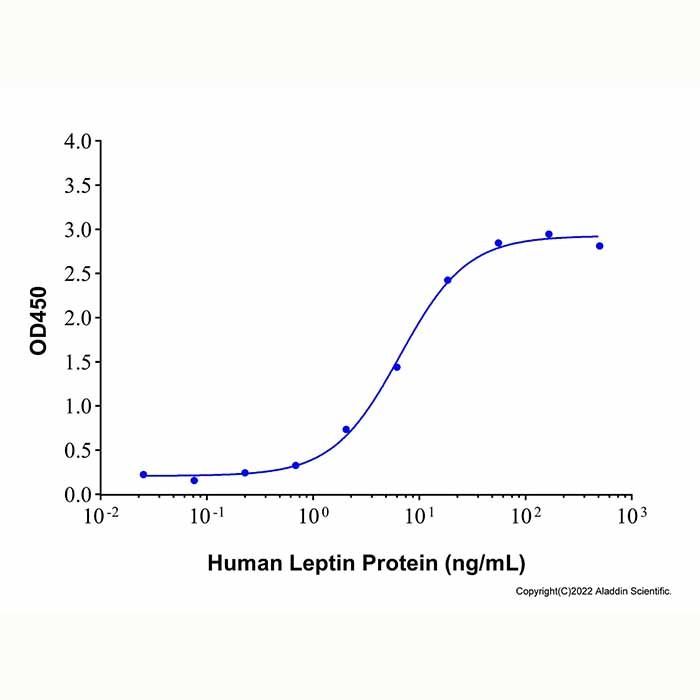
Immobilized Recombinant Human Leptin Receptor Protein (rp184128) at 2.0 μg/mL can bind Recombinant Human Leptin Protein (rp170412) with the EC50 of 6.6 ng/mL.
The Leptin receptor (Leptin R, gene name LEPR), also called OB R (obesity receptor), is a 150 kDa protein that is a member of the Class I cytokine receptor family. It mediates the activities of Leptin, a multi-functional hormone produced primarily by adipose tissues that plays roles in food intake, energy metabolism, angiogenesis, reproduction, hematopoiesis, bone metabolism, and immune function. The human Leptin R gene encodes 1165 amino acids (aa) including a signal peptide, an extracellular region with cytokine receptor homology (CRH), multiple fibronectin type III domains and a WSXWS motif, a transmembrane domain, and a cytoplasmic domain that supports JAK/STAT signaling. Human Leptin R shares 76% aa sequence identity with mouse and rat Leptin R, and 83-86% with bovine, canine, equine and porcine Leptin R. Leptin R isoforms include a long form, OB RL or OB Rb (primary signaling form), and at least four shorter isoforms with truncated cytoplasmic domains, named OB Ra (ubiquitous), Rc, Rd, and Rf. A soluble isoform, OB Re, is found in rodents but not humans. However, both humans and rodents produce soluble Leptin R due to release of soluble ectodomains by metalloproteinases such as ADAM10. OB Rb is highly expressed in the hypothalamus and mediates the anti-orexigenic effects of Leptin. Mutations of ObRb have caused extreme obesity in humans, mice (db/db “diabetes”), and rats (Zucker fa/fa “fatty”). Shorter isoforms of Leptin R exhibit limited signaling capability, but mediate endocytosis and degradation of Leptin and passage through the blood-brain barrier. Soluble Leptin R is the primary Leptin-binding protein in blood, where it maintains a pool of available bioactive Leptin, delays Leptin clearance from circulation, and down-regulates blood-brain transmission of Leptin. In humans, soluble Leptin R levels are inversely proportional to adiposity and are elevated in females versus males. Soluble Leptin R is also found up-regulated in patients with chronic heart failure, end-stage renal disease, and anorexia. It is expressed by tumor-initiating stem cells and is proposed as a link between cancer and obesity.
Post-translational: On ligand binding, phosphorylated on two conserved C-terminal tyrosine residues (isoform B only) by JAK2. Tyr-986 is required for complete binding and activation of PTPN11, ERK/FOS activation,for interaction with SOCS3 and SOCS3 mediated inhibition of leptin signaling. Phosphorylation on Tyr-1141 is required for STAT3 binding/activation. Phosphorylation of Tyr-1079 has a more accessory role.
生物活性
Immobilized Recombinant Human Leptin Receptor Protein (rp184128) at 2.0 μg/mL can bind Recombinant Human Leptin Protein (rp170412) with the EC50 of 6.6 ng/mL.
122.8-150.7 kDa, under reducing conditions; 122.8-150.7 kDa, under non-reducing conditions.
分子类型
蛋白质
产品线
生物产品
储存与运输
物理形态
冻干(Lyophilized)
储存缓冲液
Lyophilized from PBS, pH 7.4
复溶
We recommend that this vial be briefly centrifuged prior to opening to bring the contents to the bottom. Reconstitute at 0.5 mg/mL in sterile distilled water. Stock solutions should be apportioned into working aliquots and stored at ≤ -20 °C. Further dilutions should be made in appropriate buffered solutions.
储存条件
-20°C储存,避免反复冻融
运输条件
超低温运输
稳定性与储存
Store at -20°C for 1 year. Avoid freeze/thaw cycle.
图片
Recombinant Human Leptin Receptor Protein (rp184128) - Binding Activity Immobilized Recombinant Human Leptin Receptor Protein (rp184128) at 2.0 μg/mL can bind Recombinant Human Leptin Protein (rp170412) with the EC
₅₀
of 6.6 ng/mL.
Recombinant Human Leptin Receptor Protein (rp184128) - SDS-PAGE 3 μg/lane of Recombinant Human Leptin Receptor Protein was resolved with SDS-PAGE under reducing (R) and non-reducing (N) conditions and visualized by Coomassie® Blue staining, showing a band at 122.8-150.7 kDa.

 ZJ24F1114388


 危险品化学品经营许可证(带存储)