A170 | DMRV | EBI 3 associated protein of 60 kDa | EBI 3 associated protein p60 | EBI3 associated protein of 60 kDa | EBI3 associated protein p60 | EBI3-associated protein of 60 kDa | EBIAP | FTDALS3 | MGC127197 | ORCA | OSF-6 | Osi | OSIL | Oxidative str
规格或纯度
无载体,His标签,≥90%(SDS-PAGE),见COA
生化机理
Adapter protein which binds ubiquitin and may regulate the activation of NFKB1 by TNF-alpha, nerve growth factor (NGF) and interleukin-1. May play a role in titin/TTN downstream signaling in muscle cells. May regulate signaling cascades through ubiquitination. Adapter that mediates the interaction between TRAF6 and CYLD (By similarity). May be involved in cell differentiation, apoptosis, immune response and regulation of K(+) channels.
Post-translational: Phosphorylation at Ser-407 by ULK1 destabilizes the UBA dimer interface and increases binding affinity to ubiquitinated proteins (By similarity). Phosphorylation at Ser-407 also primes for subsequent phosphorylation at Ser-403 (By similarity). Phosphorylation at Ser-403 by CK2 or ULK1 promotes binding to ubiquitinated proteins by increasing the affinity between the UBA domain and polyubiquitin chains (PubMed:22017874, PubMed:25040165). Phosphorylation at Ser-403 by ULK1 is stimulated by SESN2 (PubMed:25040165). Phosphorylated at Ser-403 by TBK1, leading to promote relocalization of 'Lys-63'-linked ubiquitinated STING1 to autophagosomes (PubMed:29496741). Phosphorylation at Ser-349 by ULK1 promotes interaction with KEAP1 and inactivation of the BCR(KEAP1) complex, promoting NFE2L2/NRF2 nuclear accumulation and expression of phase II detoxifying enzymes (PubMed:37306101). Phosphorylated in vitro by TTN (PubMed:15802564). Ubiquitinated by UBE2J1 and RNF26 at Lys-435: ubiquitinated SQSTM1 attracts specific vesicle-associated adapters, forming a molecular bridge that restrains cognate vesicles in the perinuclear region and organizes the endosomal pathway for efficient cargo transport (PubMed:27368102, PubMed:33472082). Ubiquitination by UBE2D2 and UBE2D3 increases its ability to bind polyubiquitin chains by destabilizing the UBA dimer interface (PubMed:28322253). Deubiquitination by USP15 releases target vesicles for fast transport into the cell periphery (PubMed:27368102). Ubiquitinated by the BCR(KEAP1) complex at Lys-420, increasing SQSTM1 sequestering activity and promoting its degradation (PubMed:28380357). Ubiquitinated via 'Lys-29' and 'Lys-33'-linked polyubiquitination leading to xenophagic targeting of bacteria and inhibition of their replication (PubMed:27880896). Acetylated at Lys-420 and Lys-435 by KAT5/TIP60, promotes activity by destabilizing the UBA dimer interface and increases binding affinity to ubiquitinated proteins (PubMed:31857589). Deacetylated by HDAC6 (PubMed:31857589). Palmitoylation at Cys-289 and Cys-290 by ZDHHC19 is required for efficient autophagic degradation of SQSTM1-cargo complexes by promoting affinity for ATG8 proteins and recruitment of p62 bodies to autophagosomes (PubMed:37802024).
Dealmitoylated at Cys-289 and Cys-290 by LYPLA1 (PubMed:37802024). Microbial infection) Cleaved by S.pyogenes SpeB protease; leading to its degradation (PubMed:24331465). Degradation by SpeB prevents autophagy, promoting to S.pyogenes intracellular replication (PubMed:24331465). (Microbial infection) Deubiquitinated by Epstein-Barr virus BPLF1; leading to inhibition of the recruitment of MAP1LC3A/LC3 to SQSTM1-positive structures.
Store at -20℃ for 6 months. Upon reconstitution, it is recommended to aliquot. Avoid freeze/thaw cycle.
图片
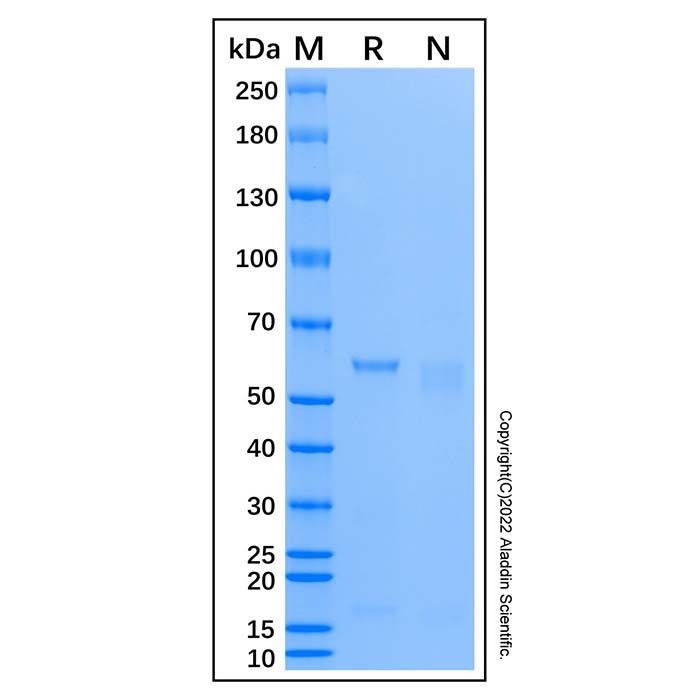
Recombinant Human SQSTM1/p62 Protein (rp184135) - SDS-PAGE 2 μg/lane of Recombinant Human SQSTM1/p62 Protein was resolved with SDS-PAGE under reducing (R) and non-reducing (N) conditions and visualized by Coomassie® Blue staining, showing a band at 58.3 kDa under reducing conditions and 57.2 kDa under non-reducing conditions.



 危险品化学品经营许可证(带存储)