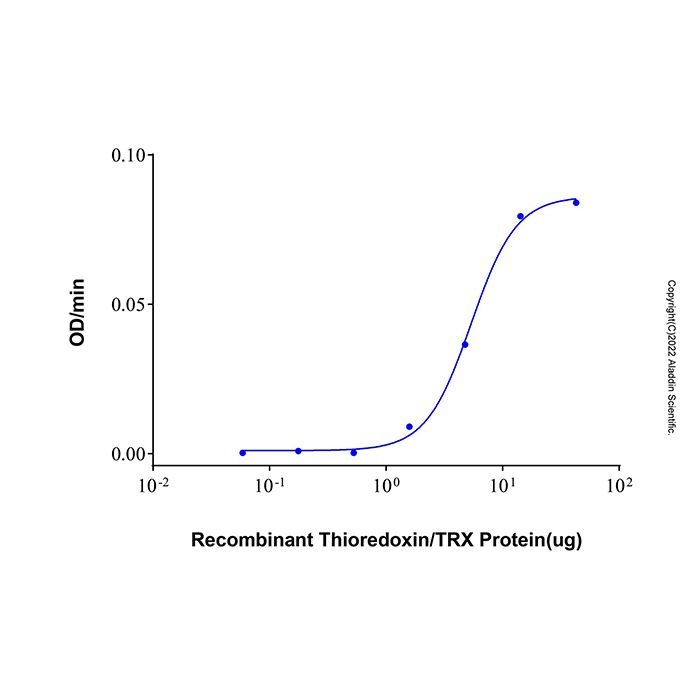
Measured by its ability to catalyze the reduction of insulin. The reaction leads to precipitation, which can be measured by absorbance at 650 nm. The specific activity is >10 A650/min/mg, as measured under the described conditions.
Thioredoxins (Trxs) are a group of small ubiquitous proteins in all living cells that are key regulators of cellular redox balance. The mammalian Trx family has three members. The Trx-1, which is a secreted and cellular protein, the mitochondria-specific Trx-2, and the Trx-like cytosolic protein p32TrxL. The active site of mammalian Trxs contains two cysteines in the conserved sequence -Y-C-G-P-C-K-. In Trx-1 the conserved cysteine residues are in positions 32 and 35, respectively. Trxs exist either in a reduced or in an oxidized state when the two cysteines at the active site form an intramolecular disulfide bridge. NADPH and the flavoprotein thioredoxin reductase can convert the oxidized Trx into the reduced Trx. Trx-1 is the only extracellular occurring thioredoxin, and is secreted by lymphocytes, hepatocytes, fibroblasts, and several tumor cells. Plasma concentrations of Trx-1 are up to 6 nM. In cells, Trx-1 is localized predominantly in the cytoplasm. Small amounts have been detected in the nucleus and in association with the outside surface of the cells. Expression of Trx-1 is increased under various stress conditions such as hypoxia, elevated hydrogen peroxide concentrations, photochemical oxidative stress, and viral and bacterial infections. Biological functions of Trx-1 include growth factor activity, antioxidant properties, a cofactor that provides reducing equivalents, and transcriptional regulation. The synovial tissue of rheumatoid arthritis patients produces increased levels of Trx-1 under oxidative stress conditions, and a correlation exists between the plasma levels of Trx-1 and the severity of the disease, making Trx-1 a biomarker for this pathological condition.
Post-translational: In the fully reduced protein, both Cys-69 and Cys-73 are nitrosylated in response to nitric oxide (NO). When two disulfide bonds are present in the protein, only Cys-73 is nitrosylated. Cys-73 can serve as donor for nitrosylation of target proteins. In case of infection, ubiquitinated by S.typhimurium protein slrP, leading to its degradation.
生物活性
Measured by its ability to catalyze the reduction of insulin. The reaction leads to precipitation, which can be measured by absorbance at 650 nm. The specific activity is >10 A650/min/mg, as measured under the described conditions.
28.5 kDa, under reducing conditions; 28.5 kDa, under non-reducing conditions.
分子类型
蛋白质
产品线
生物产品
储存与运输
物理形态
冻干(Lyophilized)
储存缓冲液
Lyophilized from PBS, pH 7.4
浓度
见COA
复溶
We recommend that this vial be briefly centrifuged prior to opening to bring the contents to the bottom. Reconstitute at 1.0 mg/mL in sterile distilled water. Stock solutions should be apportioned into working aliquots and stored at ≤ -20 °C. Further dilutions should be made in appropriate buffered solutions.
储存条件
-20°C储存,避免反复冻融
运输条件
超低温运输
稳定性与储存
-20℃保存 12个月;复溶后建议分装,避免反复冻融。
图片
Recombinant Human Thioredoxin-1 Protein - Enzyme Activity Measured by its ability to catalyze the reduction of insulin. The reaction leads to precipitation, which can be measured by absorbance at 650 nm. The specific activity is >10 A650/min/mg, as measured under the described conditions. Materials: Assay Buffer: 50 mM MES, 250 mM NaCl, 2 mM EDTA, pH 6.5 Recombinant Human Thioredoxin-1 Protein (rp184858) Human Insulin (rp218456), Dithiothreitol (DTT) (D301909), 1 M stock in deionized water Procedures: 1. Dilute rhTRX-1 to 20 µM in Assay Buffer. 2. Dilute hInsulin to 520 µM in Assay Buffer. 3. Dilute DTT to 55 mM in Assay Buffer. 4. Load into a clear plate 50 µL of Assay Buffer, 25 µL of 20 µM rhTRX-1, and 25 µL of 520 µM hInsulin. For a Substrate Blank, load 75 µL of Assay Buffer and 25 µL of 520 μM hInsulin. Start the reaction by adding 10 µL of 55 mM DTT to all wells. 5. Read at Abs650 in kinetic mode for 15 minutes. Use the linear portion of the reaction to determine specific activity. 6. Calculate specific activity: Adjusted Vmax* (Abs/min)** Specific Activity (Abs/min/mg) = amount of enzyme (mg) *Adjusted for Substrate Blank **Note: the output of many spectrophotometers in kinetic mode is in mOD. Per Well: rhTRX-1: 0.00585 mg, hInsulin: 118 µm, DTT: 5 mM.
Recombinant Human Thioredoxin-1 Protein (rp184858) - SDS-PAGE 3 μg/lane of Recombinant Human Thioredoxin-1 Protein was resolved with SDS-PAGE under reducing (R) and non-reducing (N) conditions and visualized by Coomassie® Blue staining, showing a band at 28.5 kDa.

 ZJ25F0623417


 危险品化学品经营许可证(带存储)