无载体,生物活性,ActiBioPure™,高性能,His标签,SUMO标签,≥90%(SDS-PAGE),expressed in E. coli, 见 COA
生化机理
Epigen (EPGN) is an epithelial mitogen that belongs to the EGF superfamily. Human Epigen cDNA encodes a 154 amino acid (aa) residue type I transmembrane precursor glycoprotein with a 22 aa signal peptide, an 88 aa extracellular domain, a 21 aa transmembrane domain and a 23 aa cytoplasmic domain. The extracellular domain (aa 23 ‑ 110) contains a pattern of six cysteines typical of EGF family proteins. Potential splice variants of 133, 112, 103, 94 or 73 aa, lacking either N‑terminal sequence (aa 15 or 36 to 44), transmembrane and juxtamembrane sequence (aa 87 or 96 to 137), or sequences in both regions, have been described. In addition to potentially secreted splice variants, Epigen is among several EGF family proteins that can undergo metalloproteinase cleavage to generate a soluble form. Cleavage of Epigen by TACE/ADAM17 has been demonstrated. The mature, shed form of human Epigen (aa 54 ‑ 104) shares 92%, 94% and 94% aa sequence identity with mouse, rat and equine Epigen, respectively, and more than 40% aa identity with corresponding regions of TGF‑ alpha and epiregulin. Epigen mRNA is found in many tissues, but it is mainly expressed in actively proliferating cells within these tissues. For example, Epigen in skin is found mainly in the proliferating root sheath of hair follicles, and transgenic overexpression in the skin causes hyperplasia in sebaceous glands. Epigen is also expressed developmentally and by invasive adenocarcinomas of the breast and prostate. Epigen is strongly mitogenic for epithelial cells and fibroblasts, despite its relatively weak affinity for its main receptor, ErbB1. The mitogenic potential of Epigen is enhanced by its unusually long persistence on the membrane before ubiquitylation and receptor‑mediated depletion.
生物活性
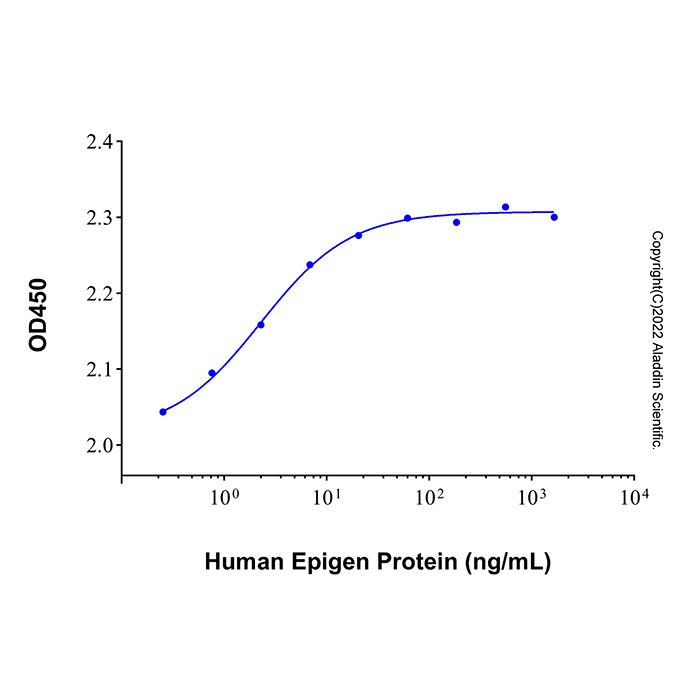
Measured in a cell proliferation assay using Balb/3T3 mouse embryonic fibroblast cells. The ED50 for this effect is 2.3 ng/mL.
16.6 kDa, under reducing conditions; 16.7 & 34.4 kDa, under non-reducing conditions.
分子类型
蛋白质
产品线
生物产品
储存与运输
物理形态
冻干(Lyophilized)
储存缓冲液
Lyophilized from PBS, pH 7.4
浓度
expressed in E. coli, 见 COA
复溶
We recommend that this vial be briefly centrifuged prior to opening to bring the contents to the bottom. Reconstitute at 0.1 mg/mL in sterile distilled water. Stock solutions should be apportioned into working aliquots and stored at ≤ -20 °C. Further dilutions should be made in appropriate buffered solutions.
储存条件
-20°C储存,避免反复冻融
运输条件
超低温运输
稳定性与储存
-20℃保存 12个月;复溶后建议分装,避免反复冻融。
图片
Recombinant Human Epigen Protein (rp184899) - Protein Bioactivity
Measured in a cell proliferation assay using Balb/3T3 mouse embryonic fibroblast cells. The ED50 for this effect is 2.3 ng/mL.
Recombinant Human Epigen Protein (rp184899) - SDS-PAGE
3 μg/lane of Recombinant Human Epigen Protein was resolved with SDS-PAGE under reducing (R) and non-reducing (N) conditions and visualized by Coomassie® Blue staining, showing the bands at 16.6 kDa under reducing conditions and 16.7 & 34.4 kDa under non-reducing conditions.
Disulfide bonds exist in proteins (Uniport: Q6UW88) .

 ZJ26F0333352


 危险品化学品经营许可证(带存储)