DNA dependent protein kinase catalytic subunit | DNA PK catalytic subunit | DNA-dependent protein kinase catalytic subunit | DNA-PK catalytic subunit | DNA-PKcs | DNAPK | DNAPK catalytic subunit | DNPK 1 | DNPK1 | Hyper radiosensitivity of murine scid mut
规格或纯度
无载体,His标签,≥90%(SDS-PAGE),见COA
生化机理
PRKDC encodes for DNA-dependent protein kinase catalytic subunit (DNA-PKcs), a kinase that forms part of a complex (DNA-dependent protein kinase [DNA-PK]) crucial for DNA double-strand break repair and V(D)J recombination. PRKDC expression was significantly increased in breast cancer tissue samples compared with NATs. High PRKDC expression was associated with higher tumor grade (P=0.001), positive lymph node metastasis (P=0.0357) and chemoresistance (P=0.0006). Furthermore, PRKDC expression was significantly correlated with OS in breast cancer patients with (0.0101) or without (P=0.0216) receiving chemotherapy. Collectively, PRKDC is a prognostic biomarker for chemoresistance in breast cancer patients.
Post-translational: Autophosphorylated at two clusters, the T2609 cluster and the S2056 cluster (PubMed:33854234). Autophosphorylated on Ser-2056, Thr-2609, Thr-2638 and Thr-2647 (PubMed:12186630, PubMed:12231622, PubMed:14734805, PubMed:33854234). Ser-2056 and Thr-2609 are DNA damage-inducible phosphorylation sites (inducible with ionizing radiation, IR) dephosphorylated by PPP5C (PubMed:12186630, PubMed:12231622, PubMed:14734805). Autophosphorylation induces a conformational change that leads to remodeling of the DNA-PK complex, requisite for efficient end processing and DNA repair (PubMed:12186630, PubMed:12231622, PubMed:14734805). Autophosphorylation in trans within DNA-PK complexes loaded on DNA ends leads to the dissociation of PRKDC from DNA and the transition into the short-range NHEJ complex (PubMed:33854234). Autophosphorylation of the T2609 cluster is required for hematopoietic development and protein synthesis in erythrocytes precursors (By similarity). S-nitrosylated by GAPDH. Polyubiquitinated by RNF144A, leading to proteasomal degradation.
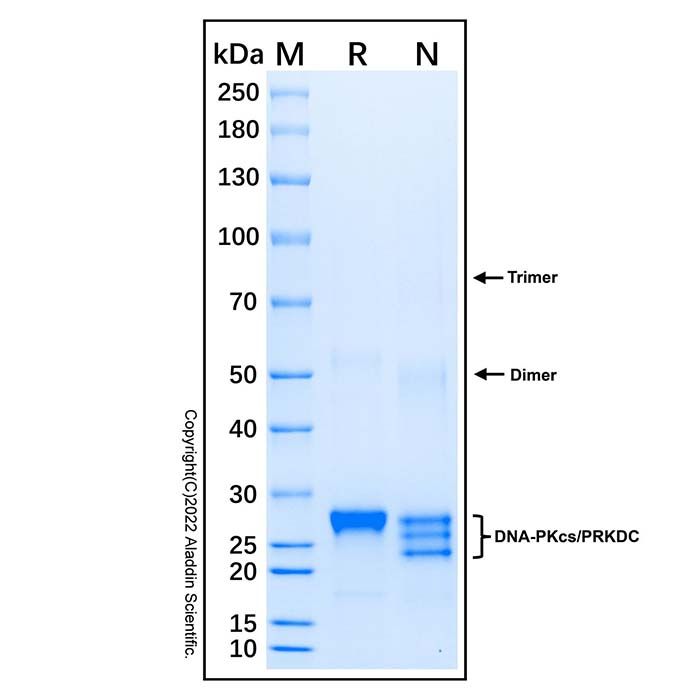
Recombinant Human DNA-PKcs Protein (rp184914) - SDS-PAGE 3 μg/lane of Recombinant Human DNA-PKcs Protein was resolved with SDS-PAGE under reducing (R) and non-reducing (N) conditions and visualized by Coomassie® Blue staining, showing a band at 27.3 & 53.3 & 88.1 kDa under reducing conditions and 23.4 & 26.0 & 27.3 & 49.7 & 75.7 kDa under non-reducing conditions. This expression region contains multiple phosphorylation post-translational modification sites, which may influence its aggregation state. The self phosphorylation of DNA-PKcs induces conformational changes, which leads to the remodeling of the DNA-PK complex. This is essential for efficient end processing and DNA repair (PMID: 33854234).



 危险品化学品经营许可证(带存储)