The galectins constitute a large family of carbohydrate-binding proteins with specificity for N-acetyl-lactosamine-containing glycoproteins. At least 14 mammalian galectins, which share structural similarities in their carbohydrate recognition domains (CRD), have been identified. The galectins have been classified into prototype galectins (-1, -2, -5, -7, -10, -11, -13, -14), which contain one CRD and exist either as a monomer or a noncovalent homodimer; chimera galectins (Galectin-3) containing one CRD linked to a nonlectin domain; and tandem-repeat galectins (-4, -6, -8, -9, -12) consisting of two CRDs joined by a linker peptide. Galectins lack a classical signal peptide and can be localized to the cytosolic compartments where they have intracellular functions. However, via one or more as yet unidentified non-classical secretory pathways, galectins can also be secreted to function extracellularly. Individual members of the galectin family have different tissue distribution profiles and exhibit subtle differences in their carbohydrate-binding specificities. Each family member may preferentially bind to a unique subset of cell-surface glycoproteins. Human Galectin-7 is a prototype monomeric galectin. It is specifically expressed in stratified epithelia, notably in epidermis, but is barely detectable in epidermal tumors and significantly down-regulated or absent from squamous carcinoma cell lines. The Galectin-7 gene is induced by tumor suppressor protein p53 transcriptional activity following genotoxic events. A pro-apoptotic protein, Galectin-7 functions intracellularly upstream of JNK activation and cytochrome-c release. This protein has been shown to increase the susceptibility of keratinocytes to UVB-induced apoptosis, an essential process in the maintenance of epidermal homeostasis. Cell lines transfected with the Galectin-7 gene localized the protein in the nucleus and intracellularly. Human and mouse Galectin-7 share 79% amino acid homology.
We recommend that this vial be briefly centrifuged prior to opening to bring the contents to the bottom. Reconstitute at 1.0 mg/mL in sterile distilled water. Stock solutions should be apportioned into working aliquots and stored at ≤ -20 °C. Further dilutions should be made in appropriate buffered solutions.
储存条件
-20°C储存,避免反复冻融
运输条件
超低温运输
稳定性与储存
Store at -20°C for 1 year. Avoid freeze/thaw cycle.
图片
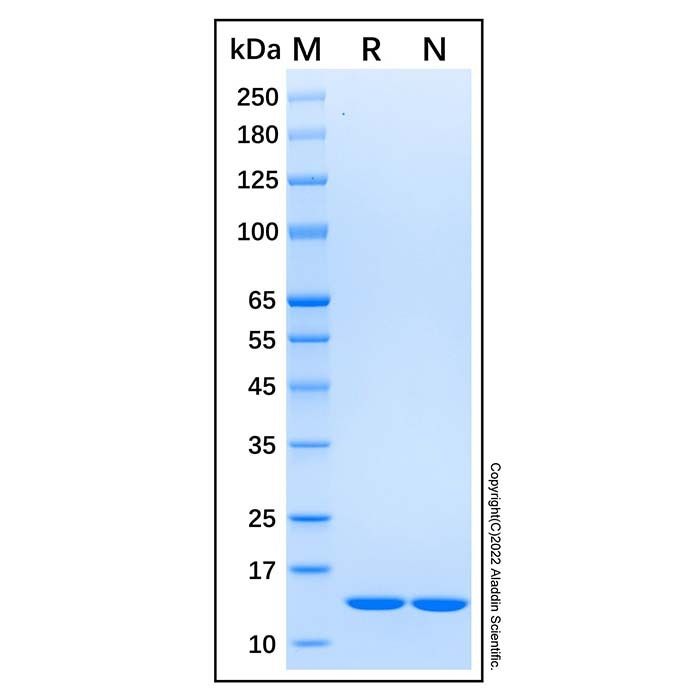
Recombinant Human Galectin-7 Protein (rp184916) - SDS-PAGE 3 μg/lane of Recombinant Human Galectin-7 Protein was resolved with SDS-PAGE under reducing (R) and non-reducing (N) conditions and visualized by Coomassie® Blue staining, showing a band at 13.2 kDa.

 ZJ25F1230339


 危险品化学品经营许可证(带存储)