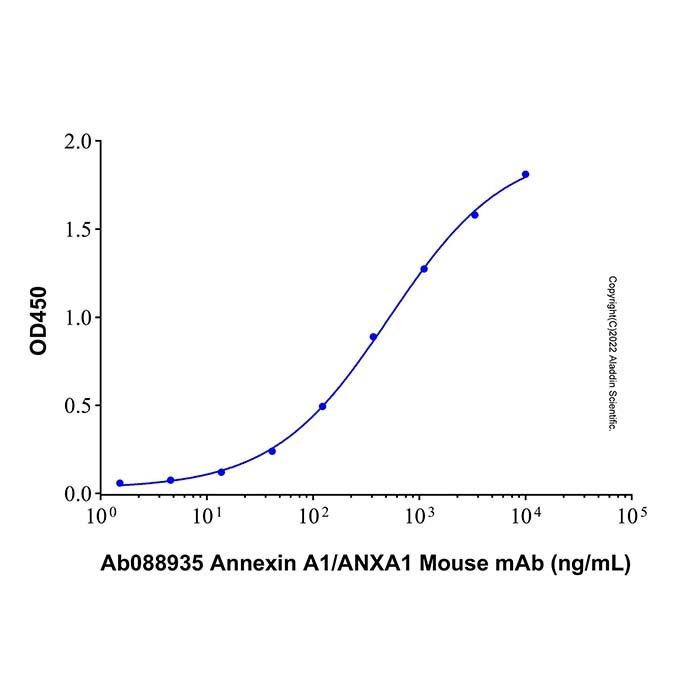
Immobilized Recombinant Human Annexin A1/ANXA1 Protein (rp184917) at 1.0 μg/mL can bind Annexin A1/ANXA1 Mouse mAb (Ab088935) with the EC50 of 520.9 ng/mL.
Annexin A1 | annexin I (lipocortin I) | Annexin I | Annexin-1 | ANX1 | ANXA1 | Calpactin II | calpactin-2 | chromobindin-9 | Lipocortin I | LPC1 | LPC1annexin-1 | p35 | Phospholipase A2 inhibitory protein
规格或纯度
无载体,生物活性,ActiBioPure™,His标签,≥95%(SDS-PAGE)
生化机理
The Annexins comprise a family of proteins that are involved in many aspects of cellular membrane dynamics and the regulation of membrane‑associated proteins. They are characterized by multiple repeats of 60‑70 amino acids (aa) which assemble into a curved disc‑like domain that binds to membrane phospholipids in a calcium‑dependent manner. Human Annexin A1 (ANXA1), also known as Lipocortin 1, Calpactin II, Lipomodulin, and Chromobindin 9, contains four annexin repeats and shares approximately 88% aa sequence identity with mouse and rat Annexin A1. Annexin A1 is found in the cytoplasm, on the cell surface, and in the extracellular fluid. The full length 37 kDa protein is susceptible to intracellular and extracellular proteolytic cleavages which generate various N‑terminal peptides and a truncated C‑terminal portion. In addition to its membrane activities, Annexin A1 is a major effector of glucocorticoid‑induced immune suppression and growth arrest. It associates with S100A11, and this complex inhibits Phospholipase A2 and the production of inflammatory eicosanoids. Annexin A1 is released by apoptotic cells and also during neutrophil adhesion to vascular endothelial cells. It binds the FPRL1/ALX receptor on neutrophils, while the cleaved N‑terminal aa 2‑26 peptide additionally binds FPR. These interactions inhibit leukocyte activation and extravasation to sites of inflammation. In contrast, the 33 kDa molecule (generated by the removal of aa 2‑26) promotes activation of vascular endothelial cells and neutrophil transendothelial migration. Annexin A1 phosphorylation at multiple locations is important for the regulation of its cleavage, membrane interactions, and ability to suppress ACTH production in the pituitary. Annexin A1 additionally regulates adaptive immune responses by enhancing T cell activation and promoting a Th1 bias. It can exert both positive and negative effects on epithelial‑mesenchymal transition and tumor metastasis.
Post-translational: Phosphorylated by protein kinase C, EGFR and TRPM7. Phosphorylated in response to EGF treatment.
生物活性
Immobilized Recombinant Human Annexin A1/ANXA1 Protein (rp184917) at 1.0 μg/mL can bind Annexin A1/ANXA1 Mouse mAb (Ab088935) with the EC50 of 520.9 ng/mL.
37.8 kDa, under reducing conditions; 37.2 kDa, under non-reducing conditions.
分子类型
蛋白质
产品线
生物产品
储存与运输
物理形态
冻干(Lyophilized)
储存缓冲液
Lyophilized from PBS, 10% Trehalose, pH 7.4.
复溶
We recommend that this vial be briefly centrifuged prior to opening to bring the contents to the bottom. Reconstitute at 0.5 mg/mL in sterile distilled water. Stock solutions should be apportioned into working aliquots and stored at ≤ -20 °C. Further dilutions should be made in appropriate buffered solutions.
储存条件
-20°C储存,避免反复冻融
运输条件
超低温运输
稳定性与储存
Store at -20°C for 1 year. Avoid freeze/thaw cycle.
图片
Recombinant Human Annexin A1/ANXA1 Protein (rp184917) - ELISA Immobilized Recombinant Human Annexin A1/ANXA1 Protein (rp184917) at 1.0 μg/mL can bind Annexin A1/ANXA1 Mouse mAb (Ab088935) with the EC₅₀ of 520.9 ng/mL.
Recombinant Human Annexin A1/ANXA1 Protein (rp184917) - SDS-PAGE 3 μg/lane of Recombinant Human Annexin A1/ANXA1 Protein was resolved with SDS-PAGE under reducing (R) and non-reducing (N) conditions and visualized by Coomassie® Blue staining, showing a band at 37.8 kDa under reducing conditions and 37.2 kDa under non-reducing conditions.

 ZJ25F1230344


 危险品化学品经营许可证(带存储)