无载体, 生物活性, ActiBioPure™, ≥95%(SDS-PAGE), expressed in E. coli; 见COA
生化机理
Human Pin 1 is a peptidyl-prolyl cis/trans isomerase (PPIase) that interacts with NIMA and essential for cell cycle regulation Pin1 is nuclear PPIase containing a WW protein interaction domain, and is structurally and functionally related to Ess1/Ptf1, an essential protein in budding yeast. PPIase activity is necessary for Ess1/Pin1 function in yeast. Pin1 is thus an essential PPIase that regulates mitosis presumably by interacting with NIMA and attenuating its mitosis-promoting activity. Substrates of Pin1 include the mitotic regulators (Cdc25 phosphatase and NIMA, PLK I, Wee, and Myt1 kinases), several transcription factors like b-Catenin, c-Jun, and the tumor suppressor protein p53, and some specific proteins like the RNA Pol II, the cytoskeleton protein tau, and the G1/S protein Cyclin D1.
Post-translational: Phosphorylation at Ser-71 by DAPK1 results in inhibition of its catalytic activity, nuclear localization, and its ability to induce centrosome amplification, chromosome instability and cell transformation (PubMed:21497122).Ser-71 is dephosphorylated upon IL33-stimulation of dendritic cells (By similarity)
生物活性
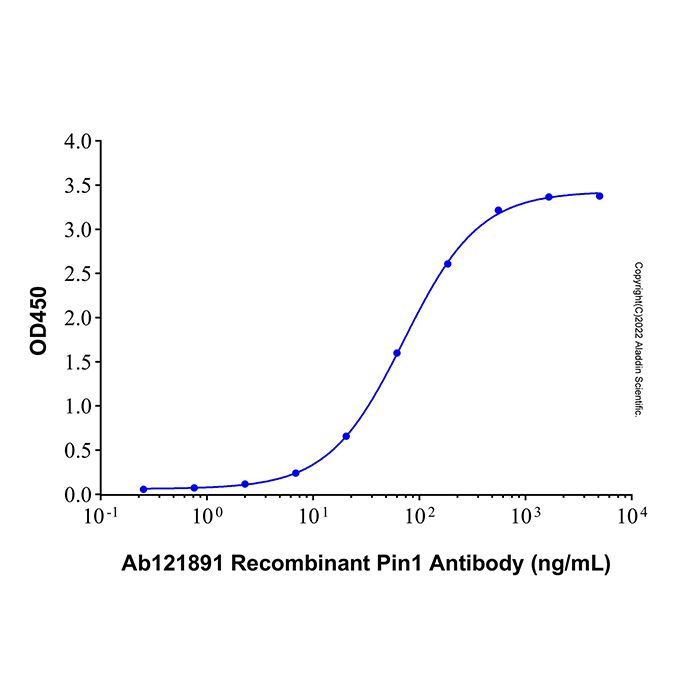
Immobilized Recombinant Human Pin1 Protein (rp184932) at 1.0 μg/mL can bind Recombinant Pin1 Antibody (Ab121891) with the EC50 of 71.76 ng/mL.
Immobilized Recombinant Human Pin1 Protein (rp184932) at 1.0 μg/mL can bind Recombinant Pin1 Antibody (Ab121891) with the EC50 of 71.76 ng/mL.
Recombinant Human Pin1 Protein (rp184932) - SDS-PAGE
3 μg/lane of Recombinant Human Pin1 Protein was resolved with SDS-PAGE under reducing (R) and non-reducing (N) conditions and visualized by Coomassie® Blue staining, showing a band at 16.7 kDa under reducing conditions and 17.0 & 33.0 & 50.0 & 67.3 kDa under non-reducing conditions.
PIN1 forms polymers through its N-terminal WW domain and the flexible hinge region under non-reducing conditions (PMID: 10932246).

 ZJ26F0434785


 危险品化学品经营许可证(带存储)