Measured by its ability to catalyze the formation of S-D-lactoylglutathione from the hemimercaptal adduct that forms spontaneously between methylglyoxal and reduced glutathione. The specific activity is >100 nmol/min/µg, as measured under the described conditions.
Glyoxalase I (also lactoylglutathione lyase, methylglyoxalase, and glx I) is a 21 kDa member of the Glyoxalase I family. The enzyme is an isomerase that catalyzes the formation of S-D-lactoylglutathione from the hemimercaptal adduct that forms spontaneously between methylglyoxal and reduced GSH. The monomeric subunit for human Glyoxalase I is 184 amino acids (aa) in length. In the mature protein, the methionine at the N-terminus is removed. Human Glyoxalase I exists in three separable isoforms as homo-and hetero-dimers of two allelic subunit variants, which differ in charge. The isoforms are formed when residue 19 is changed from cysteine to tyrosine and residue 111 is changed from glutamine to alanine. Each subunit binds one Zn2+ atom. The protein is made up of multiple beta strands and alpha helical regions. Human Glyoxalase I shares 91% and 90% aa sequence identity with rat and mouse Glyoxalase I, respectively. The enzyme is ubiquitously expressed and is also present in many tumor cell lines, in which its concentration is often upregulated. The biological role of the enzyme remains unclear, but the glyoxalase system detoxifies the precursors of advanced glycation end products, which take part in the pathogenesis of vascular, diabetic, and uremic complications. Catalyzes the conversion of hemimercaptal, formed from methylglyoxal and glutathione, to S-lactoylglutathione (PubMed:20454679, PubMed:23122816, PubMed:9705294). Involved in the regulation of TNF-induced transcriptional activity of NF-kappa-B (PubMed:19199007). Required for normal osteoclastogenesis (By similarity).
Post-translational: Glutathionylation at Cys-139 inhibits enzyme activity.Phosphorylated at Thr-107 in the presence of CaMK2. However, this is a consensus site for phosphorylation by CK2 so phosphorylation may be mediated by CK2 rather than CaMK2. Phosphorylation is induced by TNF and suppresses the TNF-induced transcriptional activity of NF-kappa-B.Exists in a nitric oxide (NO)-modified form. The exact nature of the modification is unknown, but it suppresses the TNF-induced transcriptional activity of NF-kappa-B.
生物活性
Measured by its ability to catalyze the formation of S-D-lactoylglutathione from the hemimercaptal adduct that forms spontaneously between methylglyoxal and reduced glutathione. The specific activity is >100 nmol/min/µg, as measured under the described conditions.
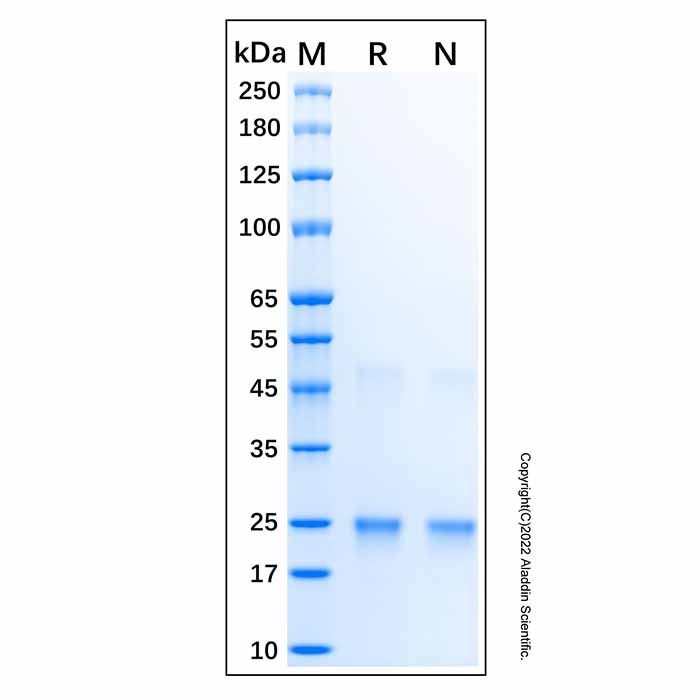
24.8 & 48.1 kDa, under reducing conditions; 24.8 & 48.1 kDa, under non-reducing conditions.
分子类型
蛋白质
产品线
生物产品
储存与运输
物理形态
液体
储存缓冲液
20mM Tris, 1mM DTT, 10% Glycerol, pH 8.0.
浓度
见COA
储存条件
-20°C储存,避免反复冻融
运输条件
超低温运输
稳定性与储存
Store at -20°C for 1 year. Avoid freeze/thaw cycle.
图片
Recombinant Human GLO1 Protein (rp184954) - SDS-PAGE 2 μg/lane of Recombinant Human GLO1 Protein was resolved with SDS-PAGE under reducing (R) and non-reducing (N) conditions and visualized by Coomassie® Blue staining, showing a band at 24.8 & 48.1 kDa.
Recombinant Human GLO1 Protein - Enzyme Activity Measured by its ability to catalyze the formation of S-D-lactoylglutathione from the hemimercaptal adduct that forms spontaneously between methylglyoxal and reduced glutathione. The specific activity is >100 nmol/min/µg, as measured under the described conditions. Materials: Assay Buffer: 0.1 M Sodium Phosphate, pH 7.0 Recombinant Human GLO1 Protein (rp184954) Glutathione, Reduced (GSH) (G105426) Methylglyoxal solution, 40% (M109035) Procedures: 1. Prepare 100 mM GSH in deionized water. Note: Prepare fresh. 2. Dilute 40% (6.48 M) Methylglyoxal solution to 100 mM in Assay Buffer. Note: Prepare fresh. 3. Combine 1420 µL Assay Buffer, 40 µL 100 mM GSH, and 40 µL 100 mM Methylglyoxal to make the Substrate Mixture. 4. Incubate at room temperature for 15 minutes. 5. Dilute rhGlyoxalase I to 0.4 ng/µL in Assay Buffer. 6. Load 50 µL of 0.4 ng/µL rhGlyoxalase I in a plate, and start the reaction by loading 150 µL of Substrate Mixture. Include a Substrate Blank containing 50 µL of Assay Buffer and 150 µL of Substrate Mixture. 7. Read at 240 nm (absorbance) in kinetic mode for 5 minutes. Include a 5 second mix before the first read and a 3 second mix between reads. 8. Calculate specific activity:
*Adjusted for Substrate Blank **Derived using calibration standard S-Lactoylglutathione (L121369) ***Using the pathlength correction of 0.32 cm Per Well: rhGlyoxalase I: 0.020 µg, Glutathione: 2 mM, Methylglyoxal: 2 mM


 ZJ24F1215653


 危险品化学品经营许可证(带存储)