Receptor-associated protein (RAP) is a molecular chaperone for low-density lipoprotein receptor-related protein (LRP), which plays a key role in cholesterol metabolism. The lipoprotein receptor-related protein (LRP) is an endocytic receptor for several ligands, such as alpha2-macroglobulin (alpha2 M) and apolipoprotein E. LRP is involved in the clearance of lipids from the bloodstream and is expressed in the atherosclerotic plaque. The LRP-associated protein (LRPAP in humans, RAP in mice) acts as a chaperone protein, stabilizing the nascent LRP peptide in the endoplasmic reticulum and Golgi complex. Alpha-2-macroglobulin receptor-associated protein, also known as low-density lipoprotein receptor-related protein-associated protein 1, RAP, and LRPAP1, is a 39 kDa protein and a member of the alpha-2-MRAP family. It is a receptor antagonist that interacts with several members of the low-density lipoprotein (LDL) receptor gene family. Upon binding to these receptors, LRPAP1 inhibits all ligand interactions with the receptors. LRPAP1 is present on the cell surface forming a complex with the alpha-2-macroglobulin receptor heavy and light chains. It binds with LRP1B and the binding is followed by internalization and degradation. LRPAP1 interacts with LRP1/alpha-2-macroglobulin receptor and LRP2 (previously called glycoprotein 330) and may be involved in the pathogenesis of membrane glomerular nephritis. LRPAP1 together with LRP2 forms the Heymann nephritis antigenic complex. LRP2 is expressed in epithelial cells of the thyroid, where it can serve as a receptor for the protein thyroglobulin. Intron 5 insertion/deletion polymorphism of RAP gene (LRPAP1) has been implicated in other diseases sharing etiology with gallstone disease (GSD). The LRPAP1 insertion/deletion polymorphism influences cholesterol homeostasis and may confer risk for gallstone disease and gallbladder carcinoma (GBC) incidence usually parallels with the prevalence of cholelithiasis. The genetic variations at the LRPAP1 locus may modulate Alzheimer's disease (AD) phenotype beyond risk for disease. Also, the variation in the LRPAP1 gene could contribute to the risk of developing an early episode of myocardial infarction (MI).
规格
产品名称
Recombinant Human LRPAP1 Protein
别名
重组人LRPAP1蛋白 | 重组人类 LRPAP1 蛋白
英文别名
A2MRAP | A2MRAPMRAP | A2RAP | alpha-2-macroglobulin receptor-associated protein 1 | alpha-2-macroglobulin receptor-associated protein | alpha-2-MRAP | HBP44 | lipoprotein receptor associated protein | low density lipoprotein receptor-related protein assoc
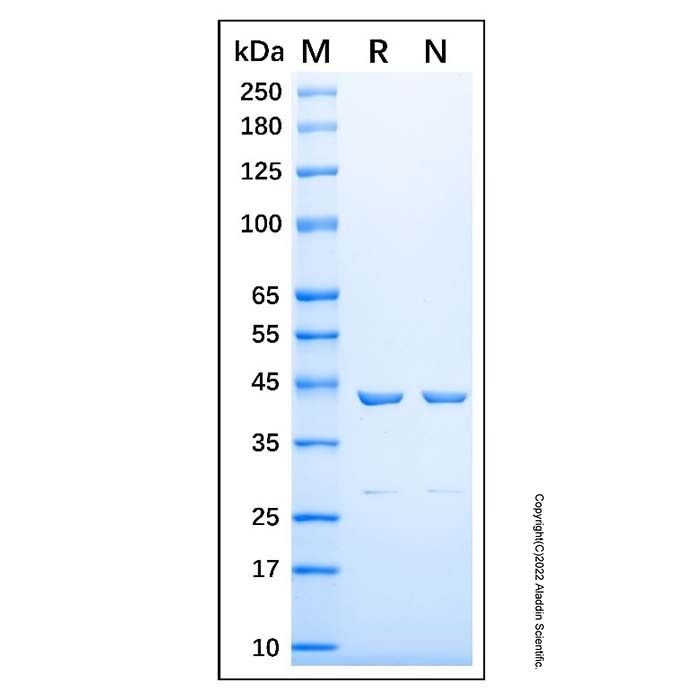
41.8 kDa, under reducing conditions; 41.8 kDa, under non-reducing conditions
分子类型
蛋白质
产品线
生物产品
储存与运输
物理形态
冻干(Lyophilized)
储存缓冲液
Lyophilized from PBS, pH 7.4
复溶
We recommend that this vial be briefly centrifuged prior to opening to bring the contents to the bottom. Reconstitute at 1.0 mg/mL in sterile distilled water. Stock solutions should be apportioned into working aliquots and stored at ≤ -20 °C. Further dilutions should be made in appropriate buffered solutions.
储存条件
-20°C储存,避免反复冻融
运输条件
超低温运输
稳定性与储存
在 -20°C 下可保存 1 年。避免冷冻/解冻循环。
图片
Recombinant Human LRPAP1 Protein (rp184959) - SDS-PAGE 1.5 μg/lane of Recombinant Human LRPAP1 Protein was resolved with SDS-PAGE under reducing (R) and non-reducing (N) conditions and visualized by Coomassie® Blue staining, showing a band at 41.8 kDa.

 ZJ24F1011766


 危险品化学品经营许可证(带存储)