Matrix metalloproteinases (MMPs) are a family of zinc and calcium dependent endopeptidases with the combined ability to degrade all the components of the extracellular matrix (ECM). MMP‑16 (MT3-MMP) is found in brain, lung, placenta, smooth muscle cells, and malignant tumor tissues including oral melanoma and renal carcinoma (1). MMP‑16 has been shown to activate proMMP-2 and degrade various ECM components including native collagens (2, 3). MMP‑16 has been proposed to possess the potential to directly enhance the growth and invasiveness of cells in vivo, two critical processes for development and carcinogenesis (4). Structurally, MMP‑16 consists of the following domains: a pro domain containing the furin cleavage site, a catalytic domain containing the zinc-binding site, a hinge region, a hemopexin-like domain, a transmembrane domain, and a cytoplamasic tail (1). The structure of the catalytic domain in complex with a hydroxamate inhibitor has been solved (5). The recombinant human MMP‑16PC consists of the pro and catalytic domains, which can be activated by treatment with furin. Post-translational: The precursor is cleaved by a furin endopeptidase.
Store at -20°C for 1 year. Avoid freeze / thaw cycle.
图片
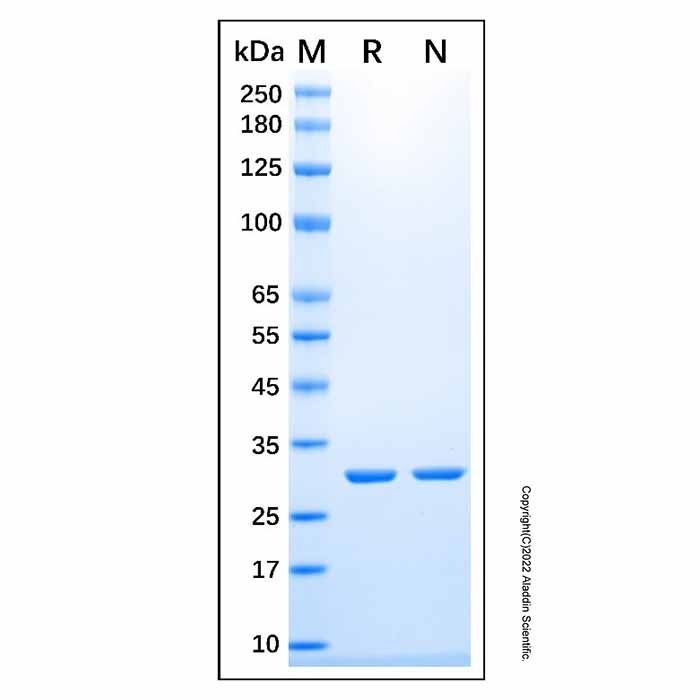
Recombinant Human MMP-16/MT3-MMP Protein (rp184961) - SDS-PAGE 2 μg/lane of Recombinant Human MMP-16/MT3-MMP Protein was resolved with SDS-PAGE under reducing (R) and non-reducing (N) conditions and visualized by Coomassie® Blue staining, showing a band at 30.0 kDa.

 ZJ24F1114302


 危险品化学品经营许可证(带存储)