Human Chemerin, also known as Tazarotene-induced Gene 2, (TIG2) is a new, but distant member of the Cystatin superfamily. Members of this superfamily contain at least two intrachain disulfide bonds and an alpha -helical structure over a distance of about 100 amino acids. Chemerin is synthesized as a 163 aa precursor that contains a hydrophobic 20 aa N-terminal sequence, an intervening 137 aa Cystatin-fold containing domain, and a six aa C‑terminal prosegment. Within the cystatin-fold domain there are three intrachain disulfide bonds that contribute to the fold, and three potential sites for phosphorylation and one for myristoylation. The precursor molecule undergoes proteolytic processing at both termini by unknown proteases. The N-terminal residue 20 aa hydrophobic segment is described as being either a signal sequence or a transmembrane (TM) segment for a type II TM protein. In either case, it gives rise to a soluble proform that undergoes further processing at the C‑terminus. In human, the C‑terminal six residues are cleaved, giving rise to a monomeric, 16 kDa heparin-binding bioactive molecule (aa 21 - 157). A shorter 134 aa form has been described. Bioactivity seems to be concentrated in the nine residues preceding the prosegment (aa 149 - 157). Retention of the prosegment blocks activity. The 137 aa mature segment is known to bind to the G-protein coupled receptor termed ChemR23. Binding results in macrophage and immature dendritic cell chemotaxis. The distribution of this receptor is limited to immune APCs, and it is assumed that Chemerin is an inflammatory molecule. It is unclear which cells are actually producing Chemerin, but keratinocytes, endothelial cells and osteoclasts are potential candidates. Mature human Chemerin shares 67% aa sequence identity with mouse Chemerin. There is apparently cross-species activity for the protein.
Post-translational: Secreted in an inactive precursor form, prochemerin, which is proteolytically processed by a variety of extracellular proteases to generate forms with differing levels of bioactivity. For example, the removal of six amino acids results in chemerin-157, which exhibits the highest activity, while removal of seven amino acids results in chemerin-156 which has slightly less activity. Some proteases are able to cleave at more than one site and chemerin forms may be sequentially processed by different enzymes to modulate activity levels. The coordinated expression and activity of chemerin-modifying enzymes is essential for regulating its bioactivation, inactivation and, consequently, biological function. Cathepsin G cleaves seven C-terminal amino acids from prochemerin (chemerin-156), elastase is able to cleave six (chemerin-157), eight (chemerin-155) or eleven (chemerin-152), plasmin cleaves five amino acids (chemerin-158), and tryptase cleaves five (chemerin-158) or eight (chemerin-155). Multiple cleavages might be required to fully activate chemerin, with an initial tryptase cleavage resulting in chemerin with low activity (chemerin-158), and a second cleavage by carboxypeptidase N or B producing highly active chemerin (chemerin-157).
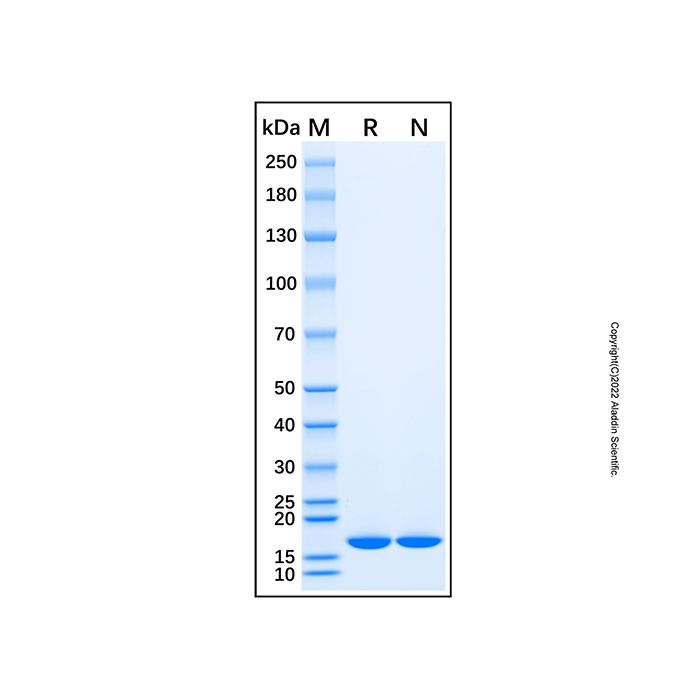
16.7 kDa, under reducing conditions; 16.7 kDa, under non-reducing conditions.
分子类型
蛋白质
产品线
生物产品
储存与运输
物理形态
冻干(Lyophilized)
储存缓冲液
Lyophilized from PBS, pH 7.4
浓度
见COA
复溶
We recommend that this vial be briefly centrifuged prior to opening to bring the contents to the bottom. Reconstitute at 0.5 mg/mL in sterile distilled water. Stock solutions should be apportioned into working aliquots and stored at ≤ -20 °C. Further dilutions should be made in appropriate buffered solutions.
储存条件
-20°C储存,避免反复冻融
运输条件
超低温运输
稳定性与储存
-20℃保存 12个月;复溶后建议分装,避免反复冻融。
图片
Recombinant Human Chemerin Protein (rp184966) - SDS-PAGE 3 μg/lane of Recombinant Human Chemerin Protein was resolved with SDS-PAGE under reducing (R) and non-reducing (N) conditions and visualized by Coomassie® Blue staining, showing a band at 16.7 kDa.

 ZJ25F1029130


 危险品化学品经营许可证(带存储)