Interleukin-4 (IL-4), also known as B cell-stimulatory factor-1, is a monomeric, approximately 13 kDa‑18 kDa Th2 cytokine that shows pleiotropic effects during immune responses. It is a glycosylated polypeptide that contains three intrachain disulfide bridges and adopts a bundled four alpha-helix structure. Human IL-4 is synthesized with a 24 aa signal sequence. Alternate splicing generates an isoform with a 16 aa internal deletion. Mature human IL-4 shares 55%, 39%, and 43% aa sequence identity with bovine, mouse, and rat IL-4, respectively. Human, mouse, and rat IL-4 are species-specific in their activities. IL-4 exerts its effects through two receptor complexes. The type I receptor, which is expressed on hematopoietic cells, is a heterodimer of the ligand binding IL-4 R alpha and the common gamma chain (a shared subunit of the receptors for IL-2, -7, -9, -15, and ‑21). The type II receptor on nonhematopoietic cells consists of IL-4 R alpha and IL‑13 R alpha 1. The type II receptor also transduces IL-13 mediated signals. IL-4 is primarily expressed by Th2-biased CD4+ T cells, mast cells, basophils, and eosinophils. It promotes cell proliferation, survival, and immunoglobulin class switch to IgG4 and IgE in human B cells, acquisition of the Th2 phenotype by naïve CD4+ T cells, priming and chemotaxis of mast cells, eosinophils, and basophils, and the proliferation and activation of epithelial cells. IL-4 plays a dominant role in the development of allergic inflammation and asthma.
Due to its role in the differentiation of certain immune cell types, IL-4 is commonly used in combination with other growth factors to transform induced pluripotent stem cells into dendritic cells in high numbers. These dendritic cells can then be used for research or clinical applications to improve disease modeling, for screening and cell therapies. Study of IL-4 signaling has led to the development of monoclonal antibodies that can block the signaling pathway at various steps to mitigate the inflammatory response in certain autoimmune diseases. While IL-4 has the capacity to improve immune functions, treatments involving IL-4 have not been utilized due to the dangerous side effects that may result from IL-4 signaling in non-immune cells. Blockade of IL-4 signaling also has been studied as a therapeutic target to suppress inflammation in the tumor microenvironment. Use of IL-4 suppressors can also improve the efficacy of anti-tumor immunotherapies, as blocking IL-4 enhances the activity of tumor-specific T lymphocytes.
生物活性
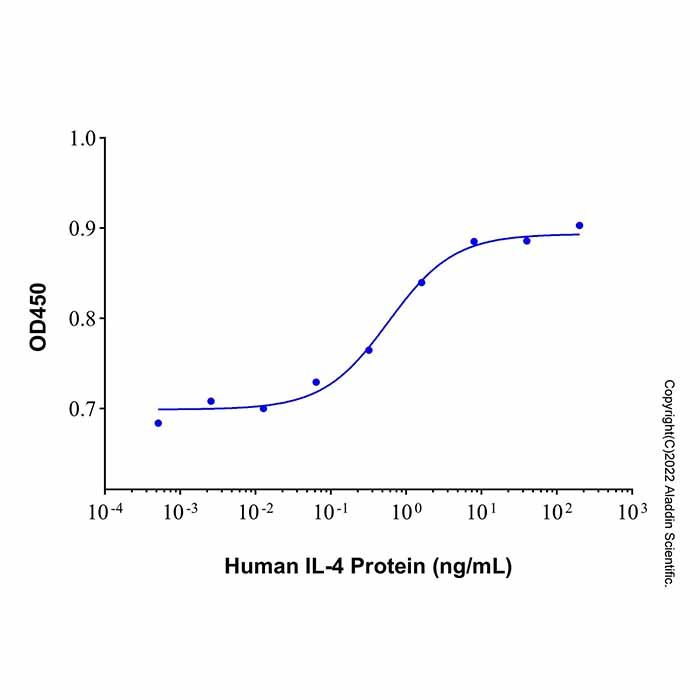
Measured in a cell proliferation assay using TF‑1 human erythroleukemic cells. The ED50 for this effect is 0.58 ng/mL.
17.5-20.8 kDa, under reducing conditions; 17.3-20.1 kDa, under non-reducing conditions.
分子类型
蛋白质
产品线
生物产品
储存与运输
物理形态
冻干(Lyophilized)
储存缓冲液
Lyophilized from PBS, pH 7.4
浓度
见COA
复溶
We recommend that this vial be briefly centrifuged prior to opening to bring the contents to the bottom. Reconstitute at 0.5 mg/mL in sterile distilled water. Stock solutions should be apportioned into working aliquots and stored at ≤ -20 °C. Further dilutions should be made in appropriate buffered solutions.
储存条件
-20°C储存,避免反复冻融
运输条件
超低温运输
稳定性与储存
-20℃保存 12个月;复溶后建议分装,避免反复冻融。
图片
Recombinant Human IL-4 Protein (rp186552) - Bioactivity Measured in a cell proliferation assay using TF‑1 human erythroleukemic cells. The ED50 for this effect is 0.58 ng/mL.
Recombinant Human IL-4 Protein (rp186552) - SDS-PAGE 3 μg/lane of Recombinant Human IL-4 Protein was resolved with SDS-PAGE under reducing (R) and non-reducing (N) conditions and visualized by Coomassie® Blue staining, showing a band at 17.5-20.8 kDa under reducing conditions and 17.3-20.1 kDa under non-reducing conditions.

 ZJ25F0825703


 危险品化学品经营许可证(带存储)