无动物源, 无载体, His标签, ≥95%(SDS-PAGE), expressed in HEK293; 见COA
生化机理
Agouti-Related Protein (AgRP), the protein product of the Agouti-Related Transcript (ART), is a neuroprotein that regulates energy metabolism and the development of obesity by antagonizing alpha -melanocyte stimulating hormone ( alpha -MSH) action on MC-3 and MC-4 receptors. AgRP is predominantly expressed in the hypothalamus and adrenal medulla. Mature mouse AgRP is a 111 amino acid (aa) polypeptide; its C-terminal portion contains ten conserved cysteines that form five disulfide bonds. Within the C-terminal region, mouse AgRP shares 80% and 90% aa sequence identity with human and rat AgRP, respectively. It also shares 44% aa sequence identity with Agouti. As with Agouti, the C-terminal cysteine-rich region is sufficient for biological activity. AgRP, however, is 100 times more potent than Agouti in antagonizing MC-3 and MC-4 receptors. AgRP also induces the beta -arrestin dependent endocytosis of MC-3 and MC-4. Hypothalamic expression of AgRP is up-regulated in obesity and diabetes, and chronic AgRP administration increases food intake and weight gain in rats. Genetically-linked polymorphisms of AgRP in humans are associated with susceptibility to anorexia nervosa. In addition, AgRP inhibits the ACTH-induced synthesis of steroid hormones via a mechanism that does not involve melanocortin receptors.
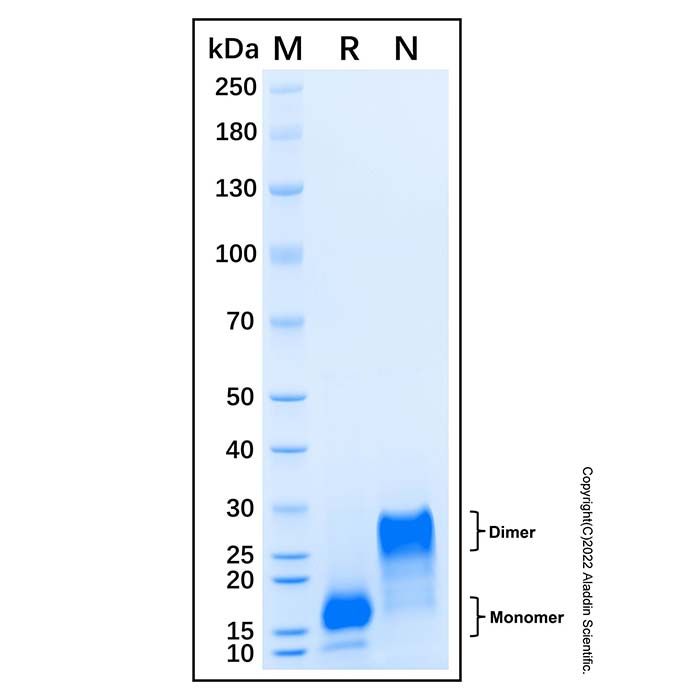
11.5 & 15.0-19.6 kDa, under reducing conditions; 25.2-29.6 kDa, under non-reducing conditions.
分子类型
蛋白质
产品线
生物产品
储存与运输
物理形态
冻干(Lyophilized)
储存缓冲液
Lyophilized from PBS, pH 7.4
浓度
expressed in HEK293; 见COA
复溶
We recommend that this vial be briefly centrifuged prior to opening to bring the contents to the bottom. Reconstitute at 0.5 mg/mL in sterile distilled water. Stock solutions should be apportioned into working aliquots and stored at ≤ -20 °C. Further dilutions should be made in appropriate buffered solutions.
储存条件
-20°C储存,避免反复冻融
运输条件
超低温运输
稳定性与储存
-20℃保存 12个月;复溶后建议分装,避免反复冻融。
图片
Recombinant Mouse AgRP Protein (rp186584) - SDS-PAGE
3 μg/lane of Recombinant Mouse AgRP Protein was resolved with SDS-PAGE under reducing (R) and non-reducing (N) conditions and visualized by Coomassie® Blue staining, showing the bands at 11.5 & 15.0-19.6 kDa under reducing conditions and 25.2-29.6 kDa under non-reducing conditions.
The first 34 residues of AGRP (87-132) are well-ordered and contain a three-stranded antiparallel beta sheet, where the last two strands form a beta hairpin. The relative spatial positioning of the disulfide cross-links demonstrates that the ordered region of AGRP (87-132) adopts the inhibitor cystine knot (ICK) fold previously identified for numerous invertebrate toxins. This fold itself possesses structural and evolutionary propensities for dimerization (PMID: 11747427).

 ZJ26F0838844


 危险品化学品经营许可证(带存储)