
计算溶液所需的质量、体积或浓度。
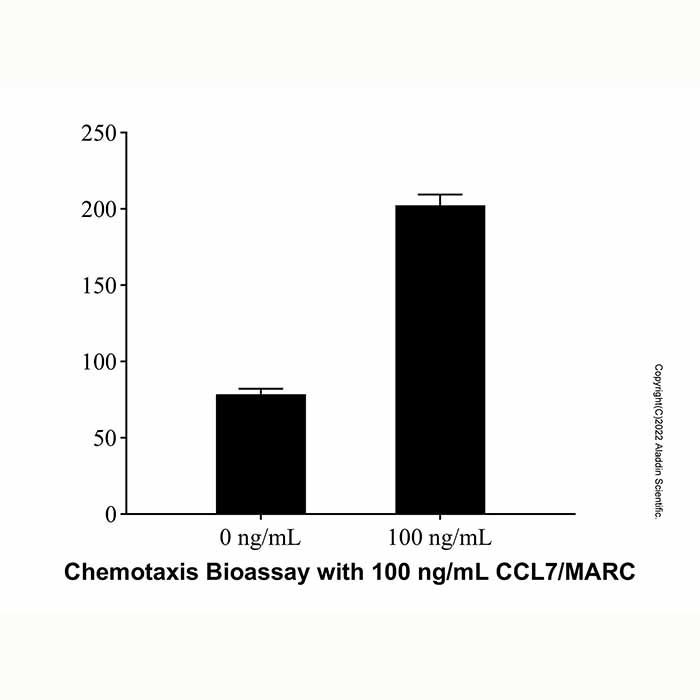
Recombinant Mouse CCL7/MARC Protein (rp186590) - Bioactivity
Determined by its ability to chemoattract human monocytes using a concentration range of 10.0-100.0 ng/mL.
Mouse MARC, a member of the beta subfamily of chemokines, was initially identified as a transcript that is induced in a mouse mast cell line after Fc epsilon RI triggering by IgE plus antigen. Sequence comparisons suggest that MARC may be the mouse homologue of the human MCP-3 gene. Mouse MARC/MCP-3 expression has also been detected during murine experimental allergic encephalomyelitis in the spinal cord, and in LPS-stimulated murine WEHI -3 cells and Swiss 3T3 cells where MARC expression is glucocorticoid-attenuated. Except for one amino acid subsititution, mouse MARC is identical to mouse FIC, the product of a growth factor-activated gene. The mouse MARC cDNA encodes a 97 amino acid residue precursor protein with a 23 amino acid residue signal peptide that is cleaved to yield a 74 amino acid residue mature protein. Mouse CCR2, a mouse chemokine receptor, has been shown to bind JE/MCP-1 with high affinity and MARC/MCP-3 with lower affinity. The E. coli-expressed mouse MARC/MCP-3 produced at R&D Systems has been shown to be a monocyte and T-lymphocyte chemoattractant.
Recombinant Mouse CCL7/MARC Protein (rp186590) - Bioactivity
Determined by its ability to chemoattract human monocytes using a concentration range of 10.0-100.0 ng/mL.
Recombinant Mouse CCL7/MARC Protein (rp186590) - SDS-PAGE
3 μg/lane of Recombinant Mouse CCL7/MARC Protein was resolved with SDS-PAGE under reducing (R) and non-reducing (N) conditions and visualized by Coomassie® Blue staining, showing a band at 12.2 kDa under reducing conditions and 12.9 kDa under non-reducing conditions.
通过匹配包装上的批号来查找并下载产品的 COA,每批产品都进行了严格的验证,您可放心使用!
| 批号(Lot Number) | 证书类型 | 货号 |
|---|---|---|
 ZJ25F0218261 |
分析证书 | rp186590 |
| ZJ25F0218262 |
分析证书 | rp186590 |
| ZJ25F0218263 |
分析证书 | rp186590 |
| ZJ25F0218264 |
分析证书 | rp186590 |
我们的级别选择指南涵盖了目录中所有的变体的纯度、稳定剂状态和应用适用性。
查看 Carrier Free 级别指南 → 查看 Bioactive 级别指南 → 查看 ActiBioPure™ 级别指南 → 查看 High Performance 级别指南 →

 危险品化学品经营许可证(带存储)