Ciliary neurotrophic factor (CNTF) is a member of the cytokine family. It is a polypeptide hormone that has functions in promoting neurotransmitter synthesis and neurite outgrowth in certain neuronal populations. Its actions appear to be restricted to the nervous system. Ciliary neurotrophic factor (CNTF) has biological effects through the activation of a multi-subunit receptor complex, consisting of an extracellular CNTF binding subunit (CNTFα) and two transmembrane signal transduction proteins: glycoprotein gp130 and LIF receptor. CNTF is considered as a potent survival factor of neurons and oligodendrocyteands may be relevant in reducing tissue destruction during inflammatory attacks. CNTF also is a survival factor for neurons of the peripheral sensory sympathetic and ciliary ganglia. It has been reported that CNTF could be an agent that has therapeutic potential and possibly induces differentiation of large multipolar ganglionic phenotype in a subset of progenitors.
生物活性
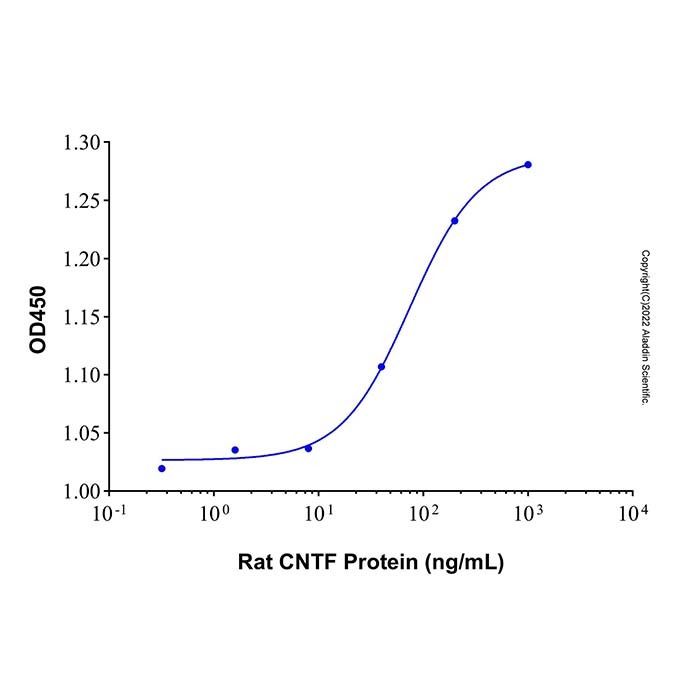
Measured in a cell proliferation assay using TF-1 cells. The ED50 for this effect is typically 74.4 ng/mL.
23.1 kDa, under reducing conditions; 23.3 kDa, under non-reducing conditions.
分子类型
蛋白质
产品线
生物产品
储存与运输
物理形态
冻干(Lyophilized)
储存缓冲液
Lyophilized from 50mM Tris, 100mM NaCl, 8% Trehalose, pH 7.5.
复溶
We recommend that this vial be briefly centrifuged prior to opening to bring the contents to the bottom. Reconstitute at 1.0 mg/mL in sterile distilled water. Stock solutions should be apportioned into working aliquots and stored at ≤ -20 °C. Further dilutions should be made in appropriate buffered solutions.
储存条件
-20°C储存,避免反复冻融
运输条件
超低温运输
稳定性与储存
Store at -20°C for 1 year. Avoid freeze/thaw cycle.
图片
Recombinant Rat CNTF Protein (rp186591) - Protein Bioactivity
Measured in a cell proliferation assay using TF-1 cells. The ED50 for this effect is typically 74.4 ng/mL.
Recombinant Rat CNTF Protein (rp186591) - SDS-PAGE 3 μg/lane of Recombinant Rat CNTF Protein was resolved with SDS-PAGE under reducing (R) and non-reducing (N) conditions and visualized by Coomassie® Blue staining, showing a band at 23.1 kDa under reducing conditions and 23.3 kDa under non-reducing conditions.

 ZJ24F1215402


 危险品化学品经营许可证(带存储)